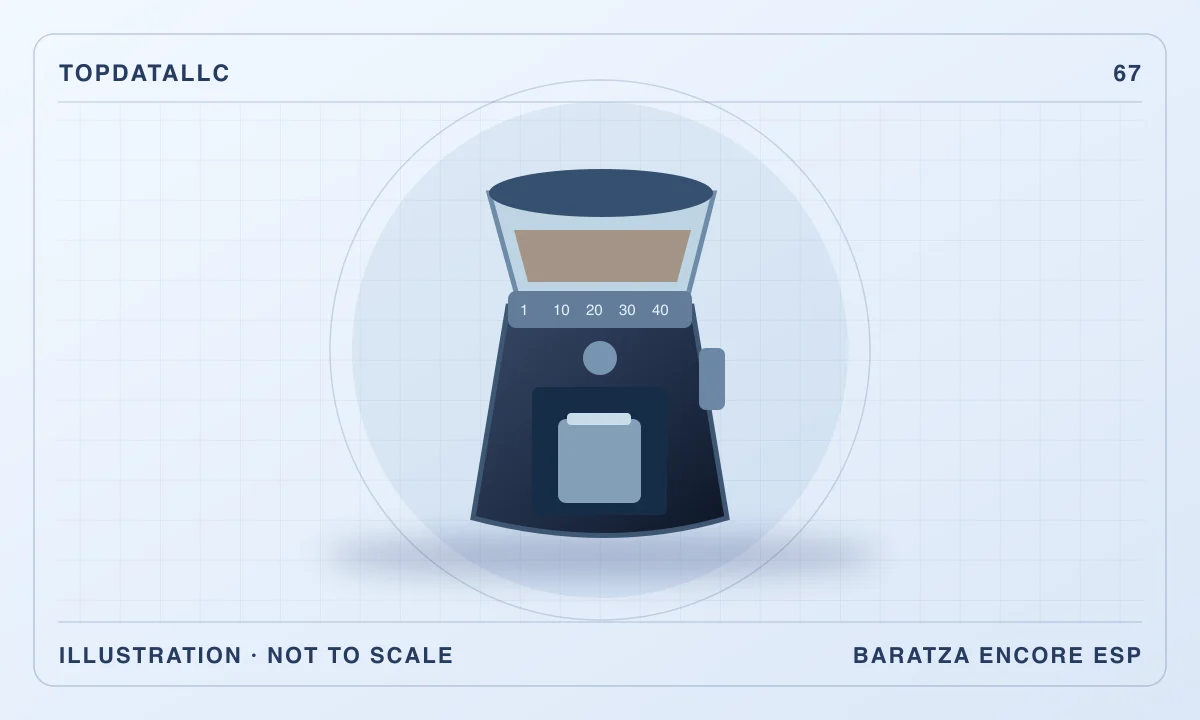
The Baratza Encore ESP is a good shortlist choice for someone building an espresso setup and wanting clear, stepped adjustment without an elaborate dosing interface. Its distinctive feature is the split grind range: finer increments for espresso and broader changes for other brewing methods. That makes it more purposeful than simply buying a general coffee grinder and hoping its finest setting will work.
This review covers the original black US Encore ESP, ZCG495BLK. It is neither the older basic Encore nor the newer ESP Pro. It suits a buyer who accepts weighing, checking and handling coffee manually. It is less suitable if automatic dosing, nearly empty internal retention or very fine adjustment for every brewing method are essential requirements.
Choose according to the coffee you actually make
Espresso asks a grinder to make small, controllable adjustments. Filter brewing has a different balance of requirements, and someone who switches constantly between methods should think carefully about the compromise. The Encore ESP’s design prioritises the finer adjustment region rather than distributing identical steps evenly across its whole range.
If espresso is your main drink and filter coffee is occasional, that is a sensible arrangement to investigate. If you never make espresso, compare a filter-oriented grinder instead of paying for a capability you do not use. Our existing OXO grinder guide addresses a different style of coffee routine. The decision should start with the brewing method, not a vague promise that one grinder can be equally convenient for every conceivable cup.
The model name matters
The original Encore and Encore ESP have similar silhouettes, but the ESP’s adjustment system is central to this review. A listing that merely says Encore is not sufficient identification. Likewise, the ESP Pro is a separate model with a different control proposition; its features should not be assumed to appear on this original stepped version.
Check the full model and colour against the US offer. If a bundle contains a dosing accessory or an alternative hopper, distinguish those additions from the standard package. This prevents an appealing title or photograph from concealing that you are comparing different products. The most useful early check is not whether the seller uses the phrase espresso-capable, but whether the exact machine is the one whose adjustment and ownership requirements you have researched.
How the split range works
Baratza’s manual divides the forty stepped positions into an espresso range from 1–20 and a filter range from 21–40. The espresso region makes smaller changes between positions. The broader filter region lets the grinder span coarser brewing methods without requiring an enormous number of clicks.
This is a useful design choice, but it creates a trade-off. A filter-coffee enthusiast may sometimes want an adjustment between two available coarser positions. An espresso user benefits from the extra resolution in the region where it is most needed. Think of the numbered collar as a repeatable reference, not a precise measurement of particle size. The same number is not a universal recipe across beans, grinders, baskets or brewing methods.
Starting points are not finished recipes
The manufacturer supplies suggested initial settings, while explicitly allowing for recipe and taste differences. Use those as a starting point and adjust from a consistent method. If you are pairing the grinder with a Bambino or another espresso machine, establish the basket, dose and intended output before changing everything in search of a better shot.
Keep brief notes about the coffee and result. A visible numbered collar makes returning to a previous region convenient, but it does not ensure the retained coffee or bean conditions are unchanged. If a new bag behaves differently, treat that as a reason to reassess the recipe rather than assuming the machine has failed. The goal is deliberate adjustment, with the grinder contributing one controllable variable in the overall extraction process.
Manual controls keep the workflow understandable
The original ESP uses a side on/off knob and a front pulse control. There is no built-in timed or weight-based automatic dosing system to decide when your required quantity has been produced. That simplicity can be appealing because the user can see and control the process without navigating programmes.
It also means the routine needs an external way of assessing the dose if precision matters. Do not confuse a repeatable grind position with a repeatable amount of coffee. One controls fineness; the other depends on how much you grind and collect. If you want a grinder to dispense the required dose automatically while you perform another task, compare equipment designed for that purpose. The ESP’s value is accessible manual operation, not quietly doing work its controls were never intended to automate.
Dosing cup and grounds bin
Baratza supplies both a dosing-cup arrangement and a conventional grounds bin. The cup is useful for transferring a smaller espresso dose, while the bin is a more natural collection point for larger filter batches. Follow the manual’s assembly instructions and check the cup’s adapter arrangement against the portafilter you actually use.
A compatible-looking diameter is not the only practical consideration. Consider where the cup stands while you prepare the basket and whether grounds can be transferred without scattering over the counter. A small tray or clear working area may be more useful than buying many accessories immediately. Use the supplied collection options first, identify any recurring inconvenience, then decide whether an additional funnel or container would genuinely improve the routine.
Retention makes single dosing more complicated
CoffeeGeek’s original testing found retained grounds and espresso clumps despite otherwise capable output. That is an important ownership qualification. Putting a weighed dose of beans into the hopper does not establish that precisely the same fresh grounds will appear in the cup immediately afterwards.
If you plan to single-dose, weigh what you collect and observe the behaviour with your normal coffee. Do not interpret a review’s retention number as a permanent specification that applies to every setting and bean. Also avoid aggressive improvised methods intended to shake or force every last particle out. Follow the manufacturer’s care guidance and decide whether the observed routine is convenient enough. Someone seeking a very clean switch between different beans may prefer a grinder built more explicitly around low-retention single dosing.
Clumping and basket preparation
Grounds collected for espresso may need careful distribution before tamping. CoffeeGeek’s test specifically noted clumping in the espresso region, with a different experience at coarser settings. This means the convenience of an electric grinder should not be mistaken for completely hands-off puck preparation.
Look at what is actually in your basket and keep the preparation method consistent. If a distribution tool becomes useful, choose one suitable for the basket and use it carefully; buying elaborate accessories before seeing the workflow is unnecessary. The relevant comparison is the whole process from bean to prepared basket. A grinder that produces enjoyable coffee but requires an extra handling step may be worthwhile for one user and irritating for another, even when both agree the grind adjustment is useful.
What the independent evaluations agree on
CoffeeGeek’s first-shipping-unit evaluation found the ESP capable across espresso and filter brewing, while identifying clumping, retained grounds and larger filter-range steps. The review disclosed that Baratza supplied the samples. Tom’s Guide’s separate original-ESP evaluation also found the controls approachable, although its experience with the finest output was less enthusiastic.
These observations support a measured recommendation rather than a guarantee that every unit will satisfy every unusually fine-grinding requirement. They also show why independent reviews should be read alongside the maker’s instructions. A favourable cup in one test does not establish an ideal setting for your machine. We use the testing to identify practical strengths and limitations, then base the buying decision on the type of coffee routine those characteristics suit.
Noise belongs in the daily-use decision
Grinding is a short task, but it can be conspicuous in a small kitchen or shared home. Do not assume an entry-level electric grinder will disappear into the background because its controls are simple or its motor speed appears modest. Consider when you will use it and who will be nearby.
A useful assessment during the return period is to grind a normal dose at the actual counter position. Listen from the adjoining living space if early-morning use is the concern. Numerical sound results from different reviews can reflect different distances and methods; they are not a guarantee of how intrusive the noise will feel. If quietness dominates the purchase, a suitable hand grinder is a different option worth evaluating, provided you accept the physical effort and time involved.
Cleaning and access to the burrs
The manufacturer documents removal of the ring burr and a quick-release arrangement for the cone burr. That is useful for maintaining the intended grinding path, but the sequence matters. Unplug the grinder before the relevant disassembly and follow the exact manual rather than pulling parts until something moves.
Baratza distinguishes washable collection or hopper parts from metal burr care. In particular, its guide warns against washing the burr in water. Keep those maintenance methods separate and allow washed permitted parts to dry fully before reassembly. A grinder is not a blender jar that can be rinsed as a complete unit. The practical buying benefit is documented access and care, not a promise that cleaning is unnecessary or that every repair should be attempted without appropriate guidance.
Counter space and bean storage
The hopper adds height, and you need access above it to add coffee and perform maintenance. Check the space beneath any wall cabinet rather than measuring only the grinder’s base. Include the power lead and the place where you will weigh or transfer the dose.
Decide whether you want to keep beans in the hopper or load small quantities for each session. Each routine has practical implications for changing coffee and handling leftovers. A household that uses the same beans every day has a different problem from someone alternating regular and decaffeinated coffee repeatedly. The supplied hopper can support a straightforward routine, but do not assume the grinder will make switching beans effortless simply because the numbered setting is easy to move.
Comparing alternatives without buying twice
Choose a filter-oriented grinder when espresso is not part of the foreseeable routine. Consider a purpose-built single-dose grinder when frequent bean changes and retained grounds are central concerns. A model with timed or weight-based dosing is relevant when you specifically want to automate quantity rather than control it manually.
The base Encore is not an equivalent substitute for someone choosing the ESP for its finer espresso adjustments. Conversely, the presence of a newer ESP Pro does not make this model unsuitable if you prefer a simple stepped collar. Compare the extra functions against your actual needs and the current complete price. Avoid purchasing a compromise solely because it is inexpensive, then immediately adding accessories to imitate a different workflow you wanted from the beginning.
A sensible first-week assessment
Use a familiar coffee and one brewing method first. Establish the collection routine, check the dose that reaches the basket and note whether changes produce understandable results. Try the second brewing method only after you have a useful reference for the first. This makes a confusing result easier to diagnose.
Also assess the unglamorous parts: scattered grounds, sound, access beneath cabinets and cleanup after a normal session. Those details determine whether the grinder feels manageable every morning. If the intended espresso recipe cannot be dialled in, consult the manufacturer’s appropriate troubleshooting route rather than assuming random internal adjustment is required. A return-period trial should establish suitability, not turn a new appliance into an improvised repair project.
Who should buy the Encore ESP
The original Encore ESP suits an espresso-first household that values clear adjustment and accepts manual dose management. It provides a purposeful entry into that workflow while retaining a useful range for other coffee methods. Its supplied collection options and documented maintenance are practical advantages when used as intended.
Skip it if automatic dosing, exceptionally clean bean changes or unusually fine grinding are non-negotiable. Also compare simpler alternatives if you only brew filter coffee. Confirm the original black US ESP identity and current contents, then judge the complete preparation routine. The strongest reason to choose it is the fit between its split adjustment range and the coffee you make, not a claim that an affordable electric grinder removes every remaining espresso variable.