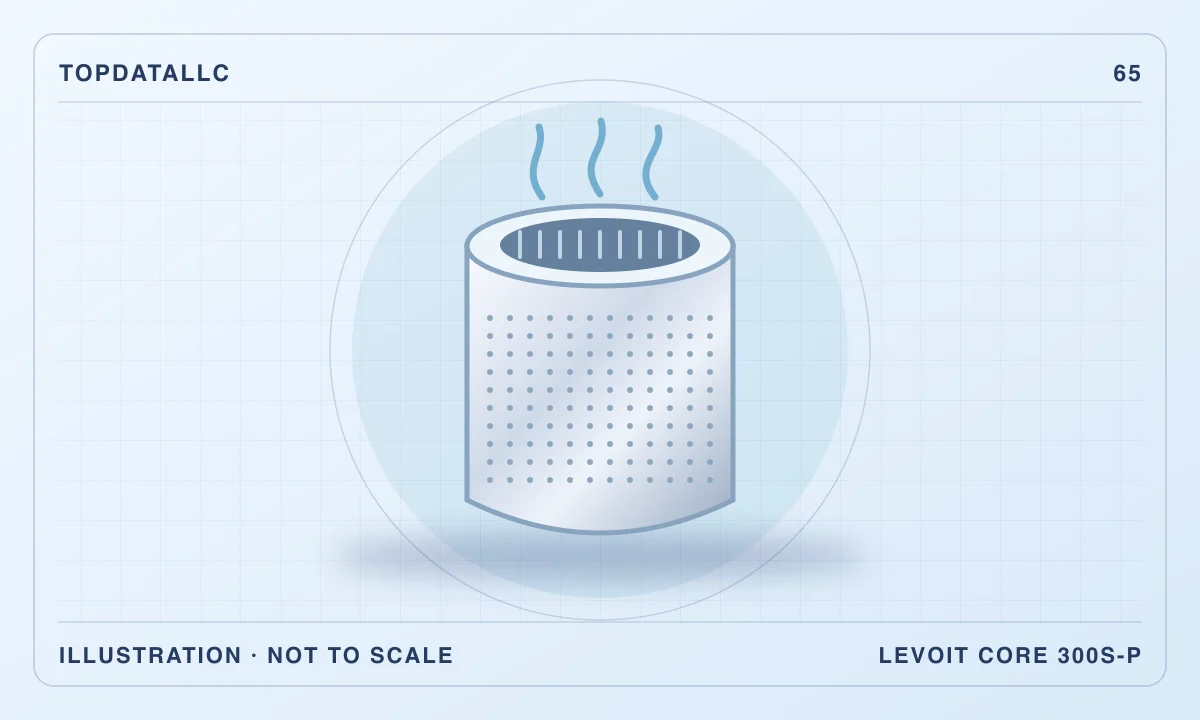
The Levoit Core 300S-P is worth considering for a smaller room where a compact purifier, quiet settings and optional app scheduling fit the daily routine. Its strongest case is convenience in a defined space. It is a less convincing choice when a large open area needs substantial airflow, or when a buyer expects a small appliance’s indicator to provide a complete assessment of indoor air quality.
This review covers the white US Core 300S-P, rather than the basic Core 300-P or a larger Levoit model. Our assessment concerns practical filtration equipment, placement and ownership. The product is not a medical treatment, a carbon-monoxide alarm or a solution to the underlying source of a pollution problem.
Start with one room and a clear task
Choose the room you actually want to use it in before comparing headline coverage claims. A bedroom with a closable door is a different project from an open kitchen, staircase and living area. Moving one small purifier between them is possible, but it does not mean all of those spaces are being served at the same time.
Write down the practical goal: perhaps running a compact unit while working in a small office, or having an unobtrusive appliance in a bedroom. That goal should be specific enough to assess after purchase. If the problem involves a persistent source such as moisture or combustion, address that source through the appropriate route instead of treating a consumer filter as the entire solution. EPA guidance places filtration alongside source control and suitable ventilation, rather than in their place.
Understand clean-air delivery before floor area
The manufacturer lists different clean-air delivery rates for smoke, dust and pollen. Those are conditional equipment measurements, not interchangeable promises about every pollutant or room. A large advertised floor area can also conceal assumptions about how often the air is processed. Compare like-for-like conditions before concluding that the smallest unit will cover a surprisingly large home.
For a buying decision, the practical question is whether the purifier can move enough filtered air through your chosen room while running at a noise level you accept. If achieving the desired airflow means leaving it on a setting you will constantly turn down, the advertised maximum is not the setting you will actually use. Choose for the routine you can maintain, with room size and acceptable sound considered together.
Quiet operation involves a trade-off
RTINGS’ independent Core 300S testing found a conveniently small machine with modest overall airflow. It also found that quieter settings reduce the particle filtration rate. That is a useful corrective to advertising that places a minimum-noise figure beside the strongest cleaning claim as though both necessarily apply at once.
Try the intended setting while reading, working or preparing to sleep. Listen from the place where you will sit or lie, rather than only beside the controls. A smooth background sound may be acceptable to one person and distracting to another. The right conclusion is not that every quiet mode is ineffective, but that slower operation is a trade-off. If you need more airflow at a tolerable sound level, compare a larger model instead of hoping a compact purifier can avoid that compromise.
The controls are part of its appeal
The Core 300S-P offers on-device controls as well as automatic operation and optional VeSync functions. That makes it possible to choose a straightforward everyday setting without treating the phone app as the only way to interact with the appliance. App scheduling can still be useful when you want a consistent routine and do not want to remember every adjustment.
Consider the needs of everyone using the room. A family member should be able to recognise whether the purifier is running and select an ordinary setting without borrowing your phone. Keep the routine understandable: complicated schedules that only the original installer knows can be inconvenient in a shared household. The useful smart feature is the one that reduces a recurring task, not the longest list of remote controls you are unlikely to open again.
Automatic mode is convenient, not comprehensive monitoring
The sensor-related indicator can help the purifier adjust itself, but it does not measure every aspect of a room’s air. Tom’s Guide’s original household evaluation reported weak or inconsistent responses during some particle and candle trials. Those observations reinforce the need to avoid treating a reassuring display as a safety verdict.
Do not deliberately generate smoke, scatter flour or spray aerosols to test a new unit at home. Use the appliance normally and assess practical operation. If you require an accurate measurement of a particular pollutant, compare instruments intended for that measurement and follow appropriate guidance. A consumer purifier’s automatic setting is a convenience feature; it cannot tell you that all gases, particles or household hazards are absent simply because its indicator looks favourable.
Placement needs a clear airflow path
The compact cylindrical body is an advantage only if it can stand somewhere useful. A narrow gap hidden behind furniture may keep the appliance out of sight while making its intake or outlet less accessible. Follow the current model’s placement instructions and keep the airflow path clear rather than choosing a location solely because the case fits.
Include the power lead and normal room movement in that decision. A position beside a chair may be easy to reach but inconvenient if someone repeatedly catches the cable. A small shelf may be tidy but leave too little space above the outlet. Before ordering, identify a stable position where the unit can operate without being moved every time someone opens a drawer or uses the room. That is a more practical space check than comparing the closed body alone.
Filter identity and recurring cost
The replaceable filter assembly is an ongoing supply, not an accessory to think about only after the warning light appears. Check the exact replacement specified for the Core 300S-P, its current delivered cost and the availability of genuine stock. Similar model names and specialist filter descriptions can make a marketplace listing look more interchangeable than it is.
Estimate replacement expense separately from electricity and the initial purchase. A fixed yearly total would be misleading because the environment, use and filter condition vary. The useful comparison is whether you can obtain the correct assembly at a cost you are willing to keep paying. A discount on the appliance is less attractive if it leads you to postpone necessary maintenance or rely on a replacement whose compatibility and filtration claims have not been established.
Cleaning does not mean washing the entire filter
Levoit’s replacement-filter guidance distinguishes the outer pre-filter from the main filtration material. It describes using a soft brush or vacuum hose for the outer layer. Follow the specified care method for the actual supplied assembly; a replaceable filter should not be assumed to become reusable indefinitely after washing.
This matters in a room with pets or visible dust because larger debris can collect around the intake. Plan a brief inspection as part of normal cleaning and unplug the appliance before the relevant maintenance. Do not scrub or soak filter material unless the current instructions expressly permit it. If you want a washable pre-filter as a central ownership feature, compare an appliance specifically designed around that arrangement rather than trying to create one through improvised cleaning.
Filter warnings and record keeping
An alert is a prompt to inspect and maintain the filter according to the instructions. It is not a substitute for knowing when the current assembly was installed or whether the appliance has experienced unusually heavy use. Keep a simple record of replacement dates so another household member can understand the history.
That small habit also makes ownership costs easier to assess. Instead of assuming a schedule quoted in a review applies forever, you can see how the actual filter routine fits your room. If you repeatedly delay replacement because supplies are awkward to obtain, reconsider whether this product suits the household. Filtration equipment is most useful when the ordinary maintenance is affordable and easy enough to continue, rather than only during the first enthusiastic weeks after purchase.
Avoid overstating filtration labels
Current retail descriptions and older reviews do not always use the same filtration terminology. Do not infer that every filter option, operating mode or complete machine has the same independent certification simply because a product title contains a familiar label. Check the current exact assembly and the scope of the evidence.
For this review, the meaningful buying case is the compact design, documented particle-filtering workflow and practical airflow limitations. We are not promising a clinical outcome, eliminating every odour or certifying every replacement filter a seller might supply. If a particular certification determines your choice, verify it in the relevant current record for that exact product. Keeping the distinction clear avoids turning broad marketing language into a stronger performance claim than the evidence supports.
App convenience and account preferences
Before pairing, consider whether remote control adds something useful in your home. Scheduling can help someone with a consistent workday; another person may be happier using the buttons and a steady manual setting. Review the app’s current permissions and account requirements if you decide to connect it.
A purifier does not become a better fit merely because it can join a smart-home routine. Think through what should happen when another person uses the room, the household schedule changes or the phone is unavailable. Keep any automation simple enough to understand and check after a software update. If app-dependent ownership does not appeal to you, compare simpler equipment on filtration, sound and maintenance rather than paying for remote functions you intend to avoid.
Comparing larger and simpler alternatives
RTINGS places the Core 300S below larger Levoit options in airflow capability. That makes a bigger unit a reasonable comparison for someone serving a larger room or seeking more useful output without relying on the compact model’s highest setting. Check the exact larger model’s dimensions, sound and replacement supplies rather than assuming an upgrade improves every aspect of ownership.
A simpler compact purifier may be enough if you do not value automatic adjustment or app control. Conversely, a room with persistent odours or a known gaseous pollutant requires closer attention to appropriate filtration media and the underlying source. Do not decide that the Core 300S-P solves that problem simply because it contains a carbon component. Different pollutants and different equipment claims need different evidence; the ordinary particle-filtering use case is the sounder basis for this purchase.
What to check during the return period
Set it up in the intended room and follow the unpacking instructions, including preparing the filter before operation. Confirm that the chosen location remains convenient through a normal day. Try the controls, the light behaviour and the settings you expect to use, then decide whether the sound is acceptable during the actual activities that matter.
Inspect the replacement-filter route while the purchase is still new, rather than waiting until maintenance is due. If the unit is constantly turned down, hidden in an obstructed space or moved between too many rooms, reconsider the size and layout choice. You do not need an improvised pollution experiment to make that assessment. Practical compatibility with the room is already a meaningful part of whether this appliance will remain in regular use.
Who should buy the Core 300S-P
The Core 300S-P is a sensible shortlist option for a smaller, defined room where its compact form, controls and optional scheduling are useful. Buy it with a realistic understanding that airflow and sound are linked, filters are recurring supplies and the built-in indicator is limited.
Choose another size or approach when the space is large, the intended operating setting is too noisy, or you need equipment for a specific hazard the product does not assess. Its value lies in an ordinary routine you can sustain: appropriate placement, acceptable sound and correct maintenance. Those considerations provide a stronger buying decision than a maximum coverage figure or an overly broad interpretation of a reassuring light.