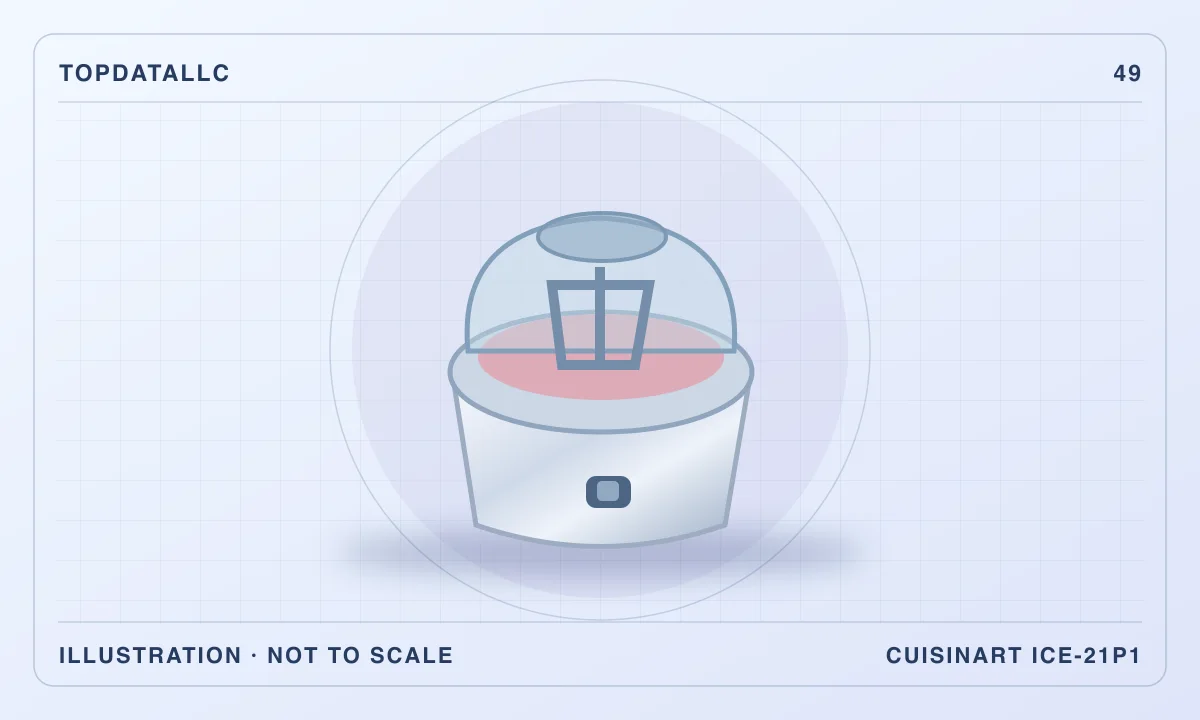
The Cuisinart ICE-21P1 is an ice cream maker for someone who is happy to plan ahead, freeze a bowl and churn a modest batch of a suitable recipe. Its appeal is a simple switch-controlled machine with few settings to learn. The important compromise happens before churning: the bowl must already be properly frozen. It is easiest to justify when freezer space and an occasional dessert-making routine fit together.
This research review covers the white US ICE-21P1, with a nominal finished capacity of up to one-and-a-half quarts. Cuisinart's product and care information establish the freezer-bowl design. Independent tests from Serious Eats and BestReviews provide texture and usability context. This model should not be confused with a compressor machine, a larger Pure Indulgence model or an appliance that processes a separately frozen dessert container.
Understand where the cooling comes from
The ICE-21 uses a double-insulated freezer bowl. The machine moves the bowl and mixture through its documented churning arrangement, while the previously frozen bowl provides the cold needed for the batch. It does not contain a refrigeration compressor that can cool a room-temperature bowl on demand.
That distinction changes the entire purchase decision. If you want to begin whenever the mood strikes, you would need to keep the bowl ready in the freezer or choose another kind of machine. A short advertised churning period leaves out the preparation that makes that period possible.
A freezer-bowl design can still be practical and straightforward. It uses a defined sequence and avoids the size and complexity of some self-freezing machines. The strongest reason to choose it is acceptance of that sequence, rather than an expectation that every ice cream maker works the same way.
Measure freezer space before counter space
The bowl needs an appropriate place in the freezer for the preparation period specified by Cuisinart. Check its actual dimensions and the required position before ordering. A narrow freezer drawer or a crowded shared compartment can be more limiting than the kitchen counter.
Decide whether the bowl will remain there between uses. Keeping it ready can make occasional dessert preparation more convenient, but it permanently occupies space that might otherwise hold food. Freezing it only before a planned batch requires remembering the preparation far enough ahead.
Consider the frozen dessert's storage too. Churning a batch and then finding there is no room for a suitable storage container creates another inconvenience. The purchase involves space for both preparation and the finished result, rather than only a place to store the motor base.
Read capacity as a finished-batch limit
Cuisinart describes output up to one-and-a-half quarts. That should not be treated as permission to pour the same volume of liquid base into the bowl. Mixture expansion and additions must be allowed for according to a recipe and the machine's instructions.
Choose a recipe written for the model's capacity while learning it. Scaling down from a large recipe can require more care than reducing every ingredient by an approximate amount, particularly when mix-ins are involved. Measure the preparation and check the specified loading limit.
If you routinely need several flavours or a much larger quantity, include repeated preparation in the comparison. A larger freezer-bowl machine can change the quantity, while a compressor design can change the turnaround process. Those are different benefits, and neither should be assumed from a larger-looking appliance alone.
Choose the recipe before expecting the texture
The machine's job is to churn and freeze an appropriate mixture. Ingredients and proportions still influence sweetness, firmness and the way a dessert behaves after storage. A successful dairy recipe does not establish that replacing several ingredients casually will produce the same result.
Cuisinart provides supported recipe guidance, and independent testers evaluate defined mixtures. Begin with a documented recipe rather than treating the appliance as a way to make any liquid freeze into a desirable dessert. Once the process is familiar, make deliberate changes and record their effect.
The same caution applies to non-dairy preparations and sorbet. These can have their own balance and method. A labelled dessert function or a general product description is not a nutritional or texture guarantee. Choose a recipe designed for the ingredients you want to use.
Include chilling and firming in the timeline
The preparation can involve making and cooling a base before it is ready to churn. Some recipes also call for additional freezer time afterward to reach the intended serving firmness. A maker's short churning claim should therefore be read as one stage of the process.
Serious Eats found the ICE-21 efficient in its tests, while noting the need to pre-freeze the canister. Its timings belong to those recipes and conditions. They should not become a promise that every batch will be ready for scooping at the same moment after you decide to start.
For a meal with guests, work backward from serving time through the actual recipe. Allow room for preparation, chilling, churning, transfer and firming where required. A dessert that needs planning can still be easy to make, provided the schedule reflects the whole job.
Understand the simple controls
The ICE-21P1 uses a straightforward on-and-off arrangement rather than a display full of automatic programmes. That simplicity can be attractive when you want the recipe and observation to guide the process. It also means you should read the operating instructions before adding the mixture.
Set up the bowl, paddle and lid in the documented sequence. Check that the components are correctly seated before running the machine. A small number of controls does not make assembly unimportant, particularly when the cooling bowl is already cold and you want to begin promptly.
During churning, observe the mixture as the recipe directs. Do not assume that an automatic-looking appliance will decide every aspect of the finish independently. The user still needs to recognise when the documented process is complete and follow the correct stopping and transfer procedure.
Use the opening for the additions it supports
Cuisinart provides a large opening in the lid for adding ingredients. That can be convenient for permitted mix-ins at the stage specified by the recipe. It is not an invitation to add oversized hard pieces or reach into moving components.
Prepare additions before the batch reaches the relevant stage. If something needs chopping, cooling or measuring, doing that in advance makes the short finishing period easier. A practical dessert routine includes the work around the machine, rather than only the minutes when the motor is running.
Consider whether you want additions distributed through the mixture or layered afterward. Those are different results. Follow an appropriate recipe and use the permitted method instead of assuming that every ingredient must pass through the churning mechanism to become part of the dessert.
Read independent texture findings as guidance
Serious Eats found this model capable of smooth results and described relatively airy desserts in its comparison. BestReviews also reported good texture with tested ice cream and sorbet recipes. These findings support considering the machine without establishing a universal result for every ingredient substitution.
If you prefer a denser dessert, recipe choice and the complete freezing process become especially relevant. A positive assessment can reflect a texture that a particular reader would not choose. Decide what you want to serve before treating a test winner's style as automatically ideal.
Use a familiar, supported recipe for the first trial and evaluate it at the intended serving stage. A mixture tasted directly from the machine may feel different after firming in the freezer. Compare like with like before deciding whether the appliance or the recipe is the limitation.
Plan how to transfer the batch
Have an appropriate storage container and permitted utensil ready before churning finishes. Scrambling to find them while the bowl is cold makes the process less convenient. Check the method Cuisinart specifies for removing the lid, paddle and dessert.
Think about the intended portion and storage shape. A wide container may be convenient for serving, while a deep one occupies a different space in the freezer. Choose something suited to the recipe and storage guidance rather than assuming the churning bowl should become the permanent storage vessel.
Transfer is also part of the cleanup calculation. Some mixture can remain on the paddle and bowl surfaces. The aim is a manageable routine that lets you finish, store and wash appropriately, rather than expecting every ingredient to move from machine to container without any handling.
Do not expect immediate back-to-back batches
Once a freezer bowl has given up part of its cooling capacity, it needs the preparation required before another effective batch. A second recipe cannot be assumed to work simply because the motor is ready to run again. This is one of the clearest differences from a suitable compressor machine.
An additional compatible bowl may help with a planned sequence, but it requires more freezer and storage space. Verify the part for the exact ICE-21P1. A bowl that looks similar in a listing may belong to another Cuisinart model or capacity.
For frequent entertaining with several flavours, compare the full preparation and turnaround routine. The simple freezer-bowl design can be excellent for occasional planned use while being inconvenient for an ambitious multi-batch afternoon. Choose the workflow that matches the number of batches you actually expect to make.
Make hand-washing part of ownership
The freezer bowl requires the care Cuisinart specifies, and independent testing identifies hand-washing as part of the routine. Do not assume that every removable component is dishwasher-safe. Check the exact instructions for the bowl, paddle, lid and motor base separately.
Allow components to reach the condition required for cleaning rather than subjecting a very cold bowl to an improvised treatment. Use permitted materials and avoid damaging the interior. Keep the electrical base out of the washing process and follow its wipe-clean directions.
Dry and store parts as instructed. If you want the bowl ready for the next batch, the preparation cycle begins again after cleaning. That final stage is worth picturing before buying, particularly in a kitchen with a small sink or limited drying area.
Cuisinart lists a three-year limited warranty for the US product. Check the applicable terms and retain the purchase details, particularly when comparing imported, refurbished or unusually bundled offers. A support route matters for the motor assembly as well as for a damaged bowl. The manufacturer's parts listings identify separate bowls, lids and paddles, so compare the exact replacement component before deciding whether a future fault requires replacing the whole appliance. A compatible part and a clear diagnosis are more useful than an unverified substitute selected only by appearance.
Compare the system you will actually use
A compressor machine can suit someone who wants a different preparation and turnaround process, at the cost of another size and ownership proposition. A larger freezer-bowl model changes batch capacity but still needs freezing preparation. A machine that processes pre-frozen containers uses another method with its own recipe and storage requirements.
For rare desserts, buying a finished product or using a suitable no-churn recipe may be more proportionate. A dedicated appliance becomes more compelling when you enjoy the process, want to repeat supported recipes and have somewhere practical to prepare and store them.
Choose the ICE-21P1 when modest planned batches, a properly frozen bowl and straightforward controls fit that routine. Verify the exact white US model and compatible parts, then make the first batch when timing is flexible. Its strength is a clear, repeatable process, with freezer preparation accepted as part of making the dessert.