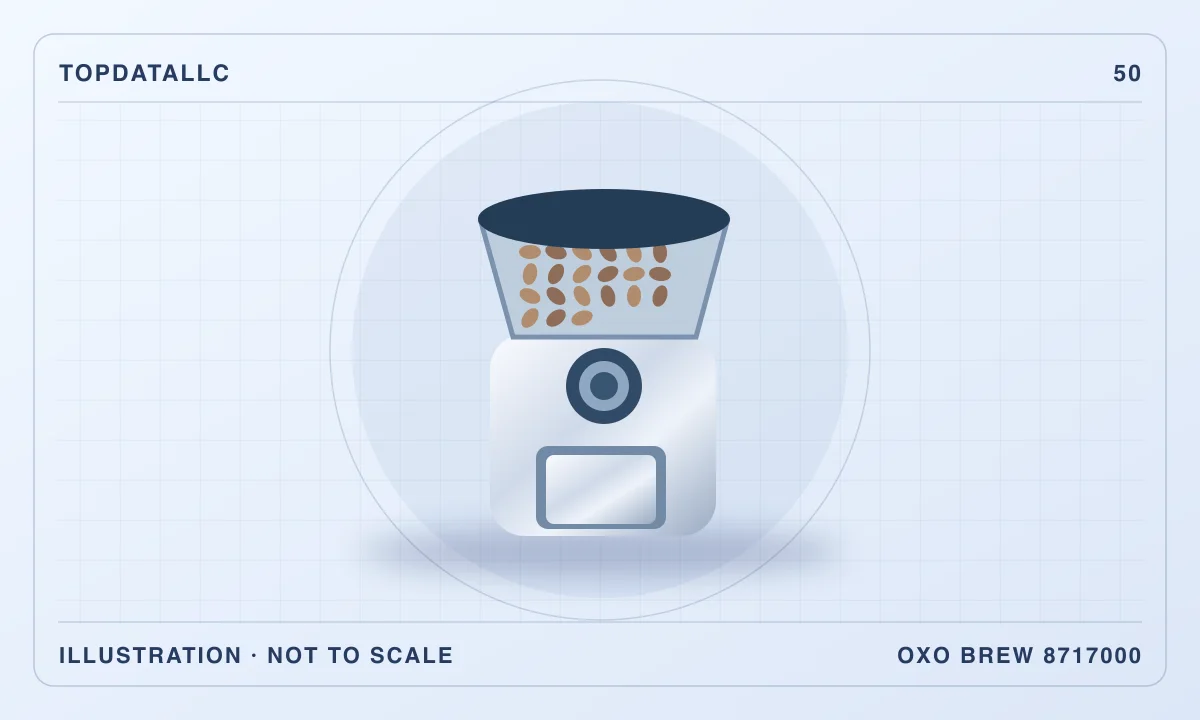
The OXO Brew Conical Burr Coffee Grinder is a countertop grinder for someone who wants a repeatable, adjustable routine for brewed coffee without weighing and selecting a complex programme on the grinder itself. The ordinary silver model uses a timer to control the dose. Its useful role is preparing fresh grounds for a brewing method you already understand. The buying decision should begin with that method, the quantity and how much adjustment you want to make.
This research review covers the US model 8717000. OXO's product information and manual establish the burr arrangement, controls and cleaning requirements. Independent comparisons from Epicurious and TechGearLab provide context for usability and grind consistency. The version with an integrated scale and the newer Compact grinder are different products, so their dosing features and performance should not be transferred to this one.
Begin with the brewing method
Identify the coffee you make most often. A filter brewer, a French press and an espresso machine ask for different grind behaviour. An adjustable burr grinder can support a range of preparations without necessarily giving the same degree of control at every end of that range.
Write down the batch size and the part of the current routine you want to improve. You may want more repeatable grounds than a blade grinder supplies, easier preparation than a hand grinder, or the ability to change settings for different brewers. Those are more concrete reasons to buy than a general promise of better coffee.
If you mainly use pre-ground coffee successfully and brew only occasionally, the improvement may be less valuable than the extra equipment and cleanup. The OXO makes the strongest case when grinding is a regular part of a routine you want to control more deliberately.
Understand burrs without expecting perfection
OXO specifies stainless-steel conical burrs. Burr grinders control particle size through an adjustable grinding gap, rather than repeatedly striking the beans with a blade. That is a relevant design difference, but the burr label alone does not establish that every resulting particle will have the same size.
Independent tests compare consistency because different grinders still produce different distributions. TechGearLab did not place the ordinary OXO at the front of its consistency comparison. Its usable controls can still be attractive, but convenience and the most uniform result are separate things to weigh.
Consider the sensitivity of your brewing method. A routine cup from a filter machine may give you different priorities from finely adjusting espresso extraction. Compare evidence for the method you use, rather than treating one generic description of consistency as sufficient for every preparation.
Know which OXO model you are comparing
The ordinary 8717000 controls grinding through elapsed time. It does not contain the integrated weighing system offered in another OXO model. A photograph showing a similar hopper and grounds container can make the products easy to confuse.
That distinction affects what you do after pressing the button. If you need a particular mass of coffee, you will need to measure it through an appropriate separate method. The grinder's timer can help repeat a routine, but a repeated number of seconds is not the same as an independently measured dose.
The Compact grinder also has its own size and controls. Compare exact model numbers and manuals before choosing a listing or accessory. A smaller case or an added display can indicate a different ownership proposition, rather than another colour of the same machine.
Use the grind settings as starting points
OXO lists fifteen main grind settings, with additional microsettings. The appropriate point depends on the brewer, beans and desired result. A numbered setting on this grinder should not be assumed to equal the same number on another brand's machine.
Start from the brewer and grinder guidance, then change one variable at a time. Keep the coffee amount, water and preparation method consistent while evaluating a grind adjustment. If several things change together, it becomes harder to identify why the cup tastes different.
Record a useful setting for the coffee you normally buy. That gives you a starting point when returning to the same beans. It does not remove the need to adjust when the coffee or brewing method changes, but it prevents every morning from becoming a fresh search through the entire dial.
Separate timer repeatability from dose accuracy
The one-touch timer remembers the last setting. This is useful when you regularly prepare a similar amount. It reduces repeated input, but the mass delivered during that time can change with beans, grind size and the conditions of the feed.
For a dose-sensitive routine, weigh the output using an appropriate coffee scale and adjust the timing deliberately. A successful time setting for one bag should not become a claim that the grinder always dispenses an exact amount. Treat the timer as a convenience control whose result can be checked.
If you frequently switch between a small single cup and a large batch, consider how often you would change the setting and measure the result. A scale-equipped or different dosing system might suit that pattern better. The ordinary OXO is more attractive when the simple timed approach matches the way you brew.
Make the hopper serve your routine
OXO lists a hopper capacity of twelve ounces of beans, with a tinted body and a trap-door arrangement for removal. The capacity gives flexibility, but it is not a requirement to keep the hopper full. Decide how much coffee needs to be available between normal refills.
Think about how often you change beans. A household switching between different coffees may value easy access and a controlled refill process more than maximum capacity. A single familiar coffee used each day creates another routine. The best arrangement is the one that remains straightforward for the people making the drinks.
A tinted hopper is also not a complete coffee-storage system. Follow the coffee producer's storage advice and avoid assuming that beans kept in any countertop container remain unchanged indefinitely. Buy and load quantities that fit the rate at which you actually use them.
Evaluate espresso requirements separately
OXO describes settings extending from fine to coarse, including espresso in its product guidance. That establishes intended range, rather than proving the fine adjustment will satisfy every espresso machine and basket. The precision needed for a demanding espresso routine deserves a more specific comparison.
Identify whether you use a pressurised basket or a setup that depends heavily on controlling the grind. Look for independent tests relevant to that method and compare the available adjustment steps. A grinder that is convenient for filter coffee can be less suitable when tiny grind changes are central to the recipe.
If espresso is the main reason for buying, start with that requirement instead of treating it as an occasional extra feature. A dedicated espresso-oriented grinder may have a clearer role. If brewed coffee is the main job, do not let an uncertain future espresso plan dominate an otherwise straightforward purchase.
Include the grounds container in the workflow
The removable stainless-steel grounds container is part of the everyday handling, not merely a place for coffee to land. Consider how its opening works with the brewer you use. Transferring grounds into a wide filter basket is different from aiming them into a narrow opening.
Prepare the brewing vessel before grinding so that you can transfer the dose without moving unrelated objects around a crowded counter. A stable surface and a clear route can make the process tidier even when the grinder itself creates some loose grounds.
Check the container's fit and position before starting. If grounds begin to accumulate where they should not, stop and inspect the documented arrangement. Repeatedly running the grinder into a poorly seated or overfull container is unlikely to improve the morning routine.
Expect static to vary
OXO's manual explains that beans, humidity and other conditions can contribute to static and loose grounds. The product's static-reduction design should not be interpreted as a promise that every dose transfers without any dust or clinging particles.
Notice whether the issue changes with a new bag of beans or a change in the room. Follow the manual's permitted care and handling suggestions. Avoid adding water or using an improvised treatment inside the grinding mechanism because it appears in an unrelated online routine.
A small amount of cleanup may be an acceptable trade-off for the convenience of a motorised grinder. If keeping the surrounding counter exceptionally tidy is a main requirement, compare independently evaluated alternatives on that point. A simple control panel and a clean transfer are different ownership characteristics.
Follow the dry-care instructions for the burrs
OXO distinguishes washable removable storage components from the inside of the grinder and burrs. The manual says not to clean the internal grinding area with water or other liquids. Read the disassembly and reassembly sequence before beginning maintenance.
Keep the correct parts together and check that the removable burr is locked back into place as instructed. A grinder that does not start after cleaning may have an assembly issue rather than a failed motor. Use the troubleshooting guide instead of repeatedly forcing the switch or pressing components into an uncertain position.
The manual also excludes dishwasher cleaning for the grinder's parts. Make room for the recommended washing, brushing and drying procedures. A machine that is easy to operate can still be inconvenient if its care routine does not suit your kitchen.
This is a coffee grinder, rather than a general spice or grain mill. OXO limits what should be put into the grinding mechanism. Keep non-coffee ingredients and foreign objects out of the hopper, and use only the cleaning products or methods the manual permits. A separate spice grinder avoids asking this coffee setup to perform an unsupported second job.
Consider noise, height and access
An electric grinder creates a short active noise period. Consider when it will be used relative to sleeping family members, calls or shared kitchen activity. Do not assume a favourable usability review establishes quiet operation in your room, particularly with different beans and surfaces.
Measure the working space with access to the hopper lid and grounds container. A grinder that fits under a cabinet may need to be moved for refilling. Check the actual model's dimensions and the way you intend to reach it instead of relying only on a front-facing product photograph.
A permanently useful position can make the routine easier. You should be able to load, select, grind and transfer without moving several other appliances. If it will be stored after every use, include carrying and reassembling that arrangement in the comparison.
Compare the simplest route to a better cup
A suitable hand grinder can be attractive for small quantities and a different noise and storage routine, with more manual effort. A higher-end electric grinder can be relevant when consistency or fine adjustment is the limiting requirement. A scale-equipped design can change dosing convenience.
Epicurious favoured the ordinary OXO as a budget option in its testing, while TechGearLab's comparative results show that it is not the leading performer in every metric. These are compatible observations when price, usability and grinding performance are weighted differently. Your brewing method should determine the balance.
Choose the 8717000 when timed dosing, accessible grind adjustment and an ordinary brewed-coffee routine fit together. Confirm the silver US model and read the cleaning instructions before ordering. Its value is a repeatable process you can understand and maintain, with the limits of timed dosing and category-wide grind comparisons kept in view.