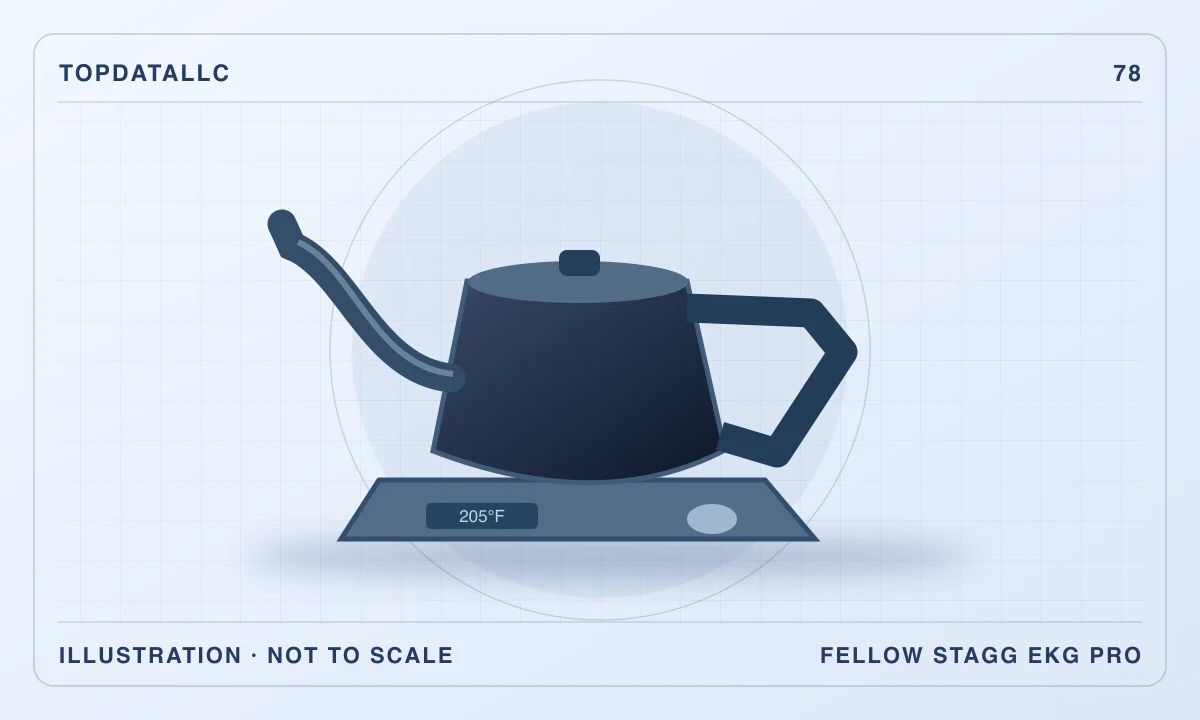
The Fellow Stagg EKG Pro is easiest to justify when pour-over coffee is a regular part of your day and controlling the water stream is useful to you. Its narrow spout, adjustable temperature and on-base controls support a deliberate brewing routine. If you mainly want to fill a large pot quickly or boil water for several people, its small capacity and controlled pour may be the wrong priorities.
This review covers the standard Pro in matte black with the US power configuration, retail SKU 1222PRO-MB-US. The original Stagg EKG and Pro Studio Edition are different offers. Fellow’s current shared product page, its manufacturer documents and Reviewed’s original Pro evaluation inform the assessment. The recommendation rests on the brewing task, not on the assumption that a premium-looking kettle automatically makes better coffee.
What a gooseneck changes
A narrow spout is useful when you want to direct a controlled stream over a bed of coffee. That gives the brewer more deliberate control over where water lands and how quickly it is added. It can make a manual pour-over routine easier to repeat, particularly when working with a dripper such as the Hario V60 covered elsewhere on TopDataLLC.
The spout does not choose a good recipe or grind setting for you. If the coffee tastes poor because the grind, dose or brewing method is unsuitable, a more precise stream may make the same unsuitable recipe more repeatable. Treat the kettle as a control tool within a wider process rather than the single ingredient that fixes every disappointing cup.
For filling a large French press, serving several mugs of tea or transferring hot water quickly, a broader-spout kettle may be more convenient. The Stagg’s controlled flow is a purposeful design choice with a trade-off. Try to picture the actual pour you make each morning: carefully wetting a small coffee bed and rapidly filling a large vessel are different jobs.
Capacity is a real buying limit
Fellow specifies 0.9 litres, or 30oz, for the Pro. That is the maximum capacity, not a suggestion to ignore the marked fill limits. A brewing routine can also require water for rinsing a filter or warming a vessel, so the volume you drink is not necessarily the whole amount you use. Compare the complete routine with the kettle’s working range.
For a person making a modest pour-over, that size can be appropriate and avoids a larger appliance taking over the coffee area. For a household making several drinks together, refilling may become the dominant feature. Consider how often you would need another heating cycle and whether that extra step conflicts with the reason you want an electric kettle in the first place.
Space planning includes the base and the spout, not just the round kettle body. Leave room to lift it comfortably, keep it away from an exposed counter edge and follow the safety instructions around hot surfaces and steam. A narrow coffee station that looks elegant in a photograph may be awkward if the handle is trapped beside another appliance.
Adjustable temperature is useful when you use it
Fellow lists a selectable range of 104–212°F, or 40–100°C. This lets you choose a target rather than stopping at boiling for every drink. A chosen temperature can be a useful repeatable variable when comparing recipes. It is not a statement that every coffee or tea has one universally correct setting, regardless of the ingredient and method.
Start from the coffee or tea producer’s guidance and the recipe you are following. Keep the other important variables reasonably stable while deciding whether a temperature change improves the result. Changing grind, dose, pouring pattern and temperature together makes it harder to know which change mattered. The control is most useful when it helps you learn rather than encouraging endless adjustments.
The displayed target also should not be confused with a verified temperature everywhere in the coffee bed. Water travels through the spout and meets a vessel and ingredients at their own temperatures. The practical value is repeatable kettle control, while the complete drink remains a system. Buying a precise-looking display does not remove those ordinary differences between recipes and setups.
Hold and scheduling address convenience
The Pro offers a configurable hold function up to an hour, according to Fellow’s product sheet. That can be useful if you prepare several pours or get interrupted while setting up. It is less useful if you heat water, pour immediately and walk away. Judge the feature against your habits rather than assigning it value simply because it appears in a menu.
Scheduling can support a regular morning routine, but it still depends on the kettle being correctly prepared and placed according to the instructions. It is not permission to leave an unsuitable fill or an unsafe counter arrangement unattended. A convenience feature should fit a sensible routine, including checking the water and the condition of the appliance.
Consider whether a scheduled start actually saves you effort. If you usually decide on the drink after arriving in the kitchen, immediate heating may already be convenient enough. If you prepare the coffee station in advance, a scheduled setting may be useful. The answer depends on the repeated task, not on whether an app-connected feature sounds more modern than a simple switch.
The controls require a little learning
The Pro combines a colour display with a push-and-turn dial. Reviewed found the customisable settings useful, while noting that the dial and menu interactions take practice. That is a more realistic expectation than assuming every person in the household will understand the controls immediately from the kettle’s simple exterior.
Set up a small number of useful preferences first. Confirm how to select the target, start heating and manage hold before exploring every extra setting. If several people share the kettle, agree on a straightforward normal arrangement and show them how to change it. A premium appliance can become frustrating if ordinary use depends on one person remembering a complicated menu path.
The on-base brew timer is helpful when you want to observe a pour-over without reaching for another device. It does not automatically make this a weighing scale or a complete recipe controller. A scale and your chosen method still have separate roles. Decide which tools you want within reach so the brewing area remains comfortable instead of becoming a collection of overlapping screens.
Wi-Fi is for updates, not remote boiling
Fellow’s current page says the EKG Updater app delivers firmware updates over Wi-Fi and does not currently provide remote control of the kettle or its settings. That distinction should be clear before purchase. Do not choose the Pro expecting to start it from another room through the app merely because a wireless connection appears in the specifications.
It is reasonable to ask whether you need the connected function at all for ordinary brewing. The kettle’s physical controls are the important daily interface. Read the current update instructions when an update is appropriate, and avoid assuming that a promised or imagined future feature is part of the product you are buying now.
For a shared household, keep the update arrangement understandable and maintain the documentation. Network changes, a replacement phone or a new router should not leave everyone uncertain about how the appliance normally works. A useful connected feature earns its place by supporting ownership, rather than making a simple heating task seem dependent on constant phone interaction.
Heating speed needs context
The US manual gives a 110–120V supply specification and a 1000–1200W rating. Reviewed found heating useful in its test routine, but we would not transfer a historical elapsed time into a promise for every fill and starting temperature. How much water you heat and its initial condition affect the task.
If rapid bulk boiling is your main priority, compare an appropriately sized kettle designed around that need. The Stagg’s most distinctive capability is controlled brewing, so it should not win a speed comparison simply because its design is attractive. A quick result for a small amount of water and a large household serving task are not the same benchmark.
The US configuration is also not a universal travel appliance. Confirm the regional power version and use it only with a suitable supply under the maker’s instructions. A plug adapter changes the physical plug arrangement, not the underlying electrical requirements. International shoppers should check the local version and warranty rather than assuming the US affiliate offer fits their home.
Care is part of repeatability
Follow Fellow’s directions for water-only use, fill limits, cleaning and descaling. Keeping the base dry and unplugging as instructed are basic parts of appliance care. Do not treat a removable kettle as permission to immerse electrical components or put them through a cleaning method the manufacturer has not authorised.
Scale and residue can change how pleasant the appliance is to own, so include appropriate maintenance in the decision. Use the manufacturer’s current method and suitable products rather than combining household chemicals or choosing an aggressive treatment because a deposit looks stubborn. The objective is to maintain the kettle, not make a cosmetic improvement at the cost of damaging it.
The matte black finish is a style choice with its own normal handling requirements. Avoid choosing the product on the expectation that it will remain visually perfect without cleaning. If it will sit near frying or other busy cooking, consider how easily you can keep the coffee area orderly and wipe the appropriate exterior surfaces according to the care guidance.
Alternatives for different drink habits
The Cuisinart PerfecTemp CPK-17P1 covered on TopDataLLC is relevant when your priority is a more general household kettle rather than a slow, narrow pouring stream. Compare the exact capacity and controls in that guide. The key question is whether you need careful water placement or a convenient way to prepare larger everyday servings.
A stovetop gooseneck can be a more basic approach if controlling the stream is the main goal and you do not need the Pro’s electric temperature and hold features. That introduces its own heating and handling routine. Conversely, an automatic brewer may make more sense if your main objective is less involvement in coffee preparation rather than more control over each manual pour.
An existing ordinary kettle is also a valid starting point while you establish whether you enjoy pour-over brewing. Spend attention on the recipe, grinder and ingredients before assuming a premium kettle is the next necessary purchase. The Pro is easier to value once you can identify where temperature selection or stream control would improve a process you already understand.
Standard Pro versus Studio and older models
Fellow’s current product page groups Pro and Pro Studio choices together. Check the selected model and finish rather than assuming every photograph or price refers to the same package. The standard matte-black Pro discussed here does not acquire the Studio Edition’s different finish materials merely by sharing a product page.
The manufacturer manual identifies the standard Pro device as EP20AAUS, while the retail matte-black SKU is 1222PRO-MB-US. Different identifiers can describe the device and its retail finish without being contradictory. Match both the model family and the selected configuration when reviewing an offer, and ask the seller if the description is unclear.
Older reviews of the original Stagg EKG should not supply missing Pro features or current warranty terms. Likewise, an expired price or promotion does not establish today’s value. Confirm the present seller, supplied regional base, return conditions and applicable support before ordering. Paying for the right configuration is more important than finding a small discount on a superficially similar listing.
Verdict
Choose the Stagg EKG Pro when regular manual brewing makes a controlled stream, adjustable target and convenient hold genuinely useful. Its 0.9-litre size and menu controls need to fit the household, and Wi-Fi should be understood as an update function. The strongest case is a repeatable coffee routine in which those controls address a specific frustration.
We would choose a different kettle for rapid large servings, simpler shared controls or a purchase driven mainly by appearance. The Pro can be a rewarding tool for somebody who enjoys managing the brew. Its value is the control it makes available, and that value is realised by using a suitable recipe and a comfortable setup rather than expecting the appliance alone to determine the cup.