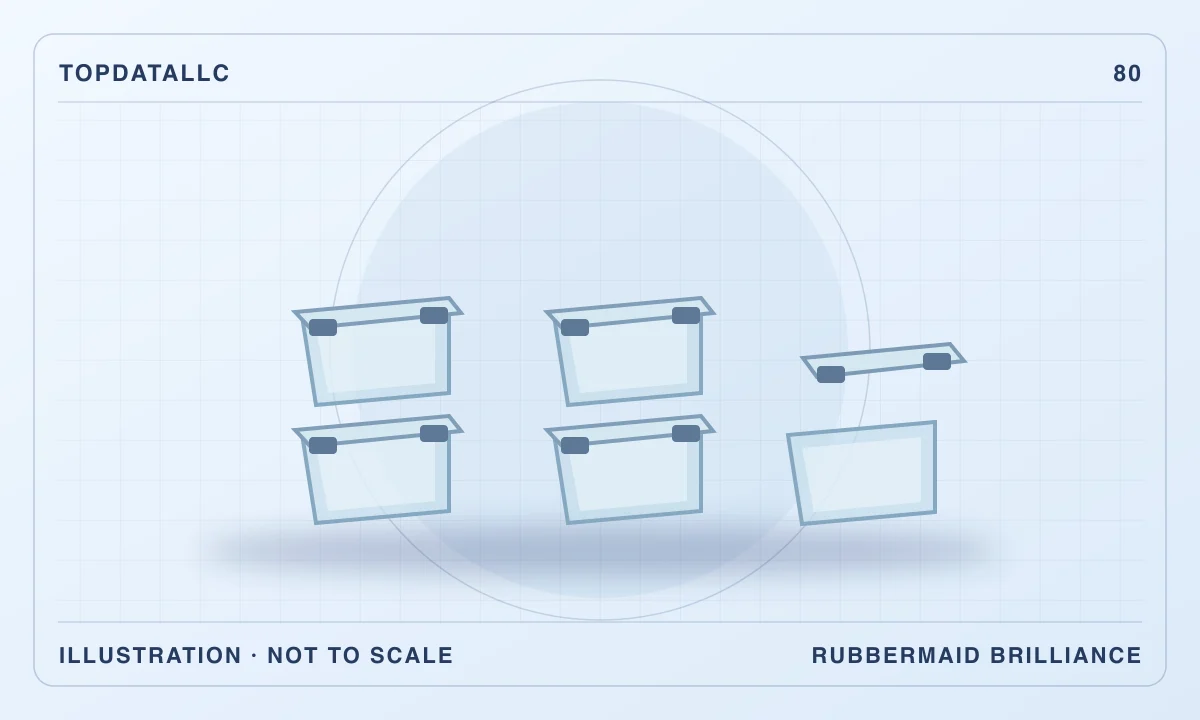
The Rubbermaid Brilliance 3.2-cup five-pack makes most sense when you want several matching lunch or leftover containers rather than a large assortment of different shapes. Clear bodies and lids make the contents easy to identify, and the latches give the closure a deliberate feel. The compromises are a fairly firm opening action and plastic-specific care limits that matter when reheating food.
This review covers five clear plastic container bodies, each with its own lid: ten pieces, not ten complete containers. Brilliance glass, pantry containers and mixed-size sets are separate purchases. Rubbermaid’s catalogue and plastic use-and-care document provide the operating reference, while Prudent Reviews’ original container tests add independent evidence about visibility, closure and leak performance.
Five equal sizes can be better than a mixed set
A repeated size is useful when your lunches or prepared ingredients follow a consistent pattern. It reduces the number of lid shapes to sort and makes it easier to see how many usable containers remain. If you regularly pack similar portions, that simplicity can be more valuable than a set containing many small pieces that rarely leave the cupboard.
The same uniformity can be a limitation for varied leftovers. A medium rectangle may be awkward for a small sauce portion and too small for a large family dish. Before buying, look at the foods you actually store over several ordinary days. Choose a repeated size because it matches those portions, not because the piece count makes the set appear larger than it is.
The 3.2-cup capacity is a volume measure, not a fixed meal weight or a nutritional portion. Bulky salad, dense cooked ingredients and a saucy dish use that space differently. Leave whatever working space the contents and use require rather than pressing food against the lid just because the nominal capacity appears adequate. A container that is consistently overfilled is the wrong size for that meal.
For lunches with several components, decide whether you want them together or separately. These are ordinary rectangular containers, not a compartmented lunch box in this configuration. If you dislike ingredients mixing or need small separate dressings, include suitable additional containers in the plan rather than assuming the set provides divisions that are absent from the product.
Visibility is the strongest everyday advantage
Prudent Reviews found the clear Brilliance plastic easier to see through than cloudier everyday containers. That matters in a crowded refrigerator where recognising the contents quickly can reduce unnecessary opening and help you use what you prepared. Clear lids are particularly useful when containers sit below eye level and the top is the easiest surface to inspect.
Visibility does not replace labelling. Similar-looking food, stacked portions and multiple household members can still create uncertainty about what belongs to whom or when it was prepared. A simple label compatible with your cleaning routine can make the clear container more useful without needing an elaborate organisation system. The product helps you see; it does not manage the contents automatically.
Think about the refrigerator shelf as well as the cupboard. Matching rectangles can create an orderly arrangement, but an orderly row of unused food is not a successful result. Put the portions you intend to use where they are easy to reach, and keep the system understandable to everyone sharing the kitchen. Buying uniform containers should support an existing routine or a realistic new one.
The closure deserves a grip test
Brilliance uses side latches and a closely fitting seal. Prudent Reviews reported that opening and closing took more effort than some competing designs. That is a meaningful issue for someone with limited grip strength, frequent hand discomfort or a lunch routine where a child must open the container independently. A secure-looking latch is not automatically the easiest closure for every user.
If possible, try the same size in a shop. Check both pressing the lid into place and lifting it away after the latches are released. Those are separate movements. A container that feels easy to close while empty may still be awkward when you are holding food, standing at a work microwave or trying to avoid spilling a sauce.
Keep the sealing surfaces clean and the lid properly seated. Food caught at the rim can interfere with an otherwise well-designed closure. Do not assume that forcing the latches down compensates for a displaced lid, trapped ingredient or damaged part. An ordinary visual check before packing is more useful than relying on a general leak-resistant description.
Leak evidence is helpful, with limits
Prudent Reviews included Brilliance plastic in its original leak comparisons and reported that it passed the test. That supports confidence in the basic closure design. It does not establish that every used container will remain sealed after damage, incorrect closing or any imaginable movement inside a bag. A single review sample cannot answer all those conditions.
For a packed lunch, check that both latches are closed and protect the container from unnecessary crushing. If carrying an especially messy meal, consider an appropriate secondary bag until you understand your own container and routine. A deliberate packing method is not an admission that the product cannot seal; it recognises the consequences of discovering a problem over a laptop or paperwork.
Do not transfer the transport expectation to hot contents or microwave operation. Heating creates a different situation, and Rubbermaid specifically requires opening the latches to vent during permitted reheating. A closure intended to retain food during storage should not be treated as a pressure-resistant cooking vessel. Use the documented mode for the task you are actually performing.
Microwave-safe has a narrower meaning than it sounds
Rubbermaid’s plastic care document permits reheating precooked food under its instructions, not cooking in the container. It tells owners to open the latches so steam can escape, use care with hot contents and avoid excessive reheating. The distinction is important: the presence of a microwave symbol does not establish that any recipe, duration or ingredient is suitable.
The manufacturer also warns against reheating foods high in salt, oil, fat or sugar, and against melting foods such as butter or sugary ingredients in the plastic. That restriction can be relevant to ordinary leftovers. Read the current instructions supplied with your set and transfer food to a suitable microwave-safe dish when the intended use is outside those limits.
Do not add plastic wrap on or inside the container during microwaving when the care guidance prohibits it. The manufacturer warns that wrap can heat, melt and adhere to the walls. The lid’s venting arrangement is part of the intended reheating method; adding an improvised covering can introduce a different material and behaviour that the container’s instructions do not cover.
The vents are not a substitute for sensible handling. Keep hands and face clear of escaping steam, use care with the hot container and follow the food and microwave guidance applicable to the task. This product review does not establish food-heating temperatures or a safe reheating schedule for every meal. The container’s material limits and proper food preparation are separate considerations.
These are not oven dishes
Rubbermaid’s plastic instructions prohibit conventional and convection ovens, browning elements and stovetops. The Brilliance name also appears on glass products with different care requirements, so check the actual material rather than remembering a claim from another item in the range. A clear container can look glass-like without being suitable for the same heating tasks.
If you want to bake, store and reheat in one vessel, a suitable glass dish may fit the job better. It brings different weight, breakage and thermal-handling considerations. The relevant comparison is the whole workflow: a light plastic lunch container and a glass baking dish are not interchangeable simply because both can hold the same volume of food.
For a desk lunch, transferring to an appropriate plate or bowl can be an acceptable part of the routine. If that extra washing is the very inconvenience you want to remove, compare a container whose documented uses match your normal meal and heating method. Choose around the permitted operation rather than buying plastic and hoping a cautious oven setting will be acceptable.
Freezer use needs room and careful handling
Rubbermaid permits freezer use but notes that plastic becomes less flexible when cold and can break if dropped. It also warns about expansion when contents freeze. Leave suitable headspace according to the contents and product guidance, and do not fill a container to the brim on the assumption that its latches can contain expanding liquid without consequence.
A review’s extreme freeze test is not an operating instruction. Prudent Reviews used several demanding comparison procedures, but the manufacturer’s limits should control normal use. A container surviving a particular test does not make deliberately overfilling it a sensible practice. The useful result is food stored in a suitable intact container, not proof that it can tolerate unnecessary stress.
Consider how the repeated size fits the freezer shelf before committing a large batch of food. Rectangles may arrange neatly, but access matters when you need to remove a specific portion. Labels remain useful when the contents are frozen and harder to identify. A freezer system should make retrieval easier rather than require moving a stack of slippery containers every time.
Cleaning focuses on the rim as well as the body
The plastic line is compatible with household dishwasher use under Rubbermaid’s instructions, including secure placement away from the heating element. Check the supplied care information and your dishwasher’s arrangement. A lid loose at the bottom of the machine is not protected merely because its material is described as dishwasher-safe.
Prudent Reviews identified the gasket as non-removable. That makes it important to clean and inspect the sealing area without assuming it can be pulled out for a separate wash. Do not pry at it with a knife or another sharp implement. Follow the manufacturer’s cleaning method, and replace an unsuitable damaged component rather than turning a fixed seal into an improvised repair project.
The care document warns that sharp utensils can scratch or scuff the plastic and that turmeric-containing foods can stain. Resistance to ordinary staining is therefore not an assurance that every colourful ingredient leaves the material unchanged. If preserving a perfectly clear appearance is essential to you, consider whether your common meals make that expectation realistic.
Plastic versus glass is a practical choice
Plastic is attractive when light weight and handling convenience matter in a lunch bag. Glass can be preferable when its documented heat uses fit the task, with more weight and a different risk if dropped. Neither material choice by itself answers every question about closure, portion size, replacement parts or how comfortably you can carry the full meal.
Rubbermaid describes this plastic as BPA-free. That is a specific material statement, not a complete health assessment of every possible use. The appropriate response is to follow the product’s intended conditions rather than assume the label removes all heating restrictions. If avoiding plastic food contact is a personal requirement, choose a suitable alternative rather than expecting a marketing phrase to resolve it.
Prudent Reviews also compared OXO Smart Seal and Pyrex Snapware, among other sets. Those are sensible alternatives to investigate if opening effort, removable seals or glass construction matter more to you. Check the exact current size and material; a comparison across product families does not establish that every pack uses the same lid or care rules.
Verdict
The 3.2-cup Brilliance plastic five-pack is a reasonable choice for repeated medium portions when clear visibility, matching lids and manageable carrying weight are the priorities. Count the offer as five complete containers and confirm the current seller, material, size and returns. Include any smaller sauce pots or larger leftover dishes you still need rather than expecting one size to organise the whole kitchen.
We would pass if firm closures are difficult for you, if your normal meals fall outside the permitted reheating conditions or if you want a dish that can go into an oven. The set is strongest as a defined storage and lunch solution. Buy it for that role, keep the sealing surfaces clean and let the actual care instructions determine how the contents are stored and reheated.