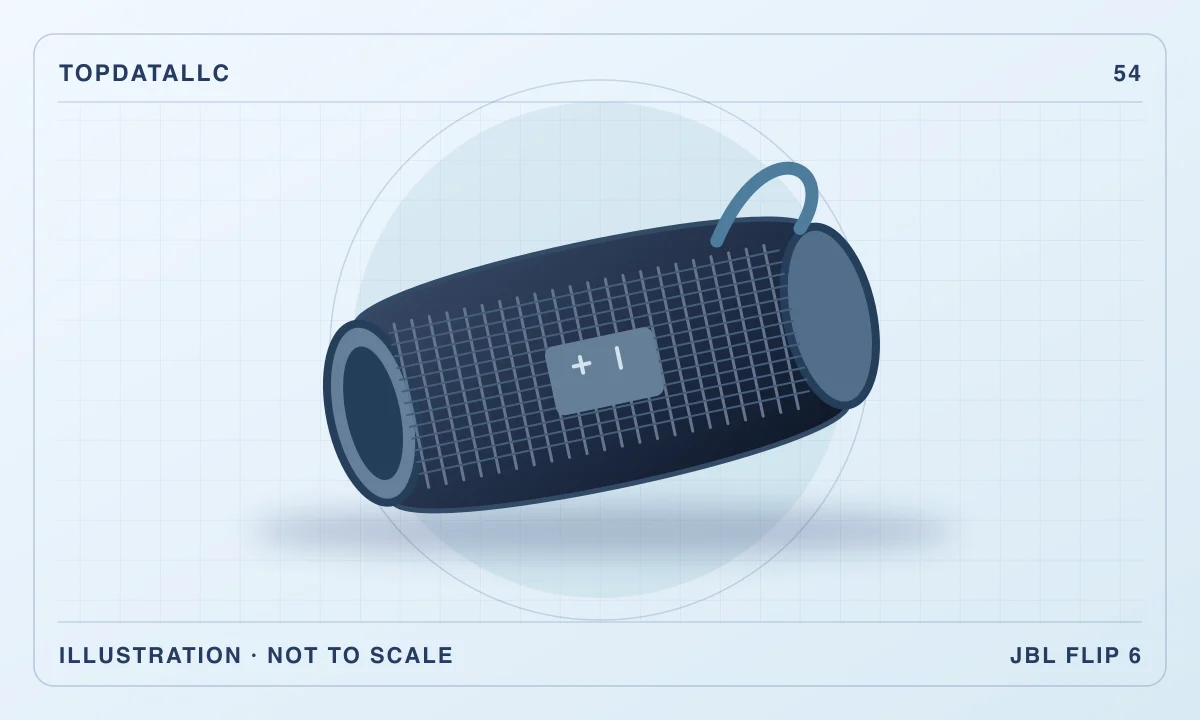
The JBL Flip 6 is a portable Bluetooth speaker for bringing music to a room, a patio or a trip without setting up a permanent audio system. It is most appealing when compact size, battery operation and a weather-resistant design are the priorities. It becomes a weaker fit when you need speakerphone calls, a wired input, home Wi-Fi audio or deep bass at party volume. Understanding those boundaries is more useful than treating a portable speaker as a miniature replacement for every other kind of sound system.
This is the Flip 6, not every JBL cylinder
This review covers the black Flip 6, identified in US retail as JBLFLIP6BLKAM. Similar shapes appear across different JBL generations and sizes, and they do not all share the same connection or linking system. Check the model and selected colour on the offer and carton. A refurbished unit, different generation or accessory bundle deserves its own condition and value assessment.
JBL describes a two-way design with a woofer and separate tweeter, together with passive radiators. Its rated amplifier figures are 20W for the woofer and 10W for the tweeter. These are manufacturer specifications, not a measurement of how loud or full the speaker will sound in your garden. The practical result depends on distance, placement, recording and the level at which you listen.
The Flip 6 is also an established design rather than a new flagship. Its value depends on the current comparison with alternatives, including newer JBL models. A launch review’s price or praise is useful historical context, but it is not a reason to assume that the same model is automatically the strongest purchase years later. Start with the features you need and the full current offer.
A portable speaker solves a specific listening problem
Imagine the intended use before choosing a speaker. Background music beside a picnic table is a different job from filling a crowded outdoor gathering. A small speaker close to listeners can be a convenient answer to the first problem. Buying several accessories or pushing a compact speaker to its limits may be a poor way to approach the second.
Indoors, the room and supporting surface affect the impression of sound. Try a stable position where the controls remain reachable and the speaker is not at risk of rolling or being knocked into a drink. Avoid judging the whole product from a placement hidden behind bags or pressed into a corner. A change in position is a useful first experiment before reaching for an equaliser.
Outside, think about where people will sit and how far the speaker will be from them. There is no enclosing room to make every listening position behave similarly. The practical question is whether the music remains enjoyable at your intended level, not whether the speaker can produce a louder sound when held close to your ear. That is a task for normal-distance listening during a sensible acceptance check.
Sound quality and bass need proportionate expectations
SoundGuys’ independent evaluation finds a portable, durable-feeling design but identifies limits in separating instruments. RTINGS also reports limited deep bass and compression at higher playback levels. These findings are external test observations, not a recording made by TopDataLLC. They are useful because they describe the tradeoff behind a compact enclosure rather than simply repeating its output rating.
If you mostly hear speech, acoustic music or moderate-volume playlists, those limits may be acceptable. If the reason for buying a new speaker is physical low-bass impact, they deserve much more weight. Decide which problem you are trying to solve. A portable cylinder is easier to carry than a larger system, but portability is not a free addition to the same acoustic performance.
Listen to familiar material across the levels you expect to use. A speaker can seem pleasantly balanced at background volume and less comfortable when pushed much harder. Do not choose solely on the loudest demonstration available in a shop or video. The useful result is a level that remains enjoyable for the room or group without continually asking the speaker to do something outside its strongest role.
One speaker does not create a conventional stereo setup
A single Flip 6 plays in mono. The separate woofer and tweeter are different parts of the frequency range, not left and right stereo channels. That distinction matters if you are considering it for a computer desk where a stereo image is part of the appeal. A small portable unit and a pair of desktop speakers are different arrangements, even when both can play the same song.
For a working desk, compare the experience you want. If the speaker must travel away from the desk most days, the Flip’s portability may be valuable. If it will remain beside the computer permanently, a supported wired stereo pair may be simpler. TopDataLLC’s Creative Pebble V3 guide is relevant to that different use case, particularly when computer connections and close listening matter more than a battery.
Be cautious about treating the purchase of a second portable speaker as an obvious upgrade path. Consider the linking requirements, where the speakers will sit and how you will charge both. A pair can be useful in an appropriate setup, but the fair comparison includes the complete cost and operating routine. It should not be an unplanned expense added after discovering that one unit does not provide the stereo experience you expected.
PartyBoost requires exact compatibility checks
JBL uses PartyBoost on the Flip 6. Other generations can use different linking systems, so the presence of JBL branding does not establish compatibility. Before buying for an existing collection, list the exact model of each speaker and check the manufacturer’s current support instructions. This is especially important when a friend’s newer speaker is the reason you are considering the purchase.
Also distinguish linking for broader playback from forming a stereo pair. SoundGuys flags generation-specific stereo restrictions. Do not infer stereo support simply because two speakers can participate in some kind of linked playback. Confirm the intended mode with the exact devices. If the main purpose is a permanent pair, compare that supported arrangement with purpose-built alternatives before committing.
For a group sharing music casually, connection simplicity may matter more than theoretical expansion. Decide who will provide the phone, how the source will stay charged and who will control the playlist. A stable simple arrangement often serves the event better than trying to combine several speakers whose pairing systems have not been checked until everyone arrives.
Bluetooth is the audio path
The Flip 6 uses Bluetooth rather than Wi-Fi for normal source playback. It has no ordinary auxiliary audio input, and its USB-C socket should not be mistaken for a general wired audio connection. If your intended source is an older music player, a television or a computer with restrictive wireless support, check how the whole connection would work before buying.
A Bluetooth transmitter may be possible in some systems, but it adds another device and its own compatibility and delay questions. That can be reasonable if you already understand the arrangement. It is less persuasive when the original goal was a simple speaker for a source with a headphone socket. A model with the required input may solve the problem more directly.
There is no microphone for speakerphone use. You can play a recording of speech, but that does not turn the speaker into a conferencing device. If the purchase is for a home-office table, make sure music playback is actually the task. A device designed for calls has to address voice pickup and communication behaviour as well as producing sound.
The app adds adjustment without making it a smart speaker
JBL’s supported app provides an equaliser and related controls. That can help tailor the balance, but it cannot give a compact driver unlimited bass or make the speaker into a Wi-Fi multiroom system. Make small changes using familiar material and compare at a sensible level. If a desired sound requires extreme adjustment, another speaker category may be the more useful answer.
Check the current app and firmware support for your phone. Software names and supported systems can change over a product’s life, so an old review is not the final compatibility list. Normal Bluetooth playback and every optional application feature should be considered separately. A buyer who prefers to avoid companion apps should determine whether the basic physical controls provide enough for the intended use.
Updates also deserve ordinary planning. Follow JBL’s official process, keep the equipment powered appropriately and avoid changing several parts of the setup at once while troubleshooting. For a speaker bought for a trip, complete the connection and app checks before departure. Discovering a compatibility problem at home is easier to address than discovering it with limited time and no alternative source.
IP67 is protection under conditions, not permission for abuse
JBL rates the Flip 6 IP67 for dust and water protection under defined test conditions. That is a useful feature for portable use, but it is not a promise that every liquid, impact or charging situation is harmless. Read the supplied precautions and the current support guidance. A product rating and a warranty claim are also different things, with separate conditions.
Keep the charging connection dry and follow the maker’s handling instructions after exposure to moisture. Do not charge a wet speaker simply because its enclosure has a water-resistance rating. Think about where it will sit around pools, cooking areas or drinks. The most useful protection is still choosing a stable position and avoiding unnecessary exposure rather than deliberately testing the limits of a rating.
Inspect a used speaker particularly carefully. Its history can include impacts, port damage or battery wear that a new-product review cannot establish. A low price does not reveal the condition of the seals or internal battery. If predictable outdoor use is central, purchase condition and the seller’s remedy are part of the decision, alongside the original specification.
Battery and carrying convenience
JBL claims up to 12 hours of playback, with runtime dependent on content and volume. It lists charging at around 2.5 hours with the specified 5V/3A supply. Treat both as conditional manufacturer figures. A longer event, loud playback or an aged battery may call for a different plan, and a charger with the right socket is not automatically the specified power arrangement.
The maker’s approximate 178 × 68 × 72mm dimensions and 550g mass describe a bag-friendly device, but its cylindrical shape still needs a place in the bag. Consider the carry loop and whether it can catch on other items. Avoid relying on a loose strap as the only security in a situation where losing the speaker would matter. Carrying convenience is best judged with your actual travel kit.
Who should shortlist it?
Choose the Flip 6 for a clear portable-music role where its size, controls and supported Bluetooth workflow fit. Compare a larger speaker for stronger low-end output, a stereo desktop system for fixed computer listening, or a conferencing device for calls. If compatibility with other JBL speakers is the deciding factor, settle that exact model-to-model question before paying.
During the first few sessions, check normal-volume sound, battery behaviour, phone reconnection and any linking mode you intend to use. The Flip 6 can be a practical companion for modest portable listening. It should be bought with that role in mind, not on the assumption that a weather-resistant Bluetooth speaker also provides smart-home audio, wired inputs and speakerphone functions that its design does not include.