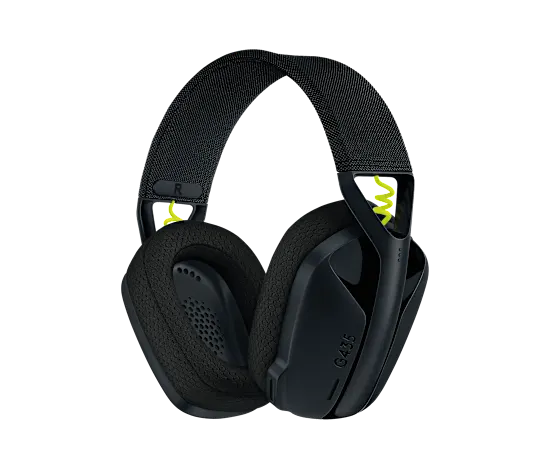
What this headset is
The Logitech G435 LIGHTSPEED Wireless Headset in Black and Neon Yellow is model 981-001049. Its appeal is not an extensive feature list. The real buying decision is whether a light frame, a USB receiver and Bluetooth matter more to you than microphone refinement, physical adjustability and software controls.
For ordinary adult computer use, the G435 makes the most sense when a conventional gaming headset feels too large or heavy. Logitech says the design is optimized for younger players and people with smaller heads, so adult fit is not a one-size-fits-all assumption. The practical question is head size, not simply whether the headset looks compact in catalogue images.
This is an entry-level design rather than a customizable audio platform. Logitech lists PC support without G Hub, and Tom’s Guide describes the sound as non-customizable. Choosing the G435 therefore means accepting its default presentation instead of planning to correct it with equalization, game profiles or surround settings.
Size and fit
The manufacturer lists the G435 at 5.82 ounces (165 grams). That low stated mass is the clearest physical reason to consider it. People who dislike the pressure and bulk associated with larger gaming headsets may find the specification appealing, although weight alone cannot predict whether the headset will remain stable.
The small format is useful only if it lands correctly on your head. Tom’s Guide reported that its reviewer, who described having a large head, did not get a good fit or a good seal. The same review said a smaller-headed partner found the fit considerably better, so the available evidence points to meaningful variation rather than universal comfort.
Adjustment is also less formal than on many full-size headsets. Tom’s Guide reported that the earcups slide up and down the headband without discrete notches and did not stay in place particularly well for its reviewer. The G435 is compact, but compact does not mean precisely adjustable.
For an adult with a small or moderate head, the lightweight frame may be the central reason to buy this model. For an adult who routinely needs a wide headband setting, the same design can become the main reason to pass. Do not select it merely because 165 grams (5.82 ounces) sounds comfortable; fit stability and ear seal still determine whether the light weight helps.
The manufacturer’s own positioning is important here. Logitech says the G435 fits a wide range of players but is optimized for younger players and those with smaller heads. That is more useful than treating the headset as a conventional full-size adult model.
Wireless connections
The box contents listed by Logitech include the G435 headset, a LIGHTSPEED wireless USB-A receiver, a USB-C to USB-A charging cable and user documentation. The receiver is therefore part of the intended computer setup, not an optional accessory that must be sourced separately.
LIGHTSPEED requires a USB 2.0 Type-A port according to Logitech’s requirements. That is straightforward for a desktop with a free Type-A socket, but it is worth checking a thin laptop, dock or tablet before buying. A USB-C-only computer may need an appropriate adapter or hub, and the supplied records do not specify one in the box.
The manufacturer lists LIGHTSPEED support for Windows 10 or later, macOS X 10.14 or later, PlayStation 4 and PlayStation 5. It also lists Nintendo Switch 2 support through USB-A or Bluetooth. These details make the receiver useful across several common systems, but the connector requirement remains part of the compatibility decision.
Bluetooth expands the headset beyond the receiver workflow. Logitech says Bluetooth works with devices that have Bluetooth audio connectivity and now includes Nintendo Switch and Switch 2. That makes the G435 relevant for a computer, phone or handheld setup where carrying a USB receiver is inconvenient.
The manufacturer specifies wireless range of up to 10 meters (33 feet) through either the LIGHTSPEED USB receiver or Bluetooth. “Up to” is a stated maximum, not a promise of the same distance through walls, interference or a crowded wireless environment. For a desk, the quoted range is ample on paper; for a whole-home listening plan, the surrounding layout matters.
Bluetooth and LIGHTSPEED are useful, but the headset is not an automatic solution for every console. Logitech’s requirements list PlayStation 4 and PlayStation 5 as USB wireless stereo connections. The official page also contains a generic “3D Compatible with Xbox” reference, but that wording does not establish direct Xbox headset support. Tom’s Guide specifically reported that the headset cannot connect to Xbox systems, so Xbox buyers should treat it as unsupported rather than infer compatibility from the generic 3D wording.
Sound and microphone
Logitech lists headphone frequency response of 20 hertz to 20 kilohertz. That is a useful technical descriptor, but it does not establish a particular tonal balance, bass level or degree of detail. The independent listening assessment is more important for deciding whether the default sound suits games, calls and music.
Tom’s Guide characterized the G435’s sound as competent but unremarkable. It reported clear game effects that lacked impact and dialogue that was audible without preserving much nuance. That points toward functional everyday audio rather than a headset chosen primarily for rich music playback or highly expressive game sound.
The same review reported limited bass and a flat presentation that could muddle vocals and instruments. This is an independent reviewer’s finding, not a manufacturer measurement, and it gives the default tuning a practical limitation. Listeners who want strong low-end weight or separation should not assume the headset will provide it simply because it is marketed for gaming.
Logitech lists passive impedance of 45 ohms. That figure helps describe the hardware, but it does not overturn the listening report. Impedance is not a substitute for a listening profile, and the G435 offers no G Hub equalizer on PC with which to reshape that profile.
The microphone is built into the earcup rather than mounted on a visible boom. Logitech describes dual beamforming microphones that reduce background noise, while Tom’s Guide reported that the hidden microphone was only adequate for voice pickup and also captured considerable background noise. The sensible expectation is usable conversation, not a deliberately positioned broadcast-style microphone.
For video meetings, the microphone design may be attractive because there is no boom to move or fold away. It is also a compromise: the distance from the mouth makes voice quality more dependent on the room and the listener’s tolerance for background sound. If clear speech is the central purpose of the purchase, a dedicated microphone or a headset with a positioned boom belongs in the comparison.
Controls and customization
Tom’s Guide reported that the controls sit on the left earcup and include a power button, volume buttons and a microphone-mute button. The review found the buttons cumbersome, particularly compared with a volume dial. That is a small operational issue, but it matters when quick adjustments are part of your normal meeting or gaming routine.
The absence of G Hub is more consequential than the control layout. Logitech’s official requirements identify PC support as “Full Support (no G-hub),” while Tom’s Guide reported that the headset cannot use G Hub for surround settings, equalization, microphone volume or individual game profiles. A buyer who wants software tuning should choose a different category of headset.
Tom’s Guide also reported that the G435 has bare-bones features and that its default sound cannot be altered through the missing software controls. That makes the purchase relatively easy to understand: you are selecting the fit and connection method first, then accepting the sound and microphone behavior that come with them.
The manufacturer lists compatibility with Dolby Atmos, Tempest 3D AudioTech and Windows Sonic Spatial Sound. Those platform-level compatibility statements do not mean the headset supplies every processing feature itself. They indicate that supported spatial-audio systems can be used with it, while the headset’s own software customization remains limited.
Battery and charging
Logitech states that the G435 provides 18 hours of play time on a full charge. The official material identifies the charging port and lists a USB-A-to-USB-C charging cable, but it does not provide a charging-time figure. Plan around the stated 18-hour operating figure rather than assuming a particular recharge speed.
The cable arrangement is simple for a desk: the included cable has USB-A on one end and USB-C on the other. A computer or charger with a free USB-A port can therefore supply the listed cable connection. The supplied records do not establish whether a wall charger is included, so that should not be assumed from the cable’s presence.
Battery ownership still involves a charging routine. Logitech provides a play-time figure and a charging cable, but the supplied specifications do not state whether the internal battery is replaceable. Charge it before a long session and keep the cable accessible rather than making assumptions about battery serviceability. Logitech lists a 2-year limited hardware warranty, which is relevant to ownership planning but does not replace checking the warranty terms for your region.
What ownership involves
The G435 is mechanically simple from a software perspective because there is no G Hub setup to maintain. Pair the receiver or Bluetooth device, use the earcup controls and charge through USB-C. That simplicity is valuable for someone who wants a headset rather than another application, profile system or tuning project.
The independent build assessment is less flattering. Tom’s Guide described a thin plastic chassis and an elastic headband that did not leave much adjustment space, calling the overall construction flimsy. That is not a laboratory durability rating, but it is a meaningful caution against treating the light weight as evidence of ruggedness.
The manufacturer says the plastic parts include a minimum of 22% certified post-consumer recycled plastic by weight. It also states that the paper packaging comes from FSC-certified forests. Those material and packaging claims may matter to buyers comparing product sourcing information, although they do not predict comfort, sound quality or longevity.
Alternatives and fit checklist
The useful alternative is not simply a more expensive gaming headset. If your priority is a smaller physical fit, compare other compact or adjustable models and inspect their headband range, earcup movement and microphone position. The G435’s differentiator is the combination of low listed mass, receiver wireless and Bluetooth, not advanced controls.
If your priority is sound shaping, look for a headset category with companion software, equalization and saved profiles. Tom’s Guide specifically identified the G435’s lack of G Hub controls and non-customizable sound as drawbacks. That comparison is enough to separate this model from software-oriented alternatives without assigning unsupported specifications to any named competitor.
If your priority is Xbox use or an analog backup, exclude this model before comparing comfort. Logitech’s listed configurations cover PC, Mac, PlayStation 4, PlayStation 5 and Nintendo Switch 2, while the independent review reported no Xbox connection and no 3.5-millimeter jack. Compatibility should come before color or advertised range.
Before buying the Black and Neon Yellow variant, confirm four things: your computer has a workable USB-A receiver path, your console appears in the supported list, Bluetooth covers the device you intend to pair, and your head does not require extensive adjustment. Then decide whether 165 grams (5.82 ounces) and 18 hours matter more than a boom microphone, stronger bass or software tuning.
Verdict
The Logitech G435 is a conditional fit purchase. Choose it for ordinary computer use when a small, light headset with LIGHTSPEED and Bluetooth is more valuable than premium sound, a highly adjustable frame or extensive controls. Logitech’s 165-gram (5.82-ounce) specification and 18-hour play-time claim support that focused use case, while the independent review supports caution about sound, build and microphone performance.
Pass on the G435 when your adult head needs a roomy, stable adjustment range, when voice quality is central, when you expect to tune the sound, or when Xbox and 3.5-millimeter compatibility are required. For everyone else, this exact 981-001049 variant is easiest to justify as a lightweight, uncomplicated wireless headset whose limitations are clear before purchase.