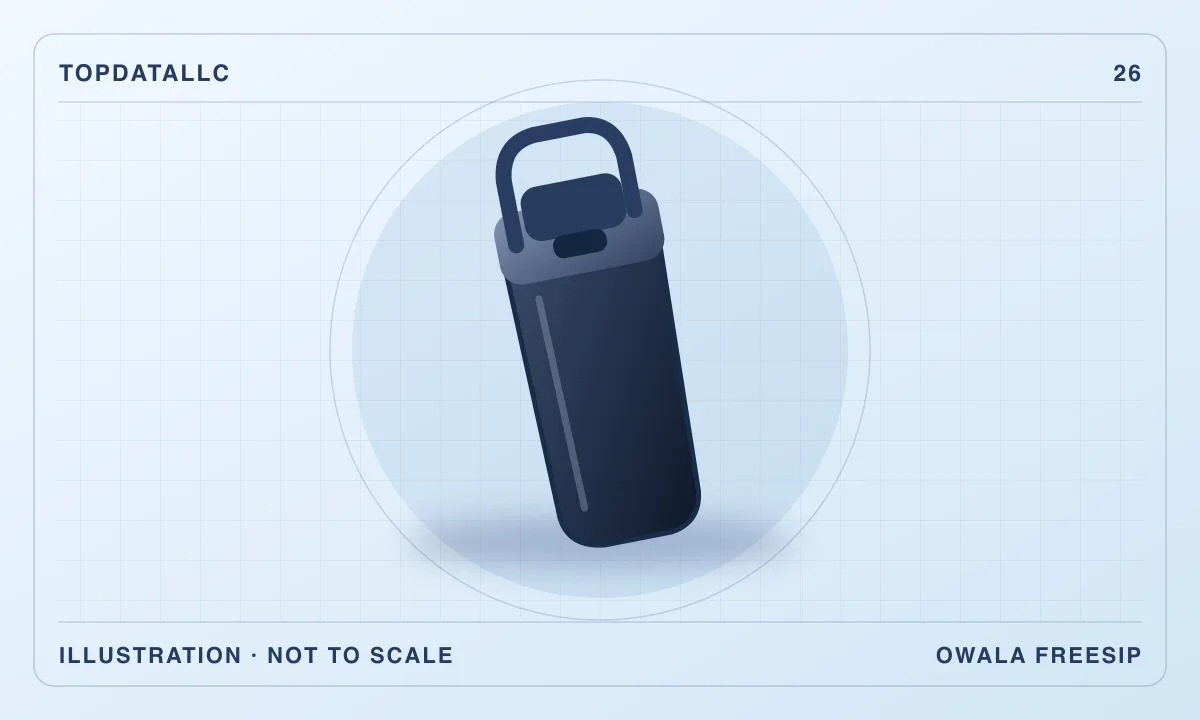
The 24-ounce Owala FreeSip is a cold-water bottle with two drinking paths in one spout. The internal straw lets you sip with the bottle upright. The wider opening lets you tip it and take a larger drink. That combination is useful if you want a different motion at a desk and on a walk. The lid also gives you another small assembly to wash and put back together. Buy it for a routine that benefits from the two ways to drink.
This review covers the stainless steel 24-ounce FreeSip in Very, Very Dark, the linked black US variant. Owala uses the FreeSip name on other sizes and materials. Check the listing and care instructions for the exact version. Owala's documentation establishes the features and limits. Food Network's published evaluation helps illustrate how the lid and spout work in everyday use.
Decide when you would actually use each drinking path
At a desk, the straw lets you keep the bottle upright while taking a sip. That is useful if you want to keep your attention on a screen and you find a tall bottle awkward to tip. On a walk or after exercise, the larger opening can be more comfortable when you want more water in one drink. A buyer who only ever uses one drinking motion may prefer a simpler lid that does that job well.
Try to picture the changeover between positions. If the bottle stays beside a keyboard all day, the straw can make the main difference. If you carry it between a desk and a gym bag, you may value the cover and lock as much as the spout. If you usually pour water into a cup, a bottle with a simple pouring cap can be easier to clean. Decide whether the lid solves a problem before focusing on insulation or color.
Food Network's reviewer described being able to choose between the upright straw and the larger opening. That is evidence for the intended design and a real-world example. Drinking flow also depends on how you tilt the bottle and how the straw is assembled. Try each method with plain water over a sink or on a clear counter before taking it somewhere you want to avoid spills.
Check the holder at its narrowest point
The 24-ounce size is a practical compromise if it holds the water you want and fits your bag or holder. Do not assume a vehicle cup holder or backpack pocket is wide enough because another bottle with the same capacity fits. Measure the opening and the inside near the bottom. Look at how far the bottle will sit down and whether the top will hit a nearby control, shelf or strap.
Bag fit is more than a base measurement. A pocket can narrow with the bag full. The bottle needs to go in and out without pulling on the lid or handle. Check the space with the things you usually carry, especially if a tablet or laptop makes the pocket tighter. An upright dedicated pocket helps you check the latch and keeps the bottle easy to reach. If you need a much larger drink between refills, compare the bigger version with your actual bag before buying.
For use at a desk, look at where the bottle will stand while you type or move papers. If the height puts it in the way of reaching a monitor control, another position may be better. Make sure you can use the lid without knocking the bottle into something beside it. A smaller bottle can be useful when refills are easy and the main concern is counter space. The size that suits a long trip need not be the best size for a short desk routine.
Learn the lid and locking motion
Owala describes a push-button cover and a carry loop that doubles as a lock when positioned as directed. Check how they move on the exact unit. Close the lid before packing it and confirm that the lock is engaged according to the instructions. Do that after cleaning too, when the lid and straw have been removed and put back together. Avoid assuming that the lid is secure because the cover looks almost closed.
Try a cool-water check at home after washing and assembly. Observe the spout and seals before carrying the bottle near anything you want to keep dry. If you notice dripping, look for a gasket that is not seated or a piece that needs to be cleaned. Consult Owala's instructions for the model and avoid relying on a damaged or incompletely assembled lid. A closure that works when carefully packed still needs the same routine each time.
Consider whether one-handed use matters. The push button is useful if you often drink while holding something else. The locking loop adds a separate step when you first unpack the bottle. If you mainly carry it to a desk and leave it there, you may be happy doing that once per trip. If the bottle is taken out and put back repeatedly, try the lock with the hand you actually use before assuming the motion will be comfortable.
Keep the FreeSip in the cold-water role
Owala says its stainless FreeSip should not be used with hot, carbonated or perishable liquids. Treat that as a firm purchase condition. If the bottle you need has to carry hot coffee in the morning and water later, choose a vessel whose manufacturer explicitly supports both intended uses. A travel mug with a different lid may serve hot drinks better. The two-way FreeSip spout is a reason to choose it for cold water within the maker's instructions.
Think about where you normally refill it. A tall bottle can be awkward under a shallow faucet or dispenser even when it fits the bag. Test the clearance with a similar bottle and allow room to take the lid off. If you use ice, check whether the pieces you normally have fit the mouth without forcing them in. Fill according to the instructions for the model. The ability to refill easily can matter more than how much water it holds on paper.
Insulation can help when you like cool water after a long gap between refills. Published performance is sensitive to the starting temperature, the amount of water and how often you open the bottle. If you normally drink all the water quickly, compare the weight and ease of use with a simple lighter bottle. If you want to keep it cool between several outings, the stainless insulated body is more relevant.
Plan how you will wash the small parts
The straw and lid are part of the reason to buy this design, and both need cleaning. Owala gives separate care directions for the body, lid and straw. It recommends hand washing the bottle body and lists dishwasher options for the lid and straw as described in its care instructions. Follow the directions for the exact version you receive. Use an appropriate brush if you need to reach through the straw and let the parts dry before assembling them.
Check how the straw fits into the underside of the lid. Make sure it is seated before testing the upright sip again. If the flow changes after a wash, inspect that connection and the rest of the spout assembly. Keep a place to set the clean parts out to dry where they cannot be knocked down a sink or lost among other utensils. A simpler wide-mouth bottle can be easier if you have little space for drying several pieces.
Consider how you would replace a worn part. Identify the model and capacity, then use the manufacturer's parts information. A lid for a similar-looking bottle may have a different design or straw length. If matching parts are an important reason for buying, check what is available for your market before assuming you can replace them later. The bottle can stay useful for longer when parts are clean, compatible and easy to reinstall.
Check the spout after the bottle has been in a bag
The cover can protect the drinking opening from contact with other items, but it is still the part you touch each time you refill. After carrying the bottle, look at the area around the button and loop and make sure it opens smoothly. Clean it as directed before drinking if it has picked up debris. A bottle that rides in a dedicated pocket is easier to inspect than one packed loosely with other gear.
Pay attention to how you grip the bottle when reaching into that pocket. If you tend to pull it out by the loop, verify the lid and loop are in the intended position. If the pocket is so tight that you catch the loop or press the button while removing it, use another pocket or reconsider the size. The bottle should go in and come out in a motion you can repeat without putting force on the lid.
For a routine with frequent refills, think about whether the cap needs to go somewhere clean while the bottle is open. A busy desk, a gym fountain and a kitchen sink offer different amounts of space. A bottle whose lid opens for drinking still needs to be opened more fully for filling. If you frequently refill at a shallow dispenser, the most useful comparison is the height of the bottle with the lid off.
Use a normal day to choose the capacity
Write down where you can refill on the day you have the fewest chances to stop. If that day still has an accessible fountain or tap, the smaller capacity may be adequate and easier to carry. If you routinely spend a long time between refills, compare larger sizes along with their exterior measurements. A larger insulated bottle also weighs more when full. Decide whether you will carry it on the day it is most useful, not just whether it holds the amount you want.
Compare it with the bottle you would buy instead
A straw-only bottle suits someone who drinks upright and wants a lid built around that single job. A plain screw-cap bottle can be simpler to wash and pack if you are comfortable removing the whole lid for a drink. A wide-mouth bottle can help if you frequently use large ice pieces or want easy access for cleaning. A hot-drink travel mug belongs in a different comparison because the FreeSip has a specific cold-liquid use limit.
Try deciding by a normal day. Follow the bottle from the sink to the bag, holder or desk, then back to the place you wash it. If you can name when each drinking path is useful and the parts fit your cleanup routine, the 24-ounce FreeSip offers a concrete advantage. If only the color or shape appeals, check a simpler model with a lid and size that fit the way you drink.
For the linked black 24-ounce bottle, the best reason to choose it is a practical combination of upright sipping, an optional wider opening and a cover you can lock for carrying. Measure the holder and refill spot first. Then decide how often you will wash the straw and lid. Those two checks tell you more about daily fit than any general ranking of water bottles.