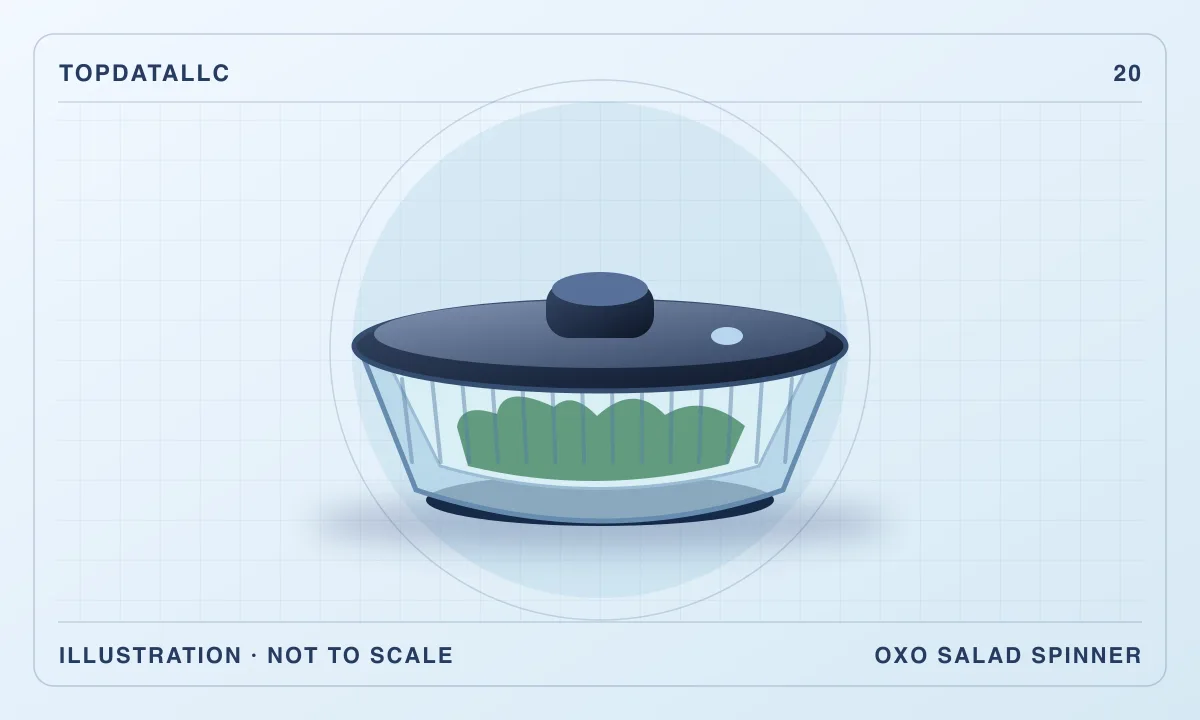
The large OXO Good Grips Salad Spinner is useful if you regularly wash enough greens that patting them dry becomes the slow part of making a salad. A push pump turns the basket inside a clear bowl. A separate brake stops it so you can empty the collected water or unload the greens. The big purchase question is whether you will use that basket often enough to give a wide bowl permanent space in your kitchen.
This review covers the large clear-bowl version linked in the US product panel. OXO lists a 6.22-quart outer bowl and a 4.95-quart basket. Those figures describe different pieces. Use the smaller basket figure to understand what can go inside, and leave room around the greens so they can move. This assessment draws on OXO's specifications and the published evaluations from Epicurious and Food Network.
Decide what you need to dry at one time
Think about the salads you prepare most often. Loose lettuce from several heads, a small bundle of herbs and a handful of greens for lunch put different demands on a spinner. The larger OXO is easier to justify if you regularly dry enough lettuce to fill a good portion of the basket. For a handful of leaves or herbs, a small spinner or a clean towel may solve the same problem without taking up as much space.
Check the actual leaves as well as the nominal capacity. Large, rigid leaves take up space differently from chopped lettuce. If you want to keep leaves whole for wraps, check whether they fit comfortably without being folded tightly into the basket. If you prep loose greens for several servings, try dividing them into loads of similar volume. A single tightly packed batch can take longer if you have to unpack it and repeat the spin. The goal is a practical batch size with room for water to escape.
Consider where the food will go next. If the whole basket is going into a serving bowl at once, a large spinner can be efficient. If you only need enough for one plate now and will store the rest separately, a smaller spinner used twice may work just as well. Decide whether the large model saves a step you do routinely or merely gives you a larger option for the occasional meal.
Follow the water from the sink to the bowl
The basket is a colander as well as the rotating insert. OXO documents both uses. The US Food and Drug Administration recommends rinsing most produce under running water and following package instructions for produce labeled ready to eat. Use the appropriate washing guidance for what you bought. The spinner removes excess water after rinsing. Treat it as a preparation tool for texture and convenience.
Let the bulk of the rinse water drain before putting the basket in the outer bowl. Place the bowl on a stable counter, fit the lid properly and press the pump. Water thrown off the leaves collects below. Stop the basket with the brake before opening it. If there is enough water in the outer bowl to splash back or reach the basket, empty it and resume with a lighter load. This is easier if there is space beside the sink to lift the basket out without setting it in the collected water again.
How wet the greens feel depends on their shape and what you plan to do with them. Check between folded leaves and in the center of a batch. If you are about to dress a salad, removing more surface water can help avoid diluting the dressing. If you want to pick up herbs and chop them, check whether they cling together or to the board. Follow the item's storage guidance if you are preparing in advance. Dryness by feel gives you information about the preparation step, while storage and handling remain separate decisions.
Check whether the pump suits your counter
OXO uses a central push pump, a nonslip base and a separate brake button. Epicurious found the large OXO easy to spin and highlighted the pump and stability in its comparison. The useful feature in a real kitchen is that downward force can be easier to control than turning a side crank, provided you have a stable surface and enough height above the lid. Try the motion with an existing bowl on the counter and see whether you can press comfortably.
If you have a shallow counter under cabinets, check the space above the pump while it is in use. A position that fits the bowl with the pump locked down for storage may be too low for operating it. A crowded prep area can also leave nowhere to put the lid while you lift out the greens. Make room for the bowl, the lid and the next vessel before you begin. The unit is easier to use when it stays in one safe spot through the wet part of the job.
The brake gives you a deliberate way to stop the basket. That is useful when you want to check the leaves, pour off water or move on to the next batch. If you prefer a crank or a pull cord, compare the hand motion and the way you hold the bowl. A crank can suit someone who has horizontal clearance and likes that motion. A pump can be more comfortable where there is little side clearance but room to reach down from above.
See what the extra bowl and basket can replace
The clear bowl can serve salad once you have removed the basket, emptied the collected water and cleaned the bowl as needed. If it replaces a serving bowl you already use, the size may be easier to justify. Check whether you like the bowl's shape for tossing and serving. A big clear bowl can make it easy to see how much food is left, while another bowl may fit a narrow dinner table better.
The colander can help when the basket fits the food and your sink. A smaller handheld strainer is still convenient for a few herbs or ingredients that need more precise handling. A spinner earns its space when one tool replaces the separate rinse basket and drying setup for a job you do often. If you always reach for another colander and only use the outer bowl once in a while, the large model functions mostly as a dedicated dryer.
Think about how you will carry the food after spinning. For prep near a sink, lift the drained greens to a separate container and empty the bowl before carrying it. If the bowl doubles as the serving piece, choose an appropriate surface to set it down between steps. A layout that makes you carry several wet parts across the kitchen can erase some of the convenience of an easy pump.
Make storage and cleanup part of the decision
OXO's design lets you lock the pump down for storage. This reduces the height of the unit when you put it away, but the bowl still needs its full footprint. Measure the opening of the cupboard as well as the interior. A shelf that is wide enough at the back can have a narrow door opening or a hinge that catches a large bowl. Check how easily you can slide it out with other cookware in place. An everyday tool is easier to use when it does not live under a stack of other items.
Follow the instructions for cleaning the bowl, basket and lid. OXO lists dishwasher-safe care for the model. Check any part-specific directions on the version you receive and whether the pieces fit your machine. A broad basket can occupy much of a rack even if it can go in the dishwasher. If you often wash it by hand, choose a spot where the pieces can drain and dry completely before you nest them back together.
The lid deserves particular attention because it contains the pumping mechanism and is less open than the bowl. Check the manufacturer's method for separating or cleaning the lid components. Avoid forcing parts apart based on instructions for a different spinner. If you usually prepare food right before leaving the kitchen, think about where the cleaned parts can stay until they are dry. The cleanup time includes space and handling, even when the actual spinning is quick.
Give herbs and broad leaves different treatment
If you frequently dry delicate herbs, check how they behave in a loosely filled basket. Small stems or leaves can settle against the slots. Starting with a modest load and checking before more pumping can help you decide whether the spinner is useful for those particular herbs. For a few sprigs that only need surface moisture removed, a clean towel can be easier to manage and leaves less equipment to wash.
A wide lettuce leaf or a mixed batch can hold water where layers touch. Separate the pieces gently before loading them and use the brake to check the result. When the leaves are ready for the next step, stop. The aim is a practical texture for the dish. A basket that handles your usual ingredients conveniently matters more than how long it can keep spinning.
Decide whether it helps when several people prep together
A spinner can make a useful dividing point between two tasks. One person rinses and drains the greens while someone else sets out the serving bowl and prepares the dressing. Keep a designated place for the lid so it stays clear of the wet sink and can go back on easily. A second batch can wait in a separate colander if necessary. If the counter is too crowded to lift the basket comfortably, split the work by time instead. A smaller spinner that you can move without rearranging the counter may be easier to use when several people cook in the same space.
Compare the simpler choices against your routine
A smaller spinner can handle an individual salad, a modest batch of greens or herbs while taking up less room. A colander followed by a clean towel can work for someone who only occasionally needs to dry produce. A manual crank model is another reasonable option if its movement is easier for you or if the bowl shape fits a cupboard better. Compare how much produce you actually handle in one session and how much work the current method causes.
For a big household, the large OXO is useful if it cuts down the number of loads you handle and the storage is easy. For a small kitchen, picture whether you can use the bowl and basket for enough different jobs to offset their footprint. If your meals are usually prepared from a small quantity of greens, a broad bowl with a large lid can be a poor use of the cupboard even when it spins well.
The purchase comes down to one typical meal. Check the amount of greens you prepare, where you can rinse and drain them, and where the parts will dry and be stored. Choose the large OXO if that process calls for a wide basket, an easy downward pump and a bowl you have room to keep. If you would only use the large capacity occasionally, choose the smaller option around the work you actually do.