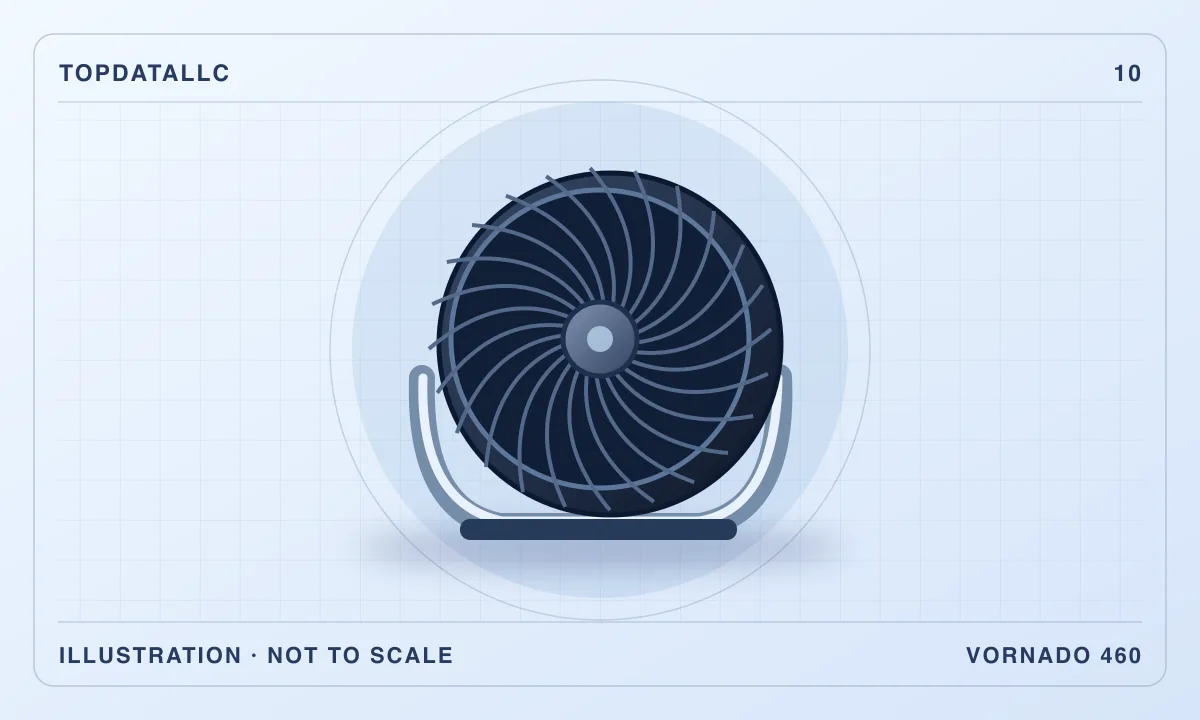
The Vornado 460 is a compact air circulator for a room with somewhere to send a steady stream of air. Its head tilts manually and stays aimed where you set it. That makes the placement decision more important than it is with a fan that sweeps across several seats. If you want to move air along a clear path in a small room, the 460 is worth considering. If you mostly want a soft breeze that periodically reaches different people, start with an oscillating model.
This review covers the black US 460, model CR1-0253-06. Vornado specifies three speeds and an adjustable tilt. The assessment draws on Vornado's manual and model page, the electrical specifications for the exact model and a published comparison of manufacturer specifications. No measured airflow or sound results are claimed here. The advice about room layouts is a way to evaluate the fit of the fan in your own space.
Decide where the air should go
Imagine a small office where a desk occupies one wall, the door is near a corner and a tall shelf divides the rest of the room. A fan aimed from behind the shelf may produce plenty of movement immediately in front of it while doing little for the desk. Moving the fan to a clear spot or tilting it over a low obstruction may do more for that room than turning it up. Before choosing a fan, stand where it might sit and trace a line from the grille to the part of the room where you want the air to move.
Vornado's use guide describes directing the airflow across a room or toward a wall or ceiling for circulation. Start with an indirect angle when the purpose is general movement around the room. Aim toward open space above furniture and sit where you normally work or relax. Change one thing at a time. First try another angle at the same speed. If a different angle makes no useful change, try another safe position. Use more speed once you have a reasonable path.
A personal breeze calls for a different setup. Aim toward one seat at a modest setting and give yourself enough distance that the airflow feels comfortable. On a desk with loose papers or a microphone, check whether the stream passes directly over either one. Tilting past the seat may reduce that interference. A compact fan on a lower surface to the side of the chair may also be easier to live with than one that takes up the working part of the desk.
Work with fixed direction instead of waiting for a sweep
The 460 has a tilting head that holds a chosen direction. The exact model's specification lists no oscillation. You can aim it upward or reposition the base to change the horizontal direction. That is useful when you already have a target, such as the open part of a room or an unobstructed stretch between pieces of furniture. If people move frequently between seats, one direction may suit some of them better than others.
Picture two people on opposite ends of a sofa. Direct aim toward one person can leave the other with less noticeable airflow. An upward angle that spreads movement indirectly may be more comfortable for both, depending on the room. An oscillating fan becomes a sensible alternative if you specifically want each person to feel the breeze as it passes. Try to separate that preference from the question of how much room the fan occupies. Those are different purchase decisions.
The direction you choose also affects the comfort of activities nearby. A continuous stream across the same spot can be distracting if you are reading, recording audio or working with light materials. In a bedroom, aim above or away from the bed if a direct stream is uncomfortable overnight. Try the placement while awake first and confirm that the switch is accessible from where you will get up to use it. The small housing helps with placement, but the unit still needs a stable surface with clear space for airflow.
Look at where a small fan can safely sit
Check the proposed surface with the head tilted as you expect to use it. Leave enough room behind the fan for its intake and cord and keep the discharge clear. A deep shelf may look like a convenient place for a small fan, but side panels, a wall at the back and objects immediately in front of it can leave little open space. Vornado's safety instructions call for keeping openings clear. The better spot is a stable surface with room around the fan and an unobstructed route for the air.
A low position can work if the path is clear. If the fan is aimed through chair legs or straight into a sofa, try a sturdy surface that gives it a clearer line. Set it back from the edge and confirm that reaching the controls will not make you pull it forward. Plan the power cord route before settling on a spot. An outlet across a walkway can make an otherwise suitable corner impractical. Leave the cord where it will not be pinched by furniture or placed where people pass.
Grainger lists the black US model as a 120 V AC appliance. Confirm the label, plug and local supply if you are outside the United States. A plug adapter changes the physical connection and may leave the electrical supply unchanged. Choose a version rated for the supply where you intend to use it. Follow Vornado's manual for the electrical and placement limits of the unit you receive.
Treat the three speeds as three practical settings
Low is the first setting to try when the fan is close to you or you work in a quiet room. Adjust its position before deciding that you need the next step. For a longer path past furniture, start with a clear aim and see whether the middle setting gives you a useful change at your seat. A higher setting may make sense for a short period when you want stronger air movement and the sound is less important.
Sound is a room-specific judgment. In a room with hard surfaces or a tabletop that vibrates, the same fan can be more conspicuous than it is in a furnished room. People also differ in how much they notice motor sound, airflow noise and intermittent background sounds. Listen from your normal working or sleeping position. If you use a microphone, record a brief sample with the fan off and on. You can then compare what it sounds like to someone on a call. A general review cannot set a useful sound threshold for your particular desk or room.
The three settings give you a simple manual choice. If you want finer speed adjustment, a timer or a remote, put those requirements on the shortlist before looking at compactness or brand. Consider where you will reach for the control with the fan in place. A location that is fine for an occasional adjustment may become inconvenient if you change the speed repeatedly through the day.
Understand what circulation can accomplish
The 460 moves air already in the room. A breeze can make the space feel more comfortable to someone in its path. A circulator can also help redistribute air where one part of a room feels still while another has a source of cooled or heated air. It has no refrigeration system. If the whole room is hot and stuffy, air movement alone leaves the underlying temperature or ventilation problem to be addressed separately.
If you use air conditioning, compare two positions while the system is operating normally. One might send air across the open part of the room. Another might send it upward above nearby furniture. Sit in the places where comfort matters and see which path is useful without putting the fan directly in front of a vent. Make that comparison at the same speed. This helps you judge the placement itself before asking a higher setting to compensate for a poor path.
Keep expectations modest across doorways and around corners. An open layout and a direct path are easier to work with than two rooms separated by a narrow opening or a hallway bend. If the intended route depends on air reaching several separate spaces, a larger fan in the same spot can still face the same obstruction. Consider a fan in the room where you need it most, or a different setup designed for that specific layout.
Make maintenance part of the placement decision
A compact fan close to the floor can be convenient, but the area around the intake may collect lint and dust. Put the unit somewhere you can see and reach the grille to clean it. Disconnect power and follow the model's cleaning instructions. The X60 series manual covers several models, so use the directions for the 460 when the instructions distinguish them. Keep the manual available if you plan to remove a part for cleaning.
If you move the fan between rooms, note the surface and cord route in each one. A unit that fits one corner neatly might need a different angle or position elsewhere. Store it where you can bring it out without catching the cord on other objects. Check the housing and cord before putting it back into service. These details matter more if you expect to use the fan in several locations than if it will stay in one spot for the season.
Compare it with the fan you would use instead
For one person at a desk, consider a small directional fan such as the Honeywell HT-900 and compare where each model would sit. If the only goal is airflow at one seat, the footprint, controls and lowest comfortable setting deserve more weight than any claim about moving air around a room. If you want the breeze to sweep across a group, compare an oscillating fan and check its range of movement against your seating arrangement.
For a larger room, Vornado's 630 is a separate model to consider. Check how much space it takes up and compare the two models' documented features. A larger unit only makes sense if you can place it with a useful air path and if it suits the sound and airflow you want. For a narrow bedroom or an office full of furniture, trying a clearer position first can be more informative than buying by room size alone.
Picture reaching the fan when the room is dark. A place that keeps it out of the way during the day can make the controls awkward to reach after a light is switched off. Leave a clear approach to the fan and avoid a location that requires reaching over a bedside drink, a stack of books or a cable. If you routinely want to change the setting without getting out of bed, compare models that explicitly provide remote control.
The 460 is strongest when you can name a safe spot for it, identify where you want the air to travel and picture leaving it aimed there. Think through a typical day before ordering. If you need circulation at the desk in the morning, a direct breeze at the sofa later and quiet operation near the bed at night, decide which job matters most and whether you can use the same manual controls and placement for each one. The right choice is the one whose everyday setup you can actually live with.