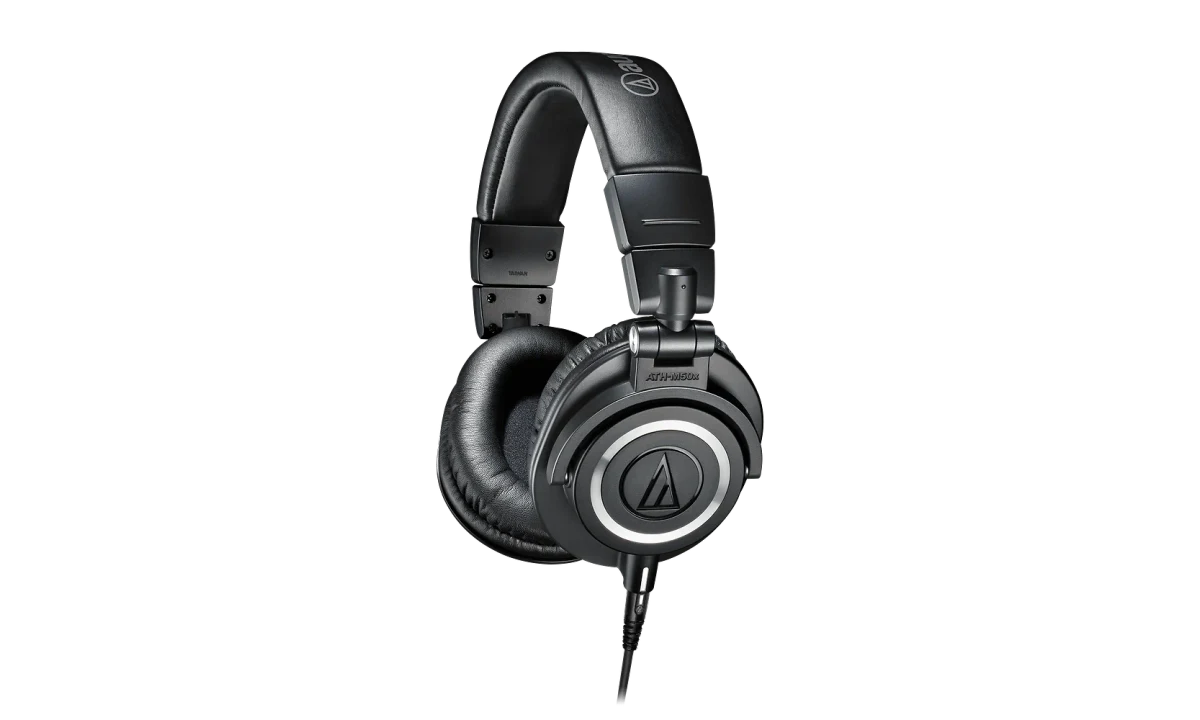
The Audio-Technica ATH-M50x is a wired headphone for people who want one pair to move between a desk, an audio interface and ordinary listening. Its folding construction and interchangeable cables make that flexibility tangible. The compromise is equally tangible: you get neither wireless convenience nor an integrated microphone, and a studio label does not make its sound a universal reference.
This evaluation combines Audio-Technica’s US specifications with SoundGuys’ independent review. It concerns the original black, wired ATH-M50x. The Bluetooth models, microphone-equipped StreamSet versions and special finishes are different purchases. Identifying the right model matters more than choosing whichever listing has the most familiar photograph or the broadest set of promotional descriptions.
Why the original wired version still has a role
A passive analog headphone has a useful kind of independence. There is no headphone battery to age, no pairing menu and no wireless operating mode to select. Provided the playback device has a suitable headphone output, the connection is straightforward. That can be appealing when a headphone is a work tool rather than another device to manage.
The manufacturer specifies closed-back, dynamic construction. It also supplies several cable options, allowing the same headphones to be used relatively close to a portable source or farther from studio equipment. Those are practical benefits for someone whose listening location changes, even if every session remains wired.
That approach also has clear limits. A modern device with only a digital connection needs an appropriate audio adapter or interface. A physical plug converter is not the same thing as a digital-to-analog audio device. Check the output your computer or phone actually provides before treating the headphone’s standard plug as proof of universal compatibility.
Check the name, not just the family resemblance
Audio-Technica uses related naming across products, which makes it easy to buy the wrong category of device. This guide’s model is ATH-M50x in black. A listing containing additional Bluetooth or headset suffixes should be evaluated on its own specifications rather than assumed to be the same headphone with a bonus feature.
The standard package is useful in its own right. Audio-Technica lists a protective carrying pouch, a screw-on adapter and three detachable cables. A retailer bundle may add a hard case, cleaning cloth or other accessories, but those extras are not evidence that they come in the manufacturer’s ordinary package. Compare like with like when judging offers.
Also distinguish a supplied pouch from a rigid protective case. A soft pouch helps keep small accessories together and covers the headphones during storage, but it does not turn a crowded bag into a safe environment for folding hinges. If a rigid case matters to your travel routine, establish whether it is included or an additional purchase.
Three cables, three different desk problems
The official cable set includes a short 1.2-meter straight lead, a 3-meter straight lead and a coiled lead with a specified 1.2-to-3-meter range. Rather than treating that as an accessory count, think about where your headphone socket sits. A connection beside the keyboard presents a different routing problem from an interface on a shelf.
The short cable is the logical option when the source is nearby and extra cable would collect around a mouse or chair. The longer straight lead can reach equipment farther away, but it needs a clear route. A coiled cable takes up slack differently and can exert noticeable pull as it extends. Choose for the working arrangement, not the apparent sophistication of a coil.
Detach and connect cables according to the manufacturer’s instructions. The headphone-side fitting is not automatically interchangeable with every ordinary audio lead. Buying a generic replacement without checking the locking connection risks leaving you with a cable that looks suitable but does not seat properly. Replaceability is useful when compatible parts can actually be obtained.
What the specifications can and cannot establish
Audio-Technica lists 45-millimeter drivers, 38-ohm impedance and a headphone weight of 285 grams without the cable and connector. Those figures describe the product, but none establishes whether it is comfortable on your head or whether your particular computer output has enough clean level for the material you use.
The published frequency range also needs perspective. It does not describe how evenly the headphone reproduces every part of that range. Two products can quote similar bandwidths while sounding different because their frequency responses and fit differ. Avoid treating a wider-looking specification as an automatic improvement in audible quality.
For a working setup, the useful checks are more ordinary: a stable connection, sufficient usable output, no obvious distortion at your normal listening level, and a comfortable fit. If your source meets those needs, adding an amplifier solely to accompany a studio-branded headphone may not solve a problem you actually have.
The independent sound assessment
SoundGuys describes the ATH-M50x as combining studio-oriented and more general listening priorities. Its evaluation found a broadly enjoyable presentation, while noting that the deepest bass was less prominent than its preference target and that parts of the response were not perfectly even. That is a more useful interpretation than calling the headphone either completely neutral or simply bass-heavy.
The practical implication is to learn its presentation before using it to make important editing decisions. Familiar speech, familiar recordings and comparison with another playback system can help reveal what the headphone emphasizes or understates for you. No single review curve removes the effect of how the pads seal around your ears.
There is also no reason to regard a preferred sound as a moral judgment about listening taste. You may enjoy a different balance from a reviewer, especially if you mainly use spoken-word content or a particular musical style. Choose according to whether the headphone helps you understand and enjoy your own material, rather than whether it matches an online reputation.
Isolation: useful containment with realistic expectations
Closed earcups provide a different starting point from open headphones such as the Sennheiser HD 560S. They can be a more practical choice when playback should be less exposed to the room. That does not turn the ATH-M50x into an active noise-cancelling travel headphone, and its passive seal cannot be assumed to remove every surrounding sound.
Fit is particularly important around glasses, hair and the shape of your jaw. A gap can alter both perceived bass and how much external sound reaches you. Before judging a tonal problem, check the normal headband adjustment and whether the cushions sit consistently. Do not force a painful fit in pursuit of a supposedly ideal seal.
For microphone work, check actual sound leakage at your intended level and microphone position. Closed construction is helpful context, not a guarantee that a sensitive microphone cannot pick up playback. Our Elgato Wave microphone guides discuss the separate recording side of that arrangement; a headphone choice does not replace microphone placement or monitoring discipline.
Folding and swiveling are conveniences, not damage protection
The ATH-M50x earcups swivel through a manufacturer-specified 90 degrees and the headphones fold for storage. That can make it easier to put them into a bag or briefly monitor with an earcup moved aside. It does not mean every hinge should be pushed until it stops or that the folded headphones can support other equipment packed on top.
Consider how you will actually transport them. A dedicated compartment reduces the chance of cable plugs pressing into a laptop or the headband being trapped under a charger. Keep the adapter and the cable you are not using somewhere they will not scratch other objects or disappear into the bottom of a bag.
At a fixed desk, folding may offer little advantage. You might prefer a headphone that simply lives in a protected place beside the interface. In that case, prioritize fit, cable routing and ease of putting the headphones on over the compactness of their folded shape. The best feature is the one that solves a recurring inconvenience in your setup.
Calls and games require a separate conversation about microphones
The ordinary ATH-M50x is not a headset with an integrated voice microphone. If your work involves calls, establish whether you will use a laptop microphone, USB microphone or interface-based microphone. Select the intended input in your meeting application instead of assuming that connecting headphones also changes how your voice is captured.
For games, the analog connection can be convenient with an appropriate controller or computer output, but a matching socket alone does not guarantee that every platform offers the same microphone arrangement. A separate microphone connection and any required adapter need to be planned together. Buying the headphone first and solving voice chat later can make the overall setup less compact than expected.
A conventional gaming headset is worth comparing if simple voice communication matters more than cable choice or separate recording equipment. Conversely, someone who already owns a microphone may appreciate keeping the listening and recording devices independent. The ATH-M50x suits that modular arrangement better than it suits a requirement for everything to work through a built-in boom mic.
Meaningful alternatives
The AKG K371 is a useful closed-headphone comparison if your priorities are fit, folding and a different sound presentation. Both have detachable cables, but their connectors, construction and wearing feel differ. Compare those details directly instead of treating similar accessory lists as evidence that either will work equally well for you.
If your listening space is private and quiet, the Sennheiser HD 560S represents a different decision: open construction and a desk-focused listening arrangement. It gives up the closed design’s practical containment. That trade is more important than trying to declare one universally superior across recording, commuting and music listening.
A wireless noise-cancelling headphone answers another problem again. It may be more convenient for movement or travel, but introduces charging and electronic features. The useful exercise is to identify which inconvenience dominates your day. The M50x’s cable flexibility does not compensate for a need to walk around a room without a wire attached.
Pads and service should enter the calculation
Audio-Technica’s US page links service parts alongside the headphone. Check the actual replacement options rather than assuming every cushion sold for the general M-Series is equivalent. Cushion thickness, material and opening affect how a headphone sits, so an aftermarket change can alter your listening reference as well as comfort.
If you depend on the headphones for regular work, keep a note of the cable and pad versions you use. When something changes, reassess familiar material before assuming a recording or playback device has developed a problem. That modest maintenance habit is more useful than an unsupported claim that any particular pair will last a fixed number of years.
Is it worth buying for your setup?
The ATH-M50x earns consideration when you want a familiar analog connection, a closed design and a useful choice of included cables in a headphone that folds. Its strengths are especially relevant when you already have suitable playback and microphone equipment. It is less compelling if the purchase requires several unplanned adapters and accessories before it meets your main need.
Before ordering, check the exact wired model and finish, standard accessories, seller, service options and return conditions. Allow enough time to assess comfort with your own glasses and usual working posture. The headphone’s published mass cannot predict whether a particular pressure point will annoy you after a longer session.
Our conclusion is conditional: buy it as a flexible wired listening tool, not as a guarantee of perfect mix translation or a replacement for every kind of headset. If its cable arrangements and closed fit suit your routine, there is a clear practical reason to choose it. If wireless freedom, cancellation or integrated calls are essential, start in a category designed to provide them.