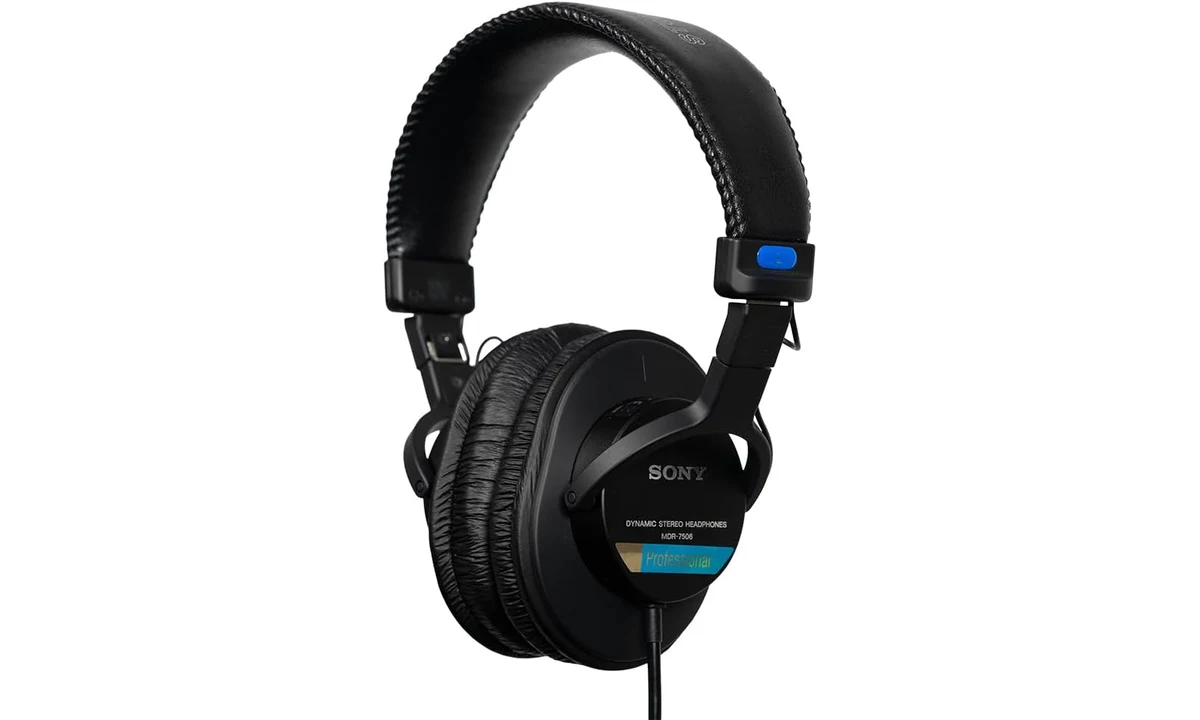
The Sony MDR-7506 makes the most sense when headphones are part of a seated recording or editing setup. It offers a conventional wired connection, folding construction and a close-fitting shape rather than wireless modes, cancellation or a built-in call microphone. The less convenient part is attached to it: a substantial coiled cable that cannot simply be unplugged from the earcup.
This research-based review uses Sony’s current US professional specification and SoundGuys’ independent assessment. We are evaluating the original black MDR-7506, not the newer MDR-M1 or a retailer bundle with extra equipment. Its established place in recording does not make it the right choice for every listener. Fit, cable routing and your existing audio connections are better starting points than its reputation alone.
Begin with the job beside your microphone
A monitoring headphone can serve several purposes: hearing a performer’s cue, checking a spoken recording, or listening for an unwanted sound during an edit. Those tasks are related, but they do not all demand the same listening judgment. Someone checking a vocal take may value a predictable connection and comfortable working position more than an elaborate feature set.
The MDR-7506 fits that practical category. Sony’s US professional document identifies a closed, dynamic design with analog connectivity. It is not an app-controlled listening system. If you already use an interface, mixer or instrument with a suitable headphone output, adding it may be straightforward. If your work happens entirely on a device without an analog socket, establish the required output adapter first.
That distinction also prevents an unnecessary purchase. A dedicated headphone does not improve the recording input by itself. If the problem is an incorrectly positioned microphone or a noisy room, different headphones may help you hear it without solving it. Identify the part of the working system that needs attention before buying another component.
Check the original model and the supplied accessories
The selected US listing is the single black MDR7506. Sony’s professional documentation specifies a protective pouch and an adapter between the common small headphone plug and a quarter-inch socket. Do not assume a retailer’s photograph of additional equipment means those extras belong to the standard package.
The pouch keeps the folded headphones and small accessories together. It does not provide the protection of a rigid case against a heavy charger or a laptop pressing into the earcups. If the headphones will travel regularly, consider the actual compartment in your bag and whether additional protection is needed. Folding changes the shape for packing; it does not make the joints indestructible.
Also avoid transferring features from other Sony professional models. A newer product with a similar studio role may have a different cable system, driver arrangement or fit. Compare exact product identities instead of treating professional branding as a uniform specification. The recommendation here concerns the original wired design and its particular compromises.
Why the fixed coiled cable matters so much
SoundGuys identifies the cable as both substantial and inconveniently heavy. Its coiled form can manage slack differently from a long straight lead, but it still needs support and a clear route. A desk with the output immediately beside a light laptop presents a different problem from a mixer positioned farther away.
Before buying, imagine ordinary movements at your workspace. Will the cable cross the keyboard, hang beside a chair wheel or pull against a small adapter? Is there somewhere for its weight to rest without tension on the plug? Those details can determine whether a sturdy-looking lead feels useful or repeatedly gets in the way.
The cable is permanently attached. Damage therefore has different consequences from a failed detachable lead that can be replaced with a compatible spare. Check service options before depending on the headphones for a recurring task. Do not interpret repairability as permission to open the housing or attempt soldering without appropriate skills and guidance.
For someone who works at one stable station, careful routing may make the cable a reasonable compromise. For someone moving frequently between a handheld device, a desk and a work bag, it may become the main reason to choose something else. This is a substantial design decision, not a minor inconvenience that sound quality automatically outweighs.
Slim earcups create a particular kind of fit
SoundGuys describes a slim profile with cushions that sit close to the ears. The reviewer found the fit less suitable with glasses, where pressure could become uncomfortable. That is a useful warning for buyers who assume every over-ear headphone leaves generous space around the ear.
Try the headphones with the glasses and posture you normally use. Look down at a keyboard and turn toward equipment beside you. Check whether the earcups remain comfortable and whether the cable encourages you to hold your head differently. An initially secure feeling can become a pressure point during a realistic editing session.
There is no useful universal comfort promise here. A relatively compact housing may suit one person and sit awkwardly on another. A favorable review should encourage an informed trial rather than override a consistent uncomfortable fit. A workable return arrangement is particularly valuable when you cannot assess the shape before ordering.
The specification is context, not a performance score
Sony’s current US professional sheet lists 40-millimeter drivers and a nominal impedance of 63 ohms. These identify the product’s documented electrical and physical design. Neither tells you how comfortable the pads are, how every frequency is balanced or whether a particular output provides enough clean level for your material.
The US professional document is the reference used here because regional product databases can present inconsistent figures. Check the documentation supplied for your actual unit and source equipment when compatibility matters. Do not select an amplifier merely because a headphone falls above an arbitrary impedance threshold, or assume a matching plug proves that every output behaves identically.
Begin with a suitable output you already own. If it provides usable clean playback at an ordinary listening level, another box may not address a real limitation. If it does not, investigate the source and connection carefully. A passive plug-size adapter does not convert a digital port into analog audio or add output power.
What the independent sound evidence contributes
SoundGuys considers the MDR-7506 useful for audio production, but its assessment also describes treble emphasis and departures from its reference target. That supports treating it as a monitoring tool to learn, rather than claiming completely neutral reproduction. The review’s useful listening observations do not become our own physical testing.
For a buyer, the practical question is whether the presentation makes your familiar material understandable without becoming tiring. Compare speech and recordings you know at a comfortable level. Notice whether you repeatedly compensate for one characteristic in every edit. That pattern may tell you more about your listening reference than about each individual recording.
Avoid buying a headphone solely because its sound is described as revealing. A presentation that draws attention to a particular region can make some details easier to notice while influencing tonal decisions elsewhere. Important work benefits from sensible comparison on another known playback arrangement, rather than assuming one familiar headphone establishes the final answer for every audience.
Closed does not mean a silent room
The closed earcups offer a different working arrangement from an open headphone, but the MDR-7506 has no active cancellation system. SoundGuys’ assessment notes limited suppression of lower-frequency environmental noise. It would be a mistake to buy it primarily as a way to erase a train, ventilation system or busy shared office.
During recording, check playback spill with the actual microphone position and listening level. A closed design is a useful starting point, not a promise that a sensitive microphone cannot hear anything escaping from the headphones. A short rehearsal can reveal a problem before a longer recording becomes difficult to use.
If the main requirement is privacy or isolation in a noisy environment, evaluate products specifically for that requirement. Increasing playback to compete with surrounding noise does not change the design. Equally, someone working in a quiet room should not assume active electronics are necessary merely because they are common in more general-purpose headphones.
Calls require their own input plan
The standard MDR-7506 does not include a voice microphone. Connecting it to a computer can change what you hear while leaving the computer’s built-in microphone as the active input. Check both settings in your calling or recording application, especially after switching between a dock, interface and direct connection.
A separate USB or interface-based microphone can make that arrangement flexible. It also adds another device to position and configure. Our workspace microphone coverage addresses that separate choice. Do not buy an analog headphone expecting its plug-size adapter to provide a microphone channel that the headphone itself does not have.
For frequent meetings while walking around, a conventional wireless headset may be a better match. For a fixed recording station where you already have an input device, keeping listening and capture separate can be entirely sensible. The right choice follows the routine you repeat, rather than a general assumption that a studio headphone must be better for every form of communication.
Pads, service and consistency over time
SoundGuys notes the design’s repair options and replaceable components, while distinguishing cable repairs from simple accessory changes. Before purchase, check current model-specific parts and the service route available where you live. The existence of repair instructions somewhere online does not establish warranty coverage, local stock or suitability for an inexperienced owner.
Cushions also form part of the listening arrangement. A replacement with a different shape or material can change the seal and how close the ear sits to the driver. If you rely on a familiar reference, reassess ordinary material after a pad change instead of assuming any difference must come from the recording or source.
Store the headphones where the lead is not trapped and the cushions are not continually compressed by other equipment. These are practical ownership considerations, not evidence for a predicted service life. A long-established product name does not guarantee that an individual unit will survive a fixed number of years or arbitrary treatment.
Alternatives should answer a specific objection
If the fixed cable is the main concern, compare the Audio-Technica ATH-M50x and AKG K371. Both offer detachable leads, but their connectors, pad shapes and listening presentations differ. Accessory flexibility is a clear reason to investigate them; it does not settle which one will feel or sound right to you.
The classic beyerdynamic DT 770 PRO provides another closed monitoring option, with its own cushion arrangement and bulky shape. It also retains a fixed lead, so it does not solve that objection. Compare it for the fit and working setup it offers, rather than treating a different brand as an automatic solution to every limitation.
An open headphone such as the Sennheiser HD 560S is relevant only if the room permits sound leakage and you do not need the same containment. That changes the category decision. It is a useful quiet-room alternative, but an unsuitable substitute where the main task is monitoring beside a microphone or keeping playback private from someone nearby.
Our buying recommendation
Consider the MDR-7506 for a stable wired recording or editing desk when its close fit suits you, your source already provides an appropriate output, and you accept the attached coiled cable. Its practical appeal is a simple working arrangement with service options to investigate, supported by independent evidence about both strengths and limitations.
Pass if integrated calls, cordless movement, strong cancellation or quick cable replacement are essential. Confirm the exact single-unit package, seller, return conditions and applicable support before ordering. The best reason to buy this Sony is that its specific design fits your work; its reputation should inform that decision without making it for you.