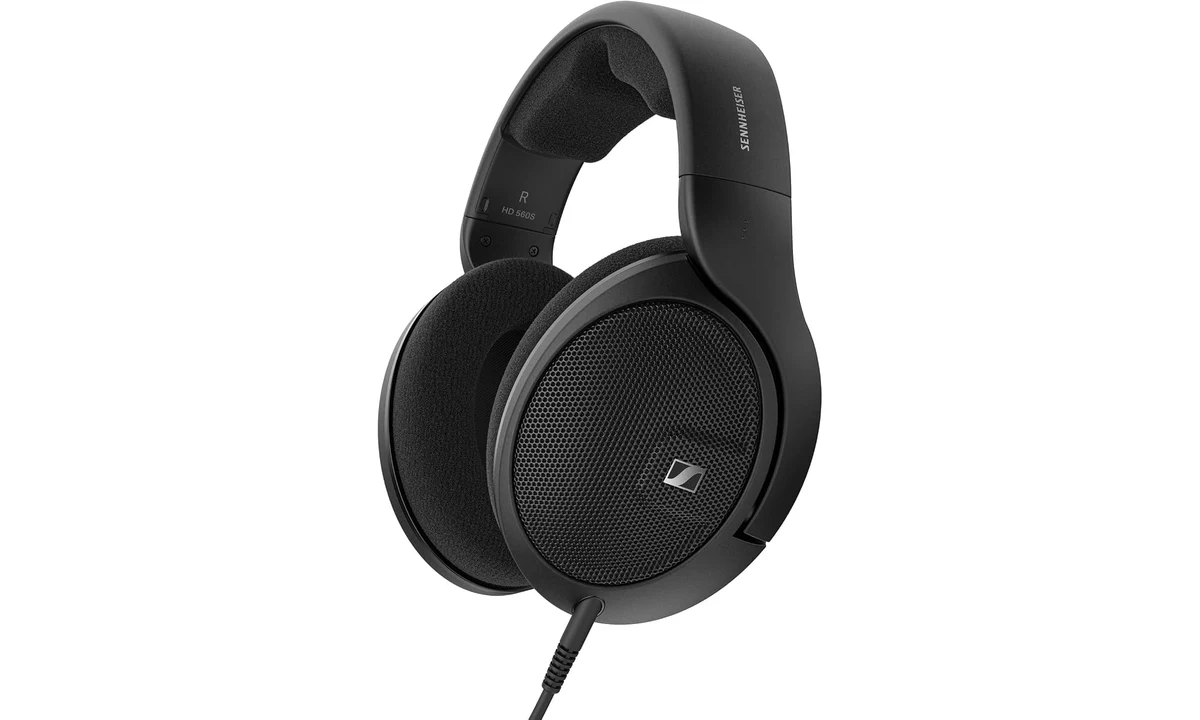
The Sennheiser HD 560S makes sense when you want to listen closely at a quiet desk and do not need your headphones to shut out the room. Its open earcups and wired connection are deliberate choices, with consequences for everyone nearby. They can be useful for music, editing and games, but this is a poor substitute for a travel headset or an all-purpose meeting accessory.
This research review weighs Sennheiser’s current specifications against SoundGuys’ independent evaluation. The useful question is whether the HD 560S fits your room, source equipment and listening habits. A reputation for reference sound cannot answer those practical questions for you, and an impressive frequency-range specification does not guarantee that its tonal balance will suit your taste.
A headphone for a particular place
The first decision is where you will use it. Sennheiser identifies the HD 560S as an open, dynamic, over-ear headphone. Sound passes through the outer earcup rather than being contained behind a solid shell. That is central to the design, not a missing feature that an app can switch on later.
For someone with a separate home office, the arrangement can be appealing. You can listen without putting a speaker on the desk, while still remaining aware of ordinary household activity. In a shared room, however, the same openness makes it difficult to keep listening private. Your audio can escape, and surrounding conversation can remain audible. Plan around both directions of sound.
Do not buy it expecting noise cancellation. There is no powered cancellation mode, wireless receiver or battery to charge. That simplicity removes charging routines, but it also removes the convenience of moving between rooms untethered. Whether that is a welcome trade depends on your actual workday rather than the word audiophile on a listing.
What the current specification tells you
Sennheiser’s current page lists a 120-ohm transducer, a detachable cable and standard analog connectivity. Its current package description specifies a 1.8-meter cable with a 3.5-millimeter plug and a 6.3-millimeter adapter. Those details deserve attention because older reviews and retailer descriptions can refer to earlier cable arrangements. Confirm the contents of the exact box offered by your seller.
The published frequency range is a statement of manufacturer specifications, not a map of how loud every frequency sounds. It cannot demonstrate tonal neutrality by itself. Nor should the presence of an adapter be mistaken for an amplifier: the adapter changes the physical connection, not the power available from your source.
There is also no built-in microphone in the standard headphone package. For meetings, streaming or multiplayer voice chat, allow for a separate microphone and suitable input. If you want everything on one cable, a dedicated headset may be a more straightforward purchase than assembling several accessories around a music headphone.
What independent listening adds
SoundGuys’ review supports the HD 560S as a credible entry into more attentive wired listening. Its reviewer particularly appreciated comfort and the removable cable, while noting the predominantly plastic construction and the inconvenience of the cable and connection arrangement in the tested package. Those observations add useful context without becoming a promise about every wearer.
The distinction between good sound and a universally preferred sound matters. Listeners accustomed to an emphatic bass presentation may react differently from listeners who want to hear vocal balance or compare recordings. Treat a reviewer’s recommendation as a reason to audition, rather than evidence that your existing preferences are incorrect.
If an exchange or return is possible, use familiar material at an ordinary listening level. Listen for whether voices sound convincing, whether percussion becomes tiring and whether you can follow quieter instruments without constantly adjusting volume. These are more useful personal checks than searching for a dramatic transformation in every song.
The connection question before buying an amplifier
An impedance number alone does not tell you whether a particular laptop, interface or adapter will provide the result you need. Output capability, the recording itself and your chosen listening level all matter. Check the source equipment you already own before adding a dedicated headphone amplifier to the shopping basket.
A sensible sequence is to verify the physical socket, connect the headphones correctly, and assess whether the source provides sufficient clean output for normal use. A USB-only computer needs a suitable analog audio output device. A passive plug adapter cannot create that output. Equally, having a headphone jack does not establish that every source behaves identically.
If you already use an audio interface for a microphone, its headphone output is the logical starting point. Avoid buying another box solely because an online comment says all higher-impedance headphones require one. Conversely, if your existing output audibly distorts or cannot provide usable level, investigate the source rather than assuming the headphone is faulty.
Comfort is about fit as well as padding
Sennheiser describes velour earpads and an around-ear shape. The current manufacturer page lists 280 grams, although weight figures in other references may use different measurement conventions. The better purchasing question is whether the headband adjustment and earcup opening work for your head and ears during a realistic session.
Fabric-covered pads can feel different from the smooth pads found on many closed headphones. That difference may influence heat, friction and how the headphones sit around glasses. None of those effects is identical for every person. A comfortable reviewer experience is useful evidence, but it cannot guarantee pressure-free use for a whole working day.
When trying the HD 560S, check both a relaxed listening position and your usual working posture. Looking down at a keyboard, moving toward a microphone or leaning back can reveal cable tension and fit issues that are easy to miss while sitting perfectly upright. Do not stretch or modify the headband to solve a fit problem without manufacturer guidance.
The cable is replaceable, but not generic at both ends
SoundGuys notes the locking connection at the earcup. That makes the removable cable more useful for maintenance than a permanently attached lead, but it does not mean any spare cable with a vaguely similar plug will fit correctly. Check the headphone-side connector and locking arrangement before ordering a replacement.
Route the lead so it does not pull against the earcup when your chair moves. A cable crossing a keyboard tray or hanging across the path to a desk can turn an otherwise comfortable setup into an annoyance. The current included length should be considered alongside the position of your source, not simply judged as long or short in isolation.
The adapter is another small item worth giving a fixed storage place. If you switch between an interface and a computer adapter, repeatedly hunting for the correct fitting can become more frustrating than the headphones themselves. A simple cable route and a consistent source often provide a better daily experience than a more elaborate collection of audio accessories.
Editing and gaming: useful, with boundaries
For audio editing, the HD 560S can provide a consistent personal listening reference once you learn how familiar material sounds through it. That is different from claiming it will automatically produce mixes that translate perfectly to every speaker. A headphone does not remove the need to check work on other playback systems or understand the recording environment.
For games, an analog connection avoids dependence on a headphone battery or wireless pairing. It does not supply a microphone or guarantee a competitive advantage. Positional cues depend on the game, its audio settings, your hearing and the fit of the headphones. Be cautious about universal promises that a particular pair makes opponents easier to locate.
Open construction is especially important beside a sensitive desktop microphone. Listen for whether your monitoring audio enters the recording at your actual working levels. If it does, changing the microphone position or monitoring arrangement may help, but a closed headphone is often the simpler category to consider when keeping playback out of a recording is a priority.
Planning a separate microphone setup
Headphone output and microphone input are separate requirements. Connecting the HD 560S to a computer does not tell a meeting application which microphone to use. If you add a desktop microphone, check the selected input and output in the actual calling or recording application. Otherwise you can hear the other person clearly while the application continues using an unsuitable built-in microphone.
A USB microphone with a headphone-monitoring socket can offer a convenient place to connect, but verify that socket’s capabilities and how its monitoring controls work. Some setups let you hear your own voice together with computer playback; the balance is then a property of the microphone or interface, not a feature inside the HD 560S. Budget and desk space should reflect the complete arrangement. Readers assembling that kind of workspace can compare our USB microphone coverage before choosing several devices independently.
When a closed alternative is the better answer
If your room contains conversation, a television or other audible activity, the HD 560S asks you to tolerate that environment rather than remove it. Increasing volume to overpower the room is not a sensible substitute for choosing an appropriate headphone design. Start with a product suited to the space.
The Audio-Technica ATH-M50x and AKG K371 are alternative closed designs worth comparing for a shared desk or a recording setup. Their fit, cables and sound presentation differ, so they should not be treated as interchangeable solutions. The useful comparison is the practical trade between openness, containment, portability and how each sits on your head.
For travel or frequent calls, consider whether a wireless noise-cancelling headset better matches the task. That category adds charging and electronic features, but it may solve problems the HD 560S was never designed to address. Our Soundcore Q20i guide explains a different set of priorities rather than a directly equivalent audio product.
Ownership, maintenance and value
A removable lead and replaceable wear items can make long-term ownership more practical, provided the correct parts remain available. Check current service options before purchase instead of assuming that a familiar brand guarantees indefinite supply. Inspect replacement-pad compatibility carefully; a pad that physically attaches may still change fit and acoustic behavior.
Keep the headphones where the cable and earcups are protected from being crushed or pulled. Open grilles also deserve ordinary care around spills and dust. Follow the manufacturer’s cleaning instructions rather than introducing liquid into the earcups or taking the headphones apart for routine cleaning.
Value depends on how often the design solves a real problem. Someone who listens attentively at the same quiet desk each evening may make good use of a dedicated open headphone. Someone who mainly takes calls while walking around the house may find it an extra purchase that still leaves their main requirement unmet. Compare the complete usable setup, including any necessary output adapter or microphone.
The buying decision
Choose the HD 560S if you specifically want a wired open headphone for a quiet personal space, have a suitable source or a clear plan for one, and are willing to evaluate fit and tonal preference for yourself. Its appeal is the focused listening arrangement, supported by independent comfort and usability observations, rather than a long list of electronic features.
Pass if sound privacy, active noise cancellation, wireless movement or an integrated microphone matters most. Those are substantive mismatches, not small inconveniences to dismiss because the headphone has an enthusiastic following. Before ordering, verify the selected model, current cable package, seller and return terms. That leaves you judging a useful listening tool on the right criteria.