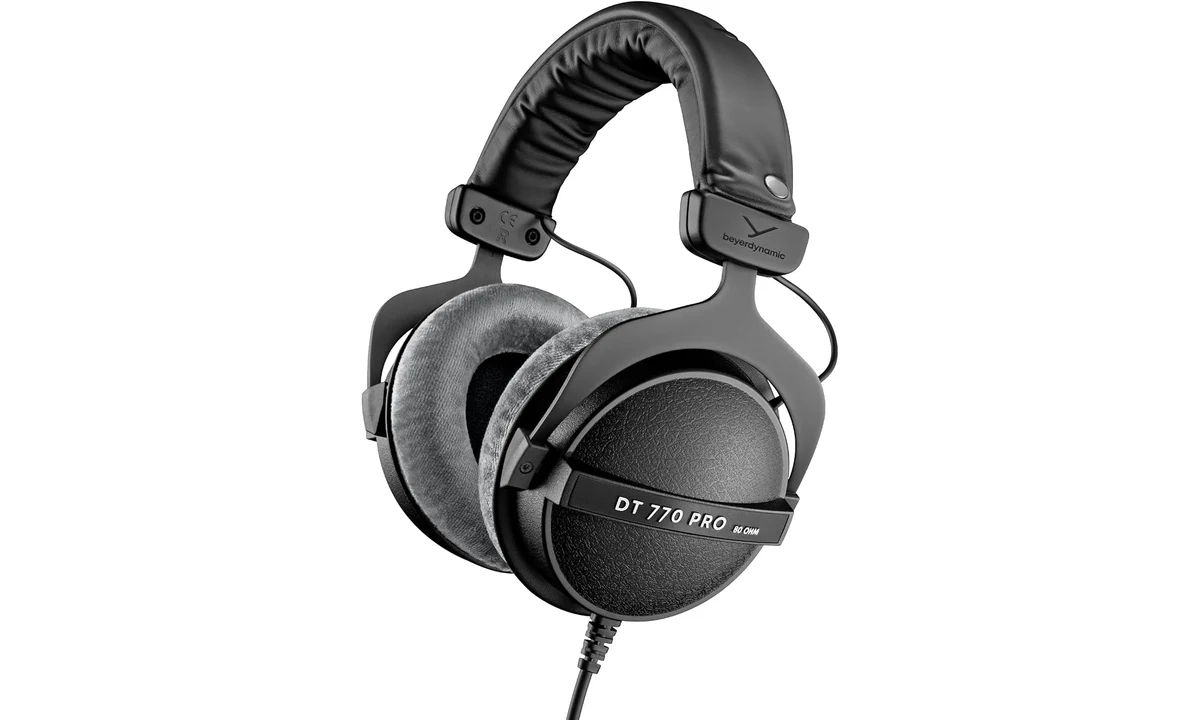
The beyerdynamic DT 770 PRO in its 80-ohm version is a closed, wired headphone built around a studio-style working arrangement. Its appeal is not a collection of smart features. It is the combination of a substantial headband, replaceable cushions and an analog connection that can remain part of a recording desk without needing to be charged or paired.
That makes it worth considering for recording, editing and seated listening, with important qualifications. The fixed cable and bulky shape are less attractive when you move between locations, and the 80-ohm label is not proof that every device will drive it equally well. This research review uses the current manufacturer page and SoundGuys’ independent assessment of the same impedance version.
Identify the classic 80-ohm model first
The exact model matters here. beyerdynamic lists this version as DT 770 PRO, 80 Ohms, article number 474746. It is separate from the other impedance options and from products whose names include PRO X. A closely related name or a photograph of familiar round earcups is not enough to establish the same construction or connection arrangement.
The manufacturer explicitly distinguishes classic DT models with fixed cables from PRO X models with detachable cables. That is a significant ownership difference. If a seller advertises an ordinary DT 770 PRO as having a detachable lead, stop and clarify which product is actually being supplied rather than treating the wording as a harmless variation.
The selected US retail listing identifies the 80-ohm version. Still check the variant selector immediately before ordering, because marketplace pages can group different versions together. The recommendation in this article should not be extended automatically to another impedance or a newer driver family. Different source requirements and features deserve their own assessment.
Start with the room and recording task
Closed earcups make the DT 770 PRO a more plausible starting point for recording beside a microphone than an open headphone. They help keep the listening arrangement more contained. The design does not provide active noise cancellation, however, and it should not be treated as a way to erase every sound in a busy room.
SoundGuys considers the 80-ohm model particularly relevant to creators who need a robust tracking headphone. Its reviewer also highlights comfort and replaceable pads, while identifying the long cable, size and limited portability as drawbacks. Those practical observations support a desk or studio role more clearly than a commuting role.
For voice recording, listen to a short test at the actual headphone level and microphone position you intend to use. If playback is audible in the microphone recording, address that arrangement before starting a longer session. A closed design reduces a particular problem; it does not remove the need to check monitoring spill in your own setup.
A fixed cable changes how you plan the desk
The current specification describes a straight cable with a 3.5-millimeter plug and a quarter-inch adapter. This is not the same cable arrangement as every other DT-series version. In particular, do not assume that a photograph or description of a coiled lead on a related product applies to this one.
With a permanently connected lead, routing matters. Keep the cable away from chair wheels and the edge of a moving keyboard tray. Leave enough slack for normal head movement without putting a loop across a walkway. A cable snag can transfer force directly to the headphones rather than merely disconnecting a replaceable lead at the earcup.
The fixed connection is a genuine compromise even for people who like the overall build. You cannot simply substitute a short lead for travel or swap a damaged cable in the same way as a plug-in cable. If easy cable replacement is central to your buying criteria, compare a model designed around that requirement instead of hoping the issue never arises.
The amplifier question needs a source-specific answer
The published impedance is 80 ohms. That number is useful for identifying the version but incomplete as a buying rule. The output capabilities of the source, the recording’s level and the amount of usable adjustment you need also matter. Avoid both extremes: assuming an amplifier is mandatory in every setup, or assuming every phone adapter is automatically sufficient.
If you already own an audio interface, begin by checking its headphone output specifications and intended headphone use. Try the headphones at a comfortable ordinary level with familiar material if your buying arrangement permits it. Listen for sufficient clean output rather than treating the position of a volume knob as a universal measure of performance.
A separate amplifier is most useful when it addresses an identified limitation. It adds another powered device, another connection and more space on the desk. Someone building a compact recording area should include those consequences in the total setup rather than comparing the headphone price in isolation. The best purchase may be the headphone that works sensibly with equipment you already have.
What the construction offers
beyerdynamic describes an adjustable padded headband, circumaural cushions and a closed operating principle. Its current page emphasizes replaceable parts and pads. SoundGuys’ assessment supports the impression of a durable, work-oriented design, but this is not a guarantee that the headphone can withstand arbitrary rough treatment or that every repair is suitable for an owner to perform.
The distinction between replaceable and user-serviceable is worth preserving. Cushions are one kind of maintenance task; a damaged fixed cable or internal component is another. Check service availability, parts compatibility and any warranty conditions before attempting a repair. A product’s repair options are more useful when there is a realistic route to using them.
The build also occupies space. These headphones are not a compact folding accessory that disappears into a small pocket. If they will live at the desk, identify a protected place for them between sessions. If they need to travel in a work bag, account for the earcups, headband and attached cable together, not just the size of the carrying pouch you hope to use.
The manufacturer’s current page gives a weight of 375 grams including the cable. That qualification matters when comparing it with headphones whose published mass excludes the lead and plug. A straight comparison of the headline numbers can exaggerate or hide a difference in what actually rests on your head. It also misses the effect of cable weight pulling from a socket below the desk. When evaluating comfort, consider how the whole assembly is supported rather than choosing whichever product has the lowest unqualified number in a marketplace table.
Velour pads and the realities of long sessions
The familiar gray velour cushions are part of the selected classic model’s appeal. SoundGuys liked their comfort, including their behavior around glasses compared with smoother cushion surfaces. That is useful independent experience, but head shape, glasses frames and personal sensitivity still determine how the headphone feels for you.
Try it with the equipment and posture you actually use. A microphone boom, glasses and the angle at which you look toward a screen can change where pressure falls. Check that the earcups surround your ears comfortably and that cable pull does not encourage you to tighten the headband unnecessarily.
Pads also change with use. When replacement becomes necessary, select the correct part for the model and reassess fit after fitting it. A different cushion material can alter the seal and listening balance. If you rely on a familiar monitoring reference, a pad change is a reason to listen carefully again, not to assume the underlying recording suddenly changed.
How to approach the sound without mythology
The manufacturer markets the DT 770 PRO for monitoring, but that wording should not be turned into a claim of perfectly flat response. SoundGuys’ independent review supports its usefulness and sound quality in a creator’s setup. Whether its presentation works for your listening priorities is still something to assess with familiar material.
For recording, monitoring can mean checking timing, hearing a vocal cue or noticing an unwanted sound during a take. For final tonal decisions, the demands can be different. Do not assume that a headphone useful while tracking becomes the only reference needed for editing, mixing or evaluating how a finished piece sounds elsewhere.
Compare speech and music you know rather than searching for a dramatic first impression. If a particular part of the presentation bothers you, establish whether that reaction persists with a comfortable fit and suitable source. An enthusiastic description of detail from another listener is not a reason to ignore discomfort or a tonal balance you consistently dislike.
Calls, games and a separate microphone
The standard DT 770 PRO does not supply a voice microphone. A computer may keep using its built-in input after you connect the headphones, so check the selected input in the calling application. Clear sound in your ears and clear sound for the other person are different parts of the system.
If you use a USB microphone, consider where its monitoring output sits and whether it can provide the headphone output you need. That can reduce the number of boxes on the desk, but it requires checking the microphone’s controls and specifications. The headphone itself does not manage the balance between your voice and computer playback.
For gaming, an appropriate analog output can make these headphones part of a capable setup, but there is no included wireless link or game-specific processing to configure inside them. Voice chat still needs an input device. Our gaming headset coverage is a useful comparison when an integrated microphone and simpler cabling matter more than a separate monitoring arrangement.
Compare the right alternatives
The Audio-Technica ATH-M50x addresses a different portability and maintenance preference with detachable cables and folding construction. If you regularly alternate between a nearby laptop and equipment farther away, that cable flexibility may be more valuable than the DT 770 PRO’s particular headband and cushion arrangement. Fit should decide the comparison alongside those features.
The AKG K371 is another closed alternative with detachable cables. Its shape and wearing feel differ, so a specifications-only comparison misses a large part of the decision. Neither should be selected simply because its driver diameter or published bandwidth looks more impressive on a retailer table.
For a quiet room where sound containment is unnecessary, an open headphone changes the decision again. The Sennheiser HD 560S guide explains why an open design can be appealing for personal listening and inconvenient around other people. That is a category choice, not a simple upgrade path from the DT 770 PRO.
Buying for years rather than for a specification badge
Before paying, confirm the classic 80-ohm version, article identity, plug arrangement, seller and service terms. Check the complete cost if your source needs an audio adapter or additional output device. Also check where you will store the headphones and whether the fixed cable suits the way you move around the desk.
The strongest case is a recurring seated task: recording, monitoring or listening at equipment that already provides an appropriate output. The substantial construction and replaceable cushions have a clear purpose in that context. The weaker case is someone trying to make it serve as a compact travel headphone, cordless meeting device and studio monitor at the same time.
Choose the DT 770 PRO 80-ohm model when its closed design, fit and service options suit a stable working setup and you accept the permanently attached cable. Look elsewhere when a detachable lead, folding portability, active cancellation or an integrated microphone is essential. Those limits should shape the purchase from the start, not become surprises after the box arrives.