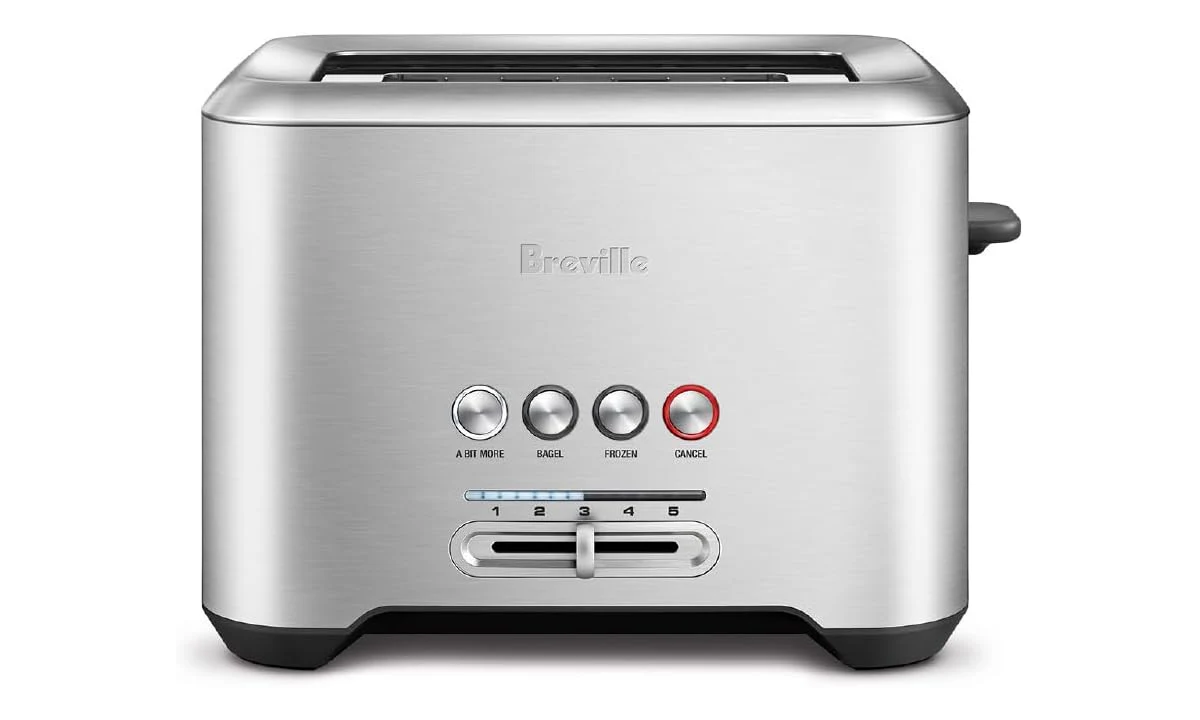
The Breville A Bit More BTA720XL is for someone who wants more control over a small batch of toast without moving to a toaster oven. Its useful ideas are simple: inspect the bread during a cycle and add a little more browning when the first result is too light. Those controls make more sense than treating a numbered setting as an exact promise of colour across every loaf.
This review covers the US two-slice brushed-stainless model, not the larger BTA730 or Breville’s motorized Smart Toaster. It draws on Breville’s current product information and manual, alongside RTINGS’ independent testing. We have not toasted bread with this unit ourselves. Our recommendation centers on its documented controls, batch size and ownership requirements, with independent observations identified as such rather than presented as our own kitchen experience.
Decide whether two slices are enough
A two-slice toaster suits a modest breakfast better than a household expecting everyone’s toast at once. The question is not simply how often you eat toast, but how many slices need to be ready together. Repeated batches can leave the first serving waiting while the next one cooks. If that is your usual routine, compare a larger model before prioritizing a smaller footprint.
Conversely, a larger appliance is unnecessary when you usually prepare one serving and have limited counter space. Breville lists the BTA720 at 8.2 × 11.3 × 7.3 inches. Measure the intended location with space for normal operation, access and the power lead, following the manual’s placement instructions. Product dimensions alone do not establish a safe fit underneath a shelf or beside other kitchen equipment.
Think about storage as well as use. A toaster that must be moved out of a cupboard every morning creates a different routine from one that stays on a clear counter. You need to let it cool before storing it appropriately. If your kitchen only has a temporary working area, consider whether the available space and handling effort justify a dedicated appliance rather than using equipment you already own.
The manual lever is part of the design
The BTA720 uses a manual lever. Its Lift & Look feature lets you inspect progress without cancelling the cycle, while the high-lift arrangement helps bring smaller pieces within reach. These are useful controls for bread that does not behave consistently from slice to slice. They do not make the toaster a motorized model or eliminate the need to pay attention to what is in the slots.
Inspection is particularly helpful when changing loaves. A setting that works for one thickness or moisture level may produce a different result with another. Rather than assuming the number represents a universal browning standard, start conservatively and inspect as needed. This is practical control over a variable food, not a failure of the concept of a toaster setting.
Do not interpret high lift as permission to put any small piece into the appliance. Follow the manual’s guidance about suitable bread and handling. If something becomes stuck, stop and follow the safe procedure rather than reaching into a powered toaster with a utensil. A convenient lifting mechanism reduces awkward access; it does not remove the basic hazards of hot electrical equipment.
The lever also makes the ownership difference from a motorized Smart Toaster clear. If you specifically want powered lowering and lifting, this is not that product. If you prefer a direct manual action and want the inspection feature without choosing a more elaborate model, the BTA720’s arrangement may suit you. Confirm the model instead of assuming all Breville toasters share the same mechanism.
What A Bit More is useful for
The namesake control adds further browning when the initial result is not quite right. That is useful because toast often falls between a preferred result and the next full cycle. It provides an explicit way to extend the process rather than starting again and hoping to interrupt it quickly enough. It still requires judgement, especially with a loaf you have not used before.
Avoid treating the feature as a guarantee that every pale slice becomes evenly browned. Bread geometry, moisture and starting condition remain relevant. A slice with an uneven thickness can present different surfaces to the heating elements. Extra time cannot necessarily correct every physical difference in the bread. The useful promise is an additional control, rather than a perfect result from any item that fits inside.
There is also a distinction between a small adjustment and rescuing an unsuitable food. A conventional toaster is not the place to experiment with dripping toppings or filled pastries unless the manufacturer explicitly permits the item. The slots and controls are designed for appropriate toasting foods. Adding time does not make a risky or poorly fitting item suitable for the appliance.
Browning, frozen bread and bagels
The toaster provides a browning slider, LED progress indication, Frozen and Bagel functions, and Cancel. These controls address common variations without turning the appliance into a programmable oven. Use the manual to establish the correct function and orientation, especially for bagels. Single-sided heating behavior is only helpful when the cut face is positioned as the manufacturer intends.
Frozen bread introduces another variable. The relevant control is preferable to assuming a room-temperature setting will behave identically with a frozen slice. However, freezing method, thickness and accumulated ice can still affect results. Adjust within the manufacturer’s instructions rather than assigning a universal setting to every loaf. The aim is a repeatable routine for the bread you use, not a numerical recipe that ignores its condition.
The LED display indicates progress through the cycle. It should not be described as a measurement of the bread’s internal temperature or a sensor guaranteeing the desired shade. A progress indication can help coordinate breakfast, but it is not a reason to leave the appliance unattended or to assume the food has reached a particular condition without looking at the result.
Cancel is worth locating before the first use, rather than when something is already browning too far. Familiar controls are especially useful in a shared kitchen where different people change the setting. Leave the appliance in a sensible state after use and expect to check the slider when preparing a different type of bread. Shared settings are a common source of inconsistent toast.
Slot fit is more than the word wide
A wide slot can accommodate some thicker bread, but width does not establish that every long slice will fit. Measure the bread you actually buy if unusual loaf shapes are part of your routine. A slice that protrudes or needs forcing into position is a poor match. Cutting bread appropriately may be practical, but it changes the convenience calculation that led you to a dedicated toaster.
Bagels and artisan bread also differ in shape and density. The best buying check is whether your usual food can sit naturally in the appliance under the manual’s guidance. Do not base the purchase solely on a promotional picture of a particularly neat slice. If you regularly toast very large or irregular pieces, a suitable toaster oven may offer a more workable cooking space.
Small slices raise the opposite problem: access after cooking. High lift helps, but your ability to remove food safely remains important. A household using many different breads should evaluate both ends of the range rather than only the standard sandwich loaf. The appliance that suits your most common breakfast can still be inconvenient for the occasional item, and that tradeoff is worth acknowledging before buying.
What independent testing contributes
RTINGS found its tested sample capable of comparatively even results between the slots, while also noting relatively slow toasting and some dryness. Those observations are useful qualifications to a feature-led description. They do not establish an assured time or texture for every loaf, setting and unit. We have not copied a test result into a promise about your particular breakfast.
The practical implication is to consider texture alongside colour. More browning is not always better if the bread becomes drier than you prefer. Lift & Look and the additional-browning control give you ways to manage the process, but they do not remove the physical effect of further heating. If you like lightly toasted, soft-centered bread, begin cautiously when establishing your settings.
A review’s comparison can help narrow choices, but it cannot decide whether the result suits your taste. Use a return period sensibly with the bread you normally buy, following the appliance’s instructions. Evaluate the complete result from both slots and the convenience of the controls. A single attractive slice does not establish that the appliance fits the household’s whole routine.
Cleaning and the stainless finish
The front crumb tray makes routine access part of the design. Empty it as directed after the appliance has been unplugged and allowed to cool. Crumb maintenance is not merely cosmetic: accumulated debris is a reason to follow the manual’s care schedule rather than waiting until a visible problem develops. The removable tray does not mean the whole toaster can be immersed or cleaned like a pan.
A brushed-stainless exterior can suit a kitchen containing other metal appliances, but the finish does not make it maintenance-free. Use the maker’s cleaning guidance and suitable materials. Avoid assuming that aggressive cleaners appropriate for another appliance are suitable here. The relevant ownership question is whether you are willing to keep the tray and exterior clean in addition to making the toast.
Allow access at the front when planning its location. A toaster squeezed into a visually neat corner can become inconvenient if the tray cannot be removed without moving other equipment. The same applies to the lever and controls. A little accessible space often contributes more to everyday satisfaction than choosing a finish solely because it matches the kettle.
Check the package on arrival
Confirm the two-slice model and the regional electrical specification against your order before using it. Review the supplied setup instructions and keep the purchase record. Similar-looking product photographs can obscure a different size or regional version, while the model label resolves that uncertainty directly.
Alternatives and the buying verdict
A four-slice toaster is the more relevant comparison for regular family batches, while a toaster oven such as the Breville Mini Smart Oven already covered on TopDataLLC suits a broader set of cooking tasks. Those alternatives occupy and operate differently. Do not buy an oven only for features you will not use, or expect a slot toaster to handle foods that need an oven’s tray and enclosed cooking space.
A simpler two-slice model remains reasonable if you consistently use the same bread and seldom want additional controls. The BTA720’s value comes from using its inspection and adjustment features, not from the stainless finish alone. Compare the current price, warranty and seller terms against the functions you will use, without assuming a higher price guarantees a preferred texture.
Our verdict is a conditional recommendation for a smaller breakfast routine that benefits from checking and adjusting toast. Confirm the BTA720XL model, allow appropriate working space and accept that bread needs individual settings. It is less suitable for large simultaneous batches or as a substitute for a toaster oven. Buy it for useful control over an ordinary task, with realistic expectations about speed, fit and cleaning.