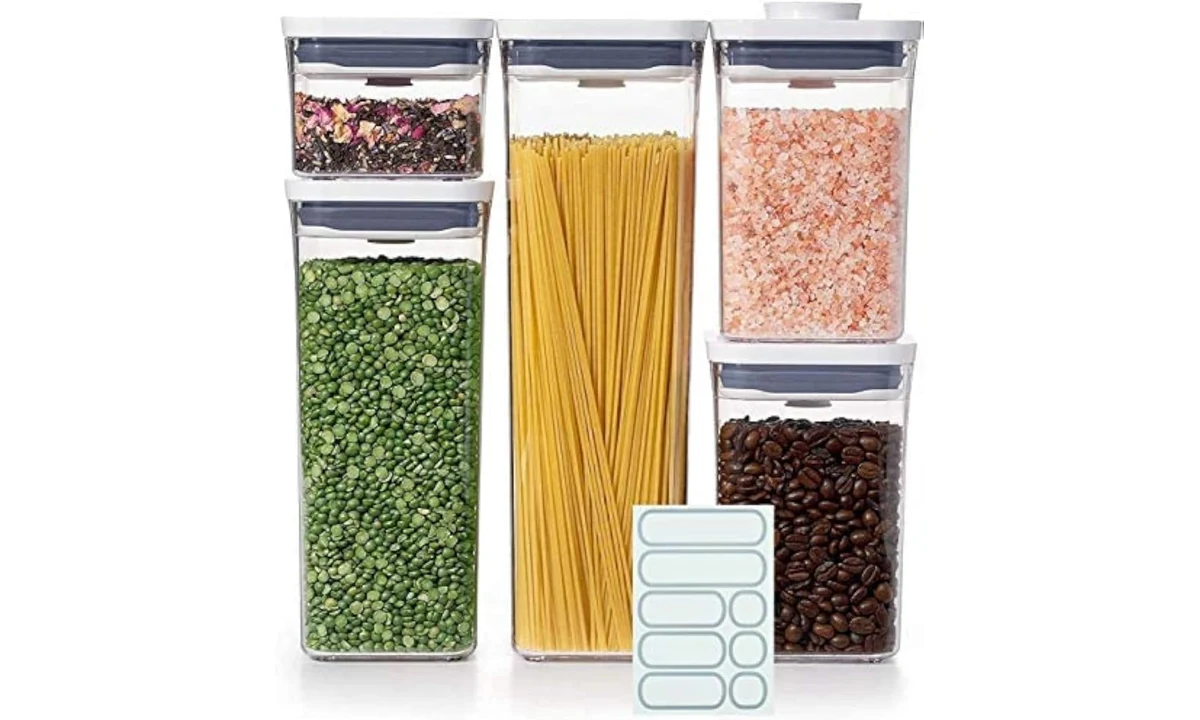
The OXO POP five-piece container set makes sense for a modest collection of dry ingredients that actually fits its assortment. It is less persuasive as a generic answer to every pantry problem. Before buying, decide what will go into each container and where the filled containers will stand. A coordinated set can look tidy while leaving the largest flour bag, an awkward scoop or the original storage problem unresolved.
This review covers the white-lidded five-container retail bundle supplied with five labels. It uses OXO’s current assortment and care information, with Your Best Digs’ original comparison as qualified context for an earlier POP set. We have not tested these containers ourselves. The older comparison is not treated as proof that the current set has identical performance, dimensions or sealing behavior.
Count useful sizes rather than matching lids
The current five-piece assortment contains one 0.4-quart container, two 1.1-quart containers, one 1.7-quart container and one 2.3-quart container. These are nominal capacities, not promises that a particular bag weight of every ingredient will fit. Different foods have different densities and shapes. A volume figure cannot be converted into a universal flour, pasta or cereal weight without knowing the contents.
The set suits a small collection better than a pantry dominated by bulk baking supplies. Two medium containers can be useful when you keep separate dry ingredients in similar quantities, while a small container can serve a limited amount of something you use sparingly. But unused sizes are not good value simply because their lids match the rest. Make a provisional contents list before buying.
Consider how you refill each container. If a new package does not fit after a partial refill, you may still need somewhere to store the remaining bag. That can leave both the container and the original package occupying space. A more attractive front row is not necessarily a reduction in storage volume. Choose sizes around the quantities you purchase, not just the quantities you would like to see on a shelf.
The selected retail bundle includes five labels in addition to the five containers. Those labels do not represent extra storage pieces, and other POP packages can differ. Check the precise assortment at checkout, including lid colour and included accessories. A broad POP title or a photograph of a larger family is not enough to identify the set reviewed here.
Push-button lids are useful, with limits
The POP closure uses a push-button mechanism and a silicone sealing component. Clear bodies make contents visible, and the coordinated shapes can help organize a shelf. The convenience is opening, closing and recognizing dry ingredients without repeatedly handling folded bags. It does not turn the containers into vacuum storage or establish an assured extension of every food’s shelf life.
OXO instructs users to hold the container body rather than carry a loaded container by the lid. That warning matters because a convenient button can be mistaken for a secure carrying handle. Lift deliberately from the body, especially when moving a filled container from a high shelf. A tidy pantry should not depend on a handling method the manufacturer specifically discourages.
The intended job is dry-food storage. Do not treat a push-button seal as evidence that a container is a leakproof lunch box for liquid transport. A lid that works for ordinary pantry access is not automatically suited to being tipped inside a work bag. Choose a container documented for the actual transport or food-preparation task instead of expanding the POP set’s role by assumption.
We do not claim that the set prevents pests, preserves food indefinitely or makes ingredient packaging instructions irrelevant. Storage conditions and the food itself still matter. Keep relevant date and preparation information, and follow the food producer’s guidance. A reusable container changes the package you see; it does not erase the conditions under which the contents should be kept or used.
Measure the shelf in use, not just at rest
A container needs room to be opened, lifted and refilled as well as room to stand. Measure the shelf depth and available height, including any obstruction above the lid. If you have to pull a tall container out every time to reach the button or scoop the contents, that may still be acceptable, but it should be a conscious part of the layout rather than a surprise.
Stacking can organize limited space, yet the stack has to be manageable when full. Put commonly used ingredients where they are accessible and avoid building a tower that requires moving several containers for every meal. The best arrangement follows your cooking habits. A symmetrical stack that is repeatedly dismantled is a less useful result than an uneven arrangement that makes daily tasks straightforward.
Think about the width of the opening and the utensil you use. A container can hold enough food while being inconvenient for a measuring cup or scoop. Your Best Digs raised access and size concerns in its earlier POP comparison, which is a useful reminder to evaluate the complete task. It is not evidence that every current container will suit or fail every utensil.
Curved corners and an organized shape can help handling, but they do not establish that pouring every ingredient will be clean or easy. Fine powders, irregular pieces and sticky dry foods behave differently. Consider whether you usually pour, scoop or measure, then choose the container shape accordingly. A large set is not a substitute for matching one frequently used ingredient to an appropriate vessel.
Current care differs from older POP guidance
OXO describes the current generation as dishwasher-safe, with specific instructions for the lid components. Older POP care material may give different restrictions. Follow the directions supplied with the actual set rather than applying a remembered rule from a previous generation. A familiar product-family name does not guarantee that every component and care method has remained unchanged.
Disassemble the lid only as instructed, clean the relevant parts and allow them to dry thoroughly before filling with dry ingredients. Trapped moisture is contrary to the purpose of a dry-storage routine. The convenience of a dishwasher does not remove the need to inspect the gasket area and reassemble it correctly. Cleaning is part of ownership, especially when changing the food stored inside.
Multiple lid components mean there is more to maintain than a simple one-piece screw cap. That is not necessarily a reason to reject the design, but it belongs in the value calculation. If you prefer very simple washing and drying, another closure may suit you better. If you like the push-button action and will maintain it properly, the extra parts may be an acceptable tradeoff.
Do not transfer dishwasher guidance into unrelated heat-use claims. This review does not recommend the containers for cooking, microwave heating or other applications not established by the selected product instructions. A storage body tolerating its specified cleaning process is not evidence that it suits every temperature or food-preparation method. Buy dedicated equipment for tasks outside its documented role.
What the older independent test establishes
Your Best Digs compared an earlier five-piece POP assortment and found weaknesses during a water-immersion sealing test. It also questioned suitability for large baking supplies and narrow access. Those observations help identify useful purchase questions. They do not prove that the current assortment fails its intended dry-pantry task, nor do they measure how long ingredients remain fresh in a normal kitchen.
Water immersion is a particular test condition, not an ordinary dry-goods shelf. It would be misleading either to ignore the test entirely or to present it as a current-model verdict on every sealing claim. The defensible conclusion is narrower: do not assume a coordinated container set is suitable for liquid transport or every storage condition, and verify the role you need before buying.
The assortment itself has changed across versions and bundles. When comparing reviews, check the listed sizes and the generation rather than matching a similar photograph. A complaint about a large container absent from this set is not directly transferable, and a favorable comment about an older lid is not a measured result for the current one. Exact product identification is as important for kitchen storage as for electronics.
Labeling should preserve useful information
Use labels for more than making the shelf look consistent. Identify the ingredient clearly and retain relevant package information, including dates and any preparation or allergy details that matter to the household. Two similar-looking powders can require very different use. Decanting should make food easier to manage, not remove the information that made the original package informative.
When refilling, think about the remaining contents rather than constantly adding new food on top without a plan. Clean and dry the container as appropriate, and follow relevant storage guidance. We do not give an invented shelf-life extension for using the POP closure. The value is organization and convenient access; claims about preserved quality need evidence for the particular food and conditions.
A label also helps a shared kitchen use the same system. If one person understands a container by location but another rearranges the shelf, visual consistency alone can create confusion. Clear naming and sensible placement are more durable than a layout that only its creator understands. The set works best when everyone who cooks can use it without guessing.
Set value versus buying individual containers
Compare the current total price with the number of sizes you will genuinely use. If only part of the set fits your ingredients, separate containers may represent better value even when the bundle appears discounted. There is no reason to assign an unneeded container a full share of usefulness just because it comes in an attractive box. The useful unit is a solved storage need.
Existing jars or containers can also remain part of the pantry. Replacing everything for visual uniformity creates a different spending decision from addressing a difficult closure or awkward package. Start with the ingredients that cause problems, then decide whether a coordinated set solves several at once. A gradual purchase can reveal the sizes you need before you commit to a larger family.
For alternatives, compare dry-pantry lines such as Progressive ProKeeper or Rubbermaid Brilliance Pantry on their exact capacities and closures. The Rubbermaid lunch containers already covered on TopDataLLC serve a different role and should not be treated as equivalent simply because they share a brand name. Storage on a shelf and transport in a bag need different evidence and features.
Verdict
The OXO POP five-piece set earns a conditional recommendation for a small dry-goods collection that matches its actual sizes. The clear bodies and push-button lids can improve access and organization, provided you allow opening space, maintain the lid components and lift from the body. The included labels are a useful bundle detail, not a reason to overlook unsuitable capacities.
Skip it as a bulk-baking solution without checking the fit, and do not buy it as leakproof liquid transport or vacuum preservation. Plan the contents, shelf and refill routine first. The set’s premium appeal is most convincing when every container has a practical job; when the assortment does not fit, carefully chosen individual containers are the more sensible route to a useful pantry.