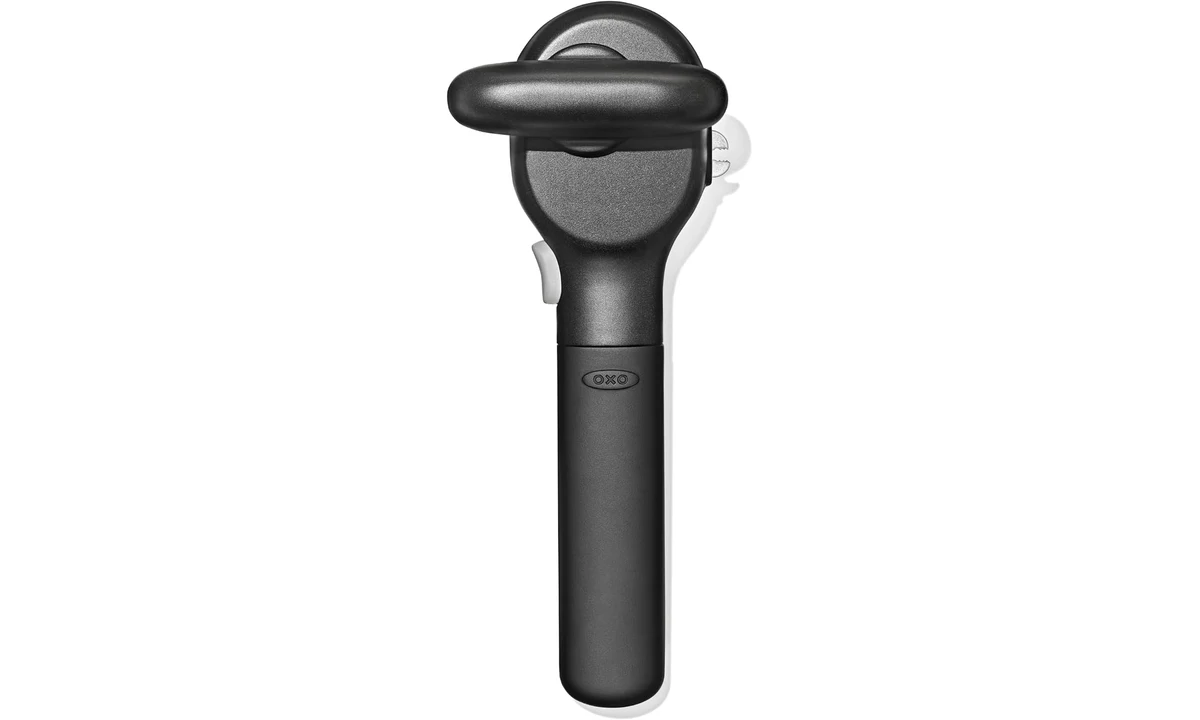
The OXO Good Grips Smooth Edge can opener is worth considering if you want to remove lids with a side-cutting mechanism rather than a conventional top cut. Its useful distinction is the way it separates the lid and provides a way to lift it. The tradeoff is a different alignment routine and continued manual effort. It is not an automatic solution for someone who finds turning a can opener difficult.
This review covers the black manual Smooth Edge model, OXO item 1049953. It uses OXO’s product information and operating instructions together with Prudent Reviews’ original comparative testing. We have not opened cans with this unit ourselves. The recommendation is based on the documented mechanism and the independent reviewer’s observations, with ordinary handling precautions retained rather than treating the words smooth edge as an absolute safety guarantee.
A different cutting route changes the routine
A conventional opener punctures through the top of the lid. The Smooth Edge follows the can’s outer seam instead. That difference explains why it sits and operates differently from an opener you may already use automatically. The first buying question is whether you are willing to learn the alignment, rather than whether the product looks broadly familiar in a drawer.
OXO’s instructions show how the curve of the tool is positioned against the top of the can. The cutting mechanism needs to engage correctly before turning. If it is misaligned, additional force is not a sensible substitute for checking its position. Follow the diagram supplied with the product rather than assuming that every can opener clamps onto the rim in the same orientation.
The purpose of the side cut is a smoother removed edge compared with a conventional cut through the lid. That is useful, but it should not be expanded into a promise that every opened can is harmless. Damaged cans, incomplete cuts and handling errors still deserve caution. Avoid testing the result by running a finger along metal, even when the product name sounds reassuring.
The lid may look more intact after removal, but that does not turn it into a preserving system. A lid resting back on an opened can is not an airtight reseal or a substitute for appropriate storage. Choose a suitable container and follow relevant food-storage guidance for leftovers. The opener changes how the lid comes off, not what happens to food after opening.
Learn the opening and release sequence
OXO’s operating sequence calls for turning clockwise around the rim, then reversing to disengage the opener. The lid can then be lifted using the built-in lid pincers operated by the button. These stages are worth learning separately. Trying to lift the opener and lid before the cut is complete or the mechanism is released can make an unfamiliar tool seem more difficult than it needs to be.
Begin with an ordinary undamaged can and the manufacturer’s instructions close at hand. Check that the tool has engaged and that it is travelling correctly around the rim. Do not use a damaged food can as a practice object simply because it is available. This is a practical familiarization exercise, not a reason to ignore normal caution about the condition of packaged food.
The lid-grabbing feature is useful because it gives you a planned way to handle the separated lid. It is preferable to improvising with fingertips around an uncertain cut. Still, make sure the lid is actually held before lifting it over the counter or food. The presence of a gripping feature does not remove the need to observe what the mechanism is doing.
A shared kitchen benefits from keeping the instructions available until everyone understands the difference. Someone expecting a familiar squeeze-and-turn top-cut opener may initially position it incorrectly. A brief explanation of the side-cut method can prevent frustration. Avoid judging another person’s difficulty as carelessness when the device genuinely uses a different operating sequence from the one they know.
Grip comfort and turning effort are separate
The Good Grips branding and soft grip areas suggest attention to handling, but the opener still relies on manual turning force. Prudent Reviews found a learning curve for alignment and more effort than some conventional models, alongside an effective smoother cut and useful lid grabber. Those observations qualify the product’s appeal for someone mainly seeking lower effort.
A comfortable contact surface can reduce the unpleasantness of a hard handle without eliminating resistance from the mechanism. If limited grip or wrist movement is the reason you need a new opener, do not infer suitability from a soft-looking knob. Consider whether you can maintain the required position and turn comfortably, ideally through a retailer with an appropriate return route.
We do not make an arthritis-treatment or pain-relief claim for this product. Retail titles can contain broad accessibility language that is not equivalent to a clinical evaluation or an individual fit assessment. Someone with a specific physical limitation may be better served by trying an appropriate electric design or seeking advice relevant to their own needs, rather than relying on a product-family name.
The turning direction and release step can also matter for coordination. A person who can manage a familiar opener without thinking may find the changed sequence inconvenient. Conversely, someone who values the side cut and lid pincers may regard the small learning effort as worthwhile. The best choice depends on which part of opening a can currently causes the problem.
Drawer size and ordinary handling
OXO lists dimensions of 7.5 × 4.5 × 2.25 inches. It is a substantial hand tool compared with a very compact basic opener. Check the drawer where it will live, including whether the knob and head interfere with other utensils. An opener that fits only when carefully arranged may become irritating in a busy kitchen where tools are put away quickly.
The shape is part of the mechanism, so do not compare only the handle length. A wider head and knob can affect storage even if the tool is not especially long. If counter storage is your alternative, choose a suitable place where it will remain clean and easy to reach. Convenience involves retrieving and putting away the tool as much as the opening action itself.
Keep it away from situations that could damage the cutting and gripping components. A crowded drawer filled with heavy tools is not an ideal substitute for basic care. This is not a claim that the OXO is unusually delicate; it is an acknowledgement that a manual mechanism needs to remain aligned and clean. A higher purchase price does not remove normal maintenance.
Prudent Reviews includes drop-test observations from its sample. Those are interesting evidence about that test, not a lifetime durability guarantee for every unit. We do not convert a successful demonstration into a promise of indefinite service. Judge the mechanism’s condition during use and follow the maker’s support guidance if it no longer engages or cuts correctly.
Cleaning deserves a clear plan
OXO specifies hand washing for this model. Do not assume that a stainless cutting component means the whole assembly belongs in a dishwasher. The tool combines several materials and a mechanism, and the care instruction applies to the complete product. Following it is more useful than applying a generic rule used for another metal kitchen utensil.
Clean the opener after use as directed and dry it appropriately before storage. A side-cut mechanism does not establish that no food or residue can ever reach the tool. The lid pincers and nearby surfaces still deserve attention. Avoid claiming that the design is automatically hygienic or maintenance-free simply because the cutting route differs from a conventional opener.
Inspect the working area rather than judging cleanliness only by the handle. Residue around a mechanism can be less obvious than a visibly dirty grip. Use the maker’s cleaning method instead of forcing implements into the cutting assembly. If the tool develops a problem, aggressive cleaning or bending is not necessarily a suitable repair.
Consider this routine when comparing an electric alternative. A powered model can reduce manual turning but has its own cleaning, counter-space and power requirements. The manual OXO avoids those electrical dependencies, while asking you to provide the movement. Neither is universally simpler; each transfers effort to a different part of the opening and maintenance process.
It is not a tool for every package problem
The Smooth Edge is a can opener, not a general-purpose device for opening jars, dealing with damaged packaging or removing every style of pull tab. Match it to the type of cans in your household. If your main difficulty is a stiff jar lid, buying a more elaborate can opener may leave the original problem untouched.
Likewise, do not assume the side cut suits every unusual rim without checking. Stop if the tool does not engage properly and follow the instructions rather than forcing the mechanism. A can’s condition and construction can matter. The useful product feature is a documented opening method, not permission to improvise around packaging that does not behave as expected.
For a kitchen that mainly uses pull-ring cans, consider how frequently a separate opener is needed. A premium manual tool may still be worthwhile for the remaining cans, but frequency affects value. Someone opening cans daily will weigh turning effort and cleanup differently from someone who wants a dependable occasional backup in the drawer.
Comparing the alternatives fairly
OXO’s conventional Soft-Handled can opener is a different model and cutting approach. A favorable observation about one should not be assigned automatically to the other. If you want the familiar top-cut routine with a comfortable grip, compare that category directly instead of paying for the Smooth Edge’s method and then wishing it operated like your previous tool.
Prudent Reviews also compares Kuhn Rikon manual and Hamilton Beach electric alternatives. Those are useful directions for further consideration when alignment or manual effort dominates the decision. Check the exact model and its instructions, rather than treating every product from either brand as equivalent. The appropriate comparison is between operating mechanisms and requirements, not merely logos.
A basic manual opener can remain a sensible choice when you use it comfortably and do not need the lid-removal approach offered here. Replacing a working tool solely because another is described as premium does not guarantee a better routine. The OXO makes its strongest case when the smoother side cut and dedicated lid pincers address something you actively dislike about your current opener.
An arrival check before it becomes essential
Confirm the Smooth Edge model and read the operation diagram before the first meal where you need it. Check that the knob, button and gripping parts move as described, then use it on a suitable ordinary can. Learning the mechanism while dinner is waiting makes a minor adjustment feel like a major fault. A short familiarization session is a more useful assessment.
Pay attention to the complete sequence: positioning, cutting, disengaging, lifting the lid and cleaning. If one stage is persistently awkward for your hands, that matters even when the cut itself looks neat. A product should be evaluated on the whole job it asks you to perform. Keep return and warranty information available while deciding whether the different mechanism earns its drawer space.
Verdict
The OXO Smooth Edge is a qualified recommendation for buyers who specifically value a side cut and a built-in way to lift the lid. It offers a coherent alternative to a conventional opener, supported by useful independent observations. Its weaknesses are manual effort, a learning step and a relatively substantial shape, rather than a lack of features on paper.
Choose a powered alternative if turning effort is the central difficulty, or a conventional model if you prefer the familiar opening routine. Follow the alignment and hand-washing instructions, and keep ordinary caution around opened metal. The right reason to buy this OXO is that its complete operating method suits your kitchen—not an assumption that the product name guarantees effortless use or eliminates every sharp-edge risk.