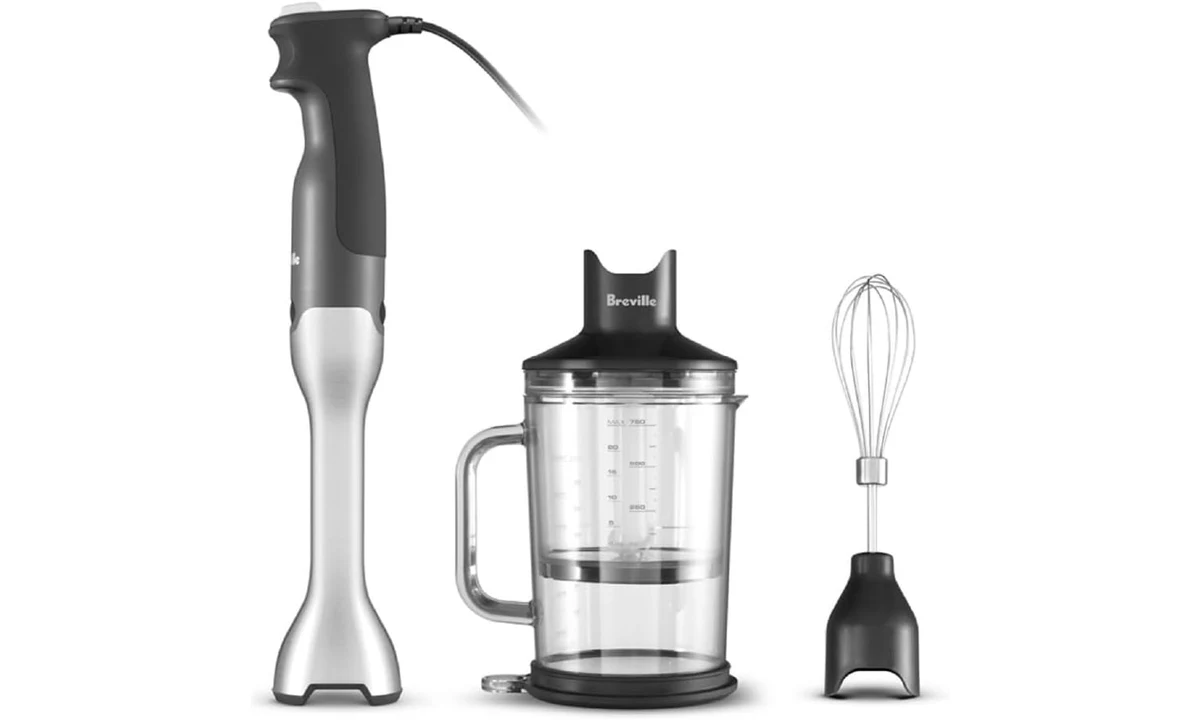
The Breville Control Grip BSB510XL is most persuasive as a way to blend suitable foods in the container you are already using. Its immersion shaft, trigger-style grip and included accessories can reduce the need to transfer ingredients into a countertop blender. They do not turn it into an appliance that can process every food continuously or handle every attachment in the same way.
Our research-based review considers Breville’s US product information and operating manual alongside RTINGS’ independent evaluation. The key decision is whether your regular cooking involves the jobs an immersion blender does well: soups, sauces and manageable preparation tasks. Buyers whose main priority is repeated frozen drinks, heavy mixtures or hands-free operation should compare a different type of machine.
What comes in this particular package
The selected US model is BSB510XL in brushed stainless steel. Breville’s product page lists a blending shaft, whisk, 42-ounce jug and 25-ounce chopping bowl. The jug has a dual-purpose lid that also works as an anti-slip mat, and the chopping bowl can nest inside it for storage.
Those accessories have distinct jobs. The immersion shaft blends in an appropriate container; the chopping bowl encloses its own blade; the whisk incorporates air into suitable mixtures. An accessory count alone does not establish whether you will use them. Think through what you cook during an ordinary week and which attachment would actually replace an existing task.
There is also storage to plan. A handheld motor may seem compact, but the full kit includes vessels, a shaft and a whisk. The nesting arrangement helps organize some of that volume, yet does not make the entire package disappear into a small utensil drawer. Measure the cabinet or shelf where it will live before assuming it saves space compared with your present equipment.
The grip and anti-suction design
Breville describes a trigger grip intended to support a natural hand position. Its bell-shaped blending base and internal ribbing are designed to reduce suction against the container. The practical aim is better control while moving through a mixture, rather than a promise that nothing can splash or that the blender will never pull toward the bottom.
That distinction is important with hot food. You still control the container, the position of the shaft and when the motor runs. A helpful guard design cannot make an unstable pan or an unsuitable liquid level safe. Treat the feature as assistance with ordinary handling, not permission to disregard the operating instructions.
For someone who has struggled with an awkward straight-body blender, the grip may be a meaningful reason to consider this model. If hand comfort is a major concern, try the shape and weight when possible. A handle that looks ergonomic in a photograph may still be uncomfortable when held at the height of your usual saucepan.
What independent testing found
RTINGS’ assessment supports the Control Grip as a sturdy immersion blender with useful soup performance and a fairly smooth result from fibrous ingredients. It also reports meaningful limitations: the machine is relatively loud, heavier use can become tiring, and ice processing is not an efficient strength. Larger or more demanding mixtures can leave some texture rather than becoming perfectly smooth.
That evidence points toward a practical role in ordinary home cooking. It does not justify presenting this as a substitute for every high-powered countertop blender or a machine designed for sustained commercial work. The manual identifies household use, and its operational limits take priority over what an independent reviewer happened to attempt during testing.
For a buyer, the useful distinction is between a task being technically possible in an experiment and being a good reason to purchase the appliance. If you repeatedly need a job that pushes an immersion blender’s limits, a more appropriate machine may save effort and provide a clearer route to the result you want.
Hot soup requires the manual’s conditions
The convenience of blending soup in its pan is a major attraction, but Breville gives specific precautions. The saucepan must be removed from its heat source, the liquid must not be boiling and hot food should be allowed to cool slightly. Appropriate care around hot liquid remains necessary even though the product is intended for suitable hot-food tasks.
That affects the cooking sequence. Plan a stable place to work, keep the power lead away from heat and check that the container offers enough depth and space for controlled blending. Do not move a hot, full pan simply to stretch a cord toward an inconvenient socket. The layout of your kitchen can determine whether the handheld format actually feels convenient.
The manufacturer also warns against lifting the operating blender out of the ingredients. Release the trigger and let the motor stop before removing it. That is a relevant buying consideration as well as a use instruction: someone wanting a completely hands-free soup process may prefer another arrangement rather than a tool that requires continuous physical control.
Check reach and working space, not just jug volume
Breville describes an eight-inch immersion depth. That is useful information for a tall container, but it is not an instruction to fill any pan to its rim. The working space still needs to allow controlled movement and suitable clearance, with the motor body kept out of the food and away from the heat source as directed.
The jug’s stated capacity likewise should not be treated as a universal maximum batch for every recipe. Ingredients move during blending, and different attachments have their own instructions. Check those limits against the containers you already own. A useful pre-purchase exercise is to identify where the pan will rest, where the socket is and where the removed attachment will go afterward. That reveals practical constraints a product photograph cannot show.
Duty limits are part of the performance specification
The manual limits continuous operation to one minute, followed by at least a minute of cooling. For dry, thick or heavy mixtures, its stated operating limit is shorter: no more than 15 seconds, with stirring and a minute of motor rest between uses. These conditions should shape expectations about batch preparation.
A reviewer’s reference to a task taking several minutes should not be interpreted as approval to run the motor without the prescribed breaks. Total preparation time and uninterrupted motor time are different things. If a recipe or workload depends on long continuous processing, establish whether this appliance is suitable before buying it.
The control dial provides a range of speeds, but more settings do not remove those limits. Think of adjustment as a way to manage a suitable task, not a way to overcome an overloaded attachment or a mixture outside the intended use. A stalled or strained tool needs reassessment according to the manual, not simply a more determined grip on the trigger.
The chopping bowl is not a miniature universal blender
Breville explicitly prohibits processing ice and specified hard foods in the chopping bowl. Its examples include coffee beans, rice, frozen foods, spices, cereal and chocolate bars. This is a particularly important distinction because buyers may see the enclosed bowl and assume it can handle any small quantity that fits inside.
It is better understood as a preparation accessory for appropriate ingredients and quantities. Check the manual’s food guide for the attachment, preparation and limits relevant to the task. Do not transfer a capability attributed to the immersion shaft onto the chopping bowl, or assume an independent reviewer’s ice test applies to every part of the kit.
For repeatable chopping, ingredient preparation and loading matter alongside motor power. A small enclosed accessory also adds a blade, lid and bowl to the cleanup. If nearly all your work is dry chopping or shredding, compare a dedicated processor such as those in our food processor coverage before choosing an immersion kit mainly for its secondary attachment.
A whisk without a full mixer’s working style
The whisk broadens the kit’s usefulness for appropriate light mixtures. It does not provide the supported bowl and hands-free workflow of a stand mixer. You continue holding the motor and managing the container, which can become inconvenient for a recipe that needs extended attention or other preparation at the same time.
Consider frequency as well as possibility. If you occasionally need a whisk while cooking and already want the immersion shaft, the attachment may prevent a separate purchase. If whipping and baking are your dominant tasks, a dedicated hand mixer may offer a more natural working arrangement. Our KitchenAid hand mixer guide addresses that different priority.
Avoid using a broad term such as mixing to collapse these categories together. Dough, light whisking, soup pureeing and chopping have different requirements. The value of the Control Grip comes from doing the right combination of suitable tasks, not from claiming that a supplied whisk replaces every appliance with beaters.
Cleaning involves different rules for different parts
The motor body must be unplugged and wiped rather than immersed or put into a dishwasher. Other components have their own rules. Breville’s manual permits dishwasher cleaning for specified removable parts but excludes the chopping-bowl lid and whisk gearbox. The whisk must be separated from its gearbox where the instructions require it.
That is why a blanket dishwasher-safe claim would be misleading. Before buying, decide whether sorting and hand-washing the excluded components fits your routine. The kit can be convenient, but it has more cleaning surfaces and attachment interfaces than the blending shaft alone.
Sharp blades require care, and the appliance should be disconnected before disassembly or clearing lodged food. Let parts dry as instructed before storing them. The nesting feature is useful for organization, but packing damp components together is not a substitute for completing the cleaning process. Follow the supplied manual rather than improvised cleaning advice from a short retailer description.
How it compares with your existing blender
An immersion blender can reduce transfers for soup, while a countertop jug can be more convenient for repeated smoothies or tasks requiring a supported vessel. Those advantages address different stages of cooking. If your present blender already works well, identify the specific job that would become easier before adding another motorized tool.
The Vitamix E310 and Ninja BN701 illustrate countertop alternatives with their own capacities, limits and cleaning arrangements. They should not be treated as directly interchangeable with this handheld kit. The right comparison is the kind of ingredients and workflow you repeat, rather than a contest between isolated power figures.
A simpler immersion blender may be sufficient if you only want occasional soup pureeing and have no use for the whisk or chopping bowl. Conversely, the Control Grip’s accessories can make sense if they displace equipment you would otherwise need. Count meaningful uses and storage requirements, not the number of pieces in the promotional photograph.
The final buying check
The BSB510XL is a sensible candidate for a cook who wants a controlled handheld grip, suitable in-pan blending and a small set of useful accessories, while accepting manual operation and the cleaning distinctions. Independent testing gives it a credible soup-focused role but does not erase the noise, handling effort or limits on difficult mixtures.
Before ordering, confirm the US electrical version, exact package, seller and service terms. Read the operating limits and attachment restrictions before deciding it matches your recipes. Choose another appliance if sustained processing, frequent ice work or hands-free preparation is the main requirement. A well-chosen immersion blender should simplify an appropriate job, rather than require you to push it beyond the conditions its maker specifies.