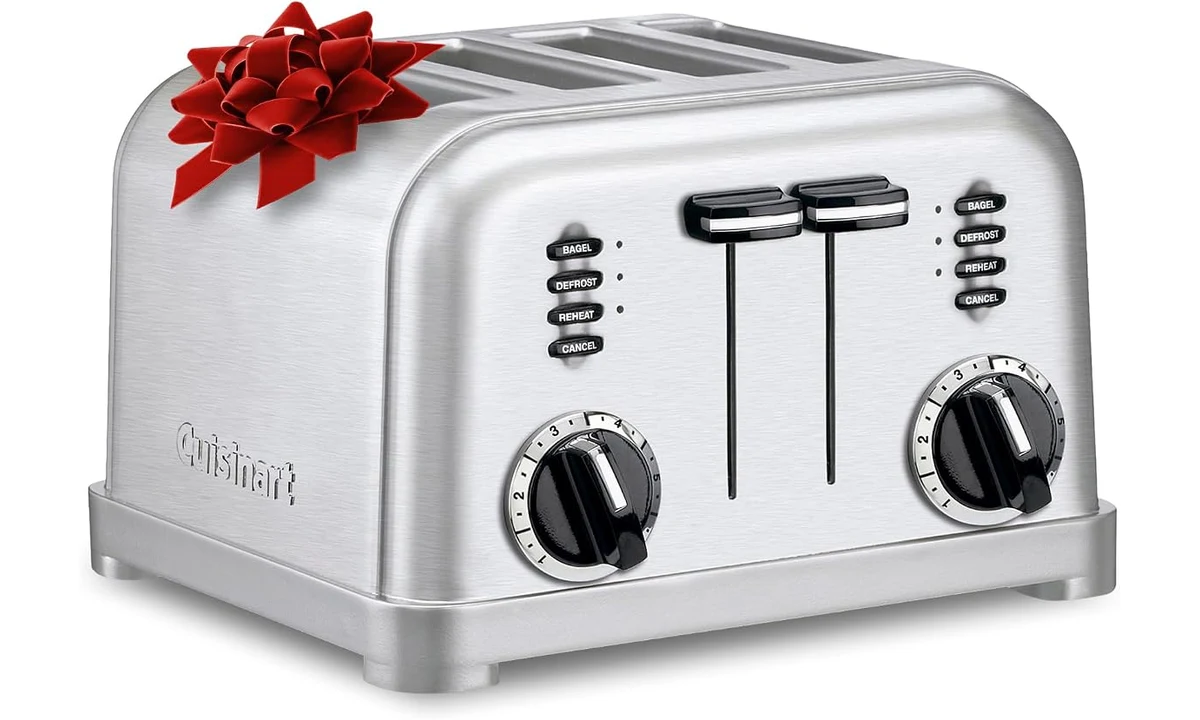
The Cuisinart CPT-180P1 is useful when breakfast involves different preferences at the same time. Its four slots are divided into independently controlled pairs, so one person’s setting does not have to dictate another person’s toast. That straightforward flexibility is the strongest reason to consider it, rather than the assumption that a brushed stainless finish guarantees a better result.
This research review assesses the brushed-stainless US model using Cuisinart’s product information and Tom’s Guide’s independent test. It is a conventional slot toaster, not a small oven or an appliance with automatic visual inspection of the bread. Its appeal is simple controls and paired capacity, with hot exterior surfaces and the absence of a preview feature as meaningful compromises.
Two controlled pairs are the point
The CPT-180P1 has separate control panels for its two pairs of slots. Cuisinart describes this as effectively combining two toasters in a single appliance. For a household that regularly wants different browning levels, that can remove the need to finish one preference before starting another.
Think through the actual breakfast pattern. If you routinely prepare several slices with different settings, the arrangement has an obvious purpose. If you mostly toast a single slice and rarely have company, the extra capacity and footprint may not improve your routine enough to justify the space.
Independent controls also mean there are settings to check on both sides. Do not assume a dial remains where you left it if other people use the toaster. A small habit of checking the selected function and browning level before lowering the bread can be more useful than expecting a familiar appliance to remember everyone’s preference.
Verify the specific CPT-180P1 version
Cuisinart’s current product information identifies the brushed stainless P1 version as CPT-180P1. Retail pages may group finishes and related configurations together, and bundles can add another appliance. Confirm the selected item rather than judging only the first photograph in a search result.
A four-slot toaster is also different from a long-slot design. The presence of four openings does not establish that every long artisan slice will fit comfortably. If unusually shaped bread is central to your routine, check the practical dimensions of the openings instead of relying on the total slice count.
The product image may include decorative styling, which does not establish included accessories. What matters is the appliance, its standard parts and the current package description. Verify the US electrical version and the seller’s terms if comparing offers intended for different countries. Similar styling should not obscure differences in the actual supplied product.
Browning settings are a starting point, not a universal timer
Each side has a six-setting browning dial, with separate functions for reheat, defrost and bagels. That offers useful control without requiring a menu system. It does not mean the numbered positions correspond to identical results with every bread or to the same timing scale as a previous toaster.
Bread thickness, moisture, ingredients and starting temperature affect the result. If you change several of those factors at once, a familiar dial position may produce a different shade. Begin with the manufacturer’s recommendations and learn the setting for the bread you actually buy rather than expecting a number to represent a fixed result universally.
This is particularly relevant in a shared household. A person using a thin slice from a fresh loaf may prefer a different setting from someone using a thicker frozen portion. The independent banks make that variation easier to manage, but they do not replace the need to select an appropriate function and observe the finished result.
What the independent test found
Tom’s Guide reported good consistency and a useful range of toasting shades from the CPT-180 arrangement. Its reviewer appreciated being able to prepare different settings simultaneously and found the controls straightforward. It also identified a warmer-feeling exterior and the lack of a way to preview the toast before the cycle ended.
Those caveats are important to the recommendation. A positive performance assessment does not mean the entire exterior stays cool, and a convenient lift mechanism is not the same as a preview function. Avoid combining favorable descriptions from another toaster with the features actually present here.
The independent result applies to the reviewer’s sample and tests, not every possible slice or future unit. It gives a sound reason to consider the design, while your bread preferences and kitchen arrangement still determine suitability. We do not reproduce the review’s measured surface temperatures as a universal operating specification or promise an exact cooking time.
Extra-wide is not the same as unlimited space
Cuisinart specifies slots that are 1.5 inches wide. That helps explain the product’s appeal for a range of bread thicknesses, but slot width is only one dimension. A slice can be thick enough to fit yet still be too long or awkwardly shaped for the opening.
Do not force food into a slot simply because a marketing phrase suggests broad compatibility. Follow the supplied instructions for appropriate foods and sizes. The toaster should be chosen around the bread you regularly use, rather than bought first and expected to accommodate any bakery shape afterward.
The extra-lift carriage is a useful feature for accessing smaller items. It should not be treated as a guarantee that every small piece rises into an easy position. Consider the size of the items you actually toast and the operating guidance. If convenient access to a wide variety of shapes is central to your needs, a toaster oven may be a better category to compare.
Bagel, defrost and reheat: check what the labels mean
The three function buttons broaden the controls, but their names should not be expanded into unsupported claims. In particular, a bagel button does not by itself establish that the toaster heats only one side. Read the instructions for the selected model instead of assuming it behaves like another brand’s bagel setting.
The defrost function is relevant if your household often works from frozen bread. The reheat function addresses a different situation, such as toast that has cooled while another part of breakfast was prepared. Choosing the appropriate function is more sensible than turning the browning dial far beyond its usual position without understanding the change.
Avoid promising that reheat can restore every texture or that defrost produces an identical result with all frozen foods. Those outcomes depend on the food and its condition. If a specific item is important to you, check that it is suitable for a slot toaster and test within the manufacturer’s directions during a reasonable return period.
No preview feature means a different style of use
The absence of a dedicated preview mechanism is not necessarily a problem if you normally let a familiar cycle finish. It becomes more relevant if you often inspect toast partway through. Tom’s Guide identified this limitation, and it should remain visible when comparing the Cuisinart with products that explicitly offer lifting or inspection during a cycle.
The extra-lift carriage concerns access to the food, not an advertised automatic continuation system after inspection. Do not assume that any lever movement provides the same behavior as a more specialized preview feature. Compare actual functions rather than treating every raised carriage as equivalent.
For a buyer who already has reliable settings for familiar bread, simple operation may be preferable to extra mechanisms. For someone experimenting with varied bakery slices every morning, a different design may reduce uncertainty. Neither preference is inherently better; the relevant question is how often the missing feature would affect your ordinary breakfast.
Plan the counter around hot surfaces
The manufacturer lists dimensions of 10.65 by 11.15 by 7.5 inches. Those are useful starting points for available space, but a working toaster needs more than a rectangle on the counter. You need suitable clearance, access to both controls and a safe arrangement consistent with the operating instructions.
Tom’s Guide’s observation about the exterior reinforces that point. Do not choose a position where people must brush against the sides to reach another frequently used item. Brushed steel can look unobtrusive, but appearance does not establish a cool-touch surface during a cooking cycle.
Also consider the route to the socket and the direction from which you remove food. A toaster placed at an awkward angle can make an otherwise simple control layout less convenient. Compare the actual accessible working position, not just whether the closed appliance fits beneath a shelf when it is switched off.
Crumb collection and everyday cleaning
Cuisinart lists a slide-out crumb tray and cord wrap. The tray makes collected crumbs more accessible, but it does not mean crumbs can be ignored indefinitely or that the appliance’s interior is maintenance-free. Follow the supplied cleaning instructions and allow the toaster to cool appropriately before handling parts that require it.
The housing also needs realistic expectations. A metallic finish can show fingerprints and splashes, particularly beside a kettle or cooking area. Choose a cleaning routine appropriate to the surface rather than aggressive products that might damage its appearance. The benefit of a simple control panel is reduced clutter, not immunity to kitchen residue.
Do not improvise repairs or insert tools into a connected appliance to retrieve food. For problems beyond the routine described in the instructions, use the appropriate support route. A product with a familiar mechanical layout can still involve electrical and heat hazards; ease of operation should not be confused with permission to treat the internals casually.
A four-slot toaster versus a small oven
The CPT-180P1 suits a fairly specific job: preparing suitable bread items in slots with independent settings. A toaster oven offers a different loading surface and may be useful for foods or shapes that do not belong in a slot toaster. It also brings different heating, cleaning, storage and operating requirements.
Our Breville Mini Smart Oven guide explores that alternative. It should not be assumed to solve every breakfast task more efficiently simply because it can do more kinds of cooking. The useful comparison is the work you regularly perform and the space available for it.
Likewise, a smaller slot toaster can be the better choice if paired capacity goes mostly unused. Our Breville A Bit More coverage provides another set of controls and priorities to investigate. Compare the particular convenience you need, such as access or preview behavior, rather than treating slice count as the whole buying decision.
Consider ownership beyond the first morning
Cuisinart advertises a limited three-year warranty for the CPT-180P1 on its US page. Read the applicable conditions, territory and seller requirements rather than treating the duration alone as a guarantee of every type of support. Keep the product identity and purchase information needed if service becomes necessary.
A practical return arrangement also matters because bread fit and preferred browning are personal to the household. Check those during ordinary use, following the instructions. If the toaster persistently fails to suit the bread you buy, a different slot shape or appliance category may be a more effective answer than repeatedly searching for a setting that cannot resolve the mismatch.
The most useful value calculation includes counter space, cleaning access and how often the second independently controlled pair will be used. A toaster that handles several preferences every morning has a clear reason to occupy its footprint. One that mainly serves a single person occasionally may have more capacity than the routine requires.
Our recommendation
Choose the CPT-180P1 when independently controlled pairs, straightforward physical controls and a conventional four-slot layout match your breakfast routine. Independent testing supports its consistency and usability, with the important limitations that its exterior can feel hot and it lacks a dedicated preview feature.
Confirm the selected brushed-stainless US model, slot suitability, operating space, seller and support terms before buying. Choose a smaller toaster if capacity is unnecessary, or investigate a toaster oven when bread shape and broader cooking are the real requirements. The Cuisinart is most convincing when its paired controls solve a daily problem, rather than when its appearance alone determines the purchase.