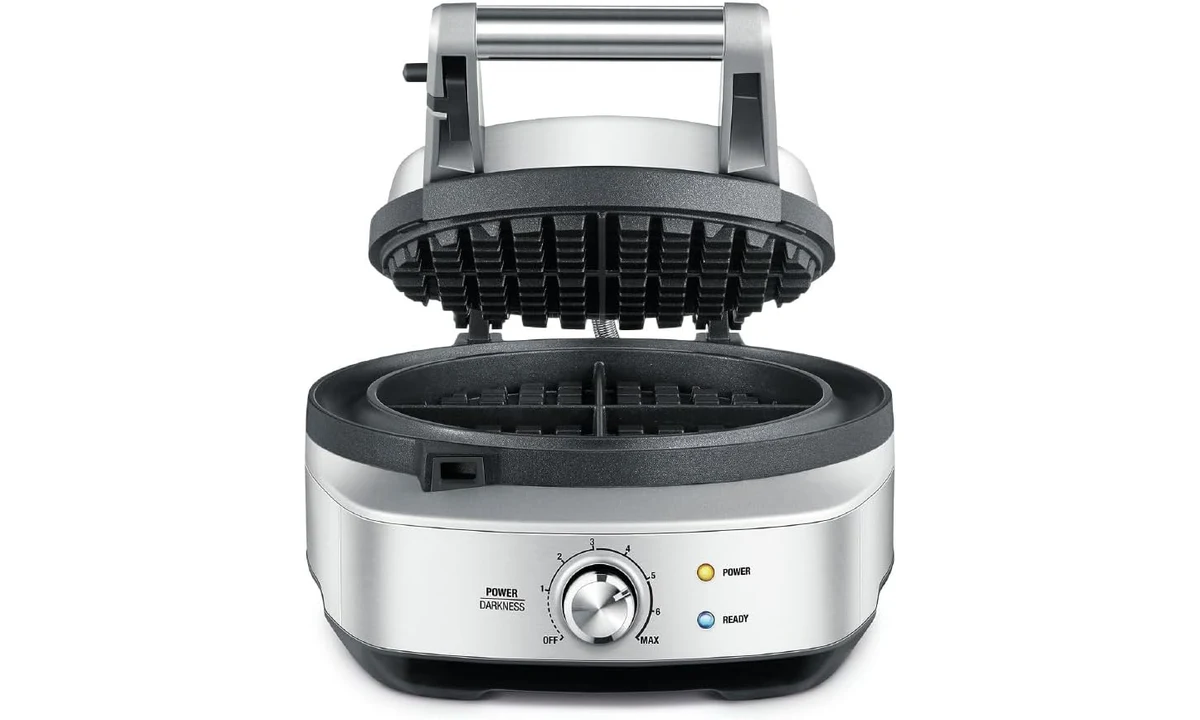
The Breville No-Mess BWM520XL makes its strongest case for someone who wants classic round waffles and dislikes cleaning batter from the counter. Its surrounding moat catches and cooks excess batter, while a simple darkness dial controls the result. It is not the obvious choice for a household whose main requirement is deep Belgian-style pockets or several waffles finishing together.
This research review combines Breville’s current US product page and operating instructions with America’s Test Kitchen’s independent waffle-maker comparison. The important distinction is the kind of waffle and breakfast routine you actually want. A premium-looking metal housing and a memorable product name cannot decide whether a single classic-format iron fits the way you serve a meal.
Choose the waffle style before the appliance
Breville describes the No-Mess as a classic circular waffle maker. America’s Test Kitchen found its waffles thicker than some other classic examples but still noticeably thinner than those from its preferred Belgian irons. That places the model in a specific category rather than somewhere universally between every waffle style.
If you want a thinner waffle with shallower pockets, that may be precisely the attraction. If you picture a deep-pocketed Belgian waffle holding substantial toppings, compare an appliance built for that format. A recipe’s name does not change the geometry of the cooking plates. The same batter cannot make every iron produce the same thickness.
This distinction is especially useful when buying a gift or replacing an old machine. Ask what the person actually likes eating rather than assuming the more expensive-looking iron is automatically an upgrade. Replacing a familiar breakfast with a different style may be a downgrade for that household even when the new appliance performs its own intended task well.
What the moat does, and what it cannot promise
The surrounding channel is the No-Mess design’s defining feature. Breville says it captures and cooks overflow batter instead of allowing it to run straight onto the work surface. That can make an occasional excess pour less troublesome and keep the cooking area more contained.
It does not remove the need to use an appropriate amount of batter or to follow the instructions. A moat has finite space, and the appliance still has hinges, a handle and a surrounding counter that need care. Treat the feature as overflow management rather than a license to fill the plates indiscriminately.
The moat also becomes part of the cleaning routine. Cooked overflow still needs to be removed, and residue should not be allowed to accumulate. Its value is that the unwanted batter is dealt with in a more manageable place, not that an appliance used for cooking no longer requires attention afterward.
The exact US model and controls
The selected model is BWM520XL in brushed stainless steel. Breville lists stainless housing, die-cast aluminum cooking plates and a nonstick surface. Its US page gives dimensions of 11.5 by 9.5 by 5.7 inches. Those numbers are useful for planning storage, but you also need operating space for the open lid and access to the controls.
The darkness dial offers seven settings. That gives adjustment within this appliance’s operating system; it does not establish a universal scale that matches another waffle maker’s numbered dial. A middle setting on the Breville should not be assumed to reproduce a familiar result from a previous machine.
The current instructions describe both audible alerts and a ready light. These are conveniences when preparing other parts of breakfast, but the intended result still depends on the batter and your preference. The appliance does not inspect every ingredient choice or eliminate the need to learn how your usual recipe behaves.
What independent testing found
America’s Test Kitchen selected the No-Mess as its preferred classic waffle maker in the cited comparison. Its detailed assessment described relatively even browning with somewhat paler edges, simple controls, alerts, a moat and a locking latch. The edge-browning qualification is worth retaining rather than turning a favorable recommendation into a claim of uniform perfection.
That result supports the design for the classic-waffle task. It does not transfer directly to another Breville model or establish that this machine is the best option for every recipe and household. The larger Smart Waffle models have different arrangements, so their results, capacities and controls should not be borrowed for this review.
An independent comparison is most useful when it informs the questions you ask. Here, those questions include whether the waffle style suits you, whether the dial is easy to understand and whether overflow management makes preparation less awkward. They are more helpful than relying on a score or a generic promise of restaurant results.
A repeatable breakfast begins with batter consistency
The manual gives an approximate starting quantity for filling the center of the plate, but a recipe’s texture and your preferred result still matter. Follow the supplied instructions for the unit and do not assume that a scoop from another appliance is interchangeable. The moat helps with excess; it does not make the amount irrelevant.
For repeatability, use the same recipe and measuring approach while learning the machine. Changing batter thickness, darkness setting and portion size at once makes it difficult to understand which change affected the result. A kitchen scale can help where your recipe supplies weights, though it does not replace following the waffle maker’s operating guidance.
This is also a reason to resist treating the first waffle as a definitive judgment of the appliance. A poorly matched recipe or inconsistent portion can produce a disappointing result without proving a hardware fault. Equally, do not ignore persistent issues once the supplied instructions and a consistent process have been followed. A workable return and support arrangement remains part of a sensible purchase.
Preheating, reheating and serving in sequence
Breville’s instructions use the ready signal for the preheat stage and describe waiting for the machine to recover when batter is not added promptly between cycles. That matters when you stop to serve, refill a bowl or help someone at the table. A machine that has sat open or idle should not simply be assumed to be ready for the next portion.
A single round iron also means a sequence of cooking and serving. If everyone expects a freshly finished waffle at the same moment, think through that constraint before buying. The No-Mess is not a multi-waffle production surface merely because its round waffle can be divided into sections.
For smaller households or an unhurried breakfast, that sequence may be perfectly acceptable. For a larger group, a different capacity or a different way of serving may suit the occasion better. We do not provide an exact production rate because recipe, setting and reheating pauses all affect it. Compare the workflow rather than inventing a fixed number of portions per hour.
The latch is for storage, not cooking
The current operating instructions explicitly say to keep the locking latch open while batter is cooking. That is an easy detail to miss when a product photograph emphasizes a secure-looking closure. A feature useful for storage does not mean the machine should be clamped shut during use.
Before cooking, place the appliance on an appropriate stable surface with the clearance required by its instructions. Hot surfaces and steam remain part of using a waffle iron. Overflow management does not make every surface cool to touch, and an audible alert is not a substitute for careful handling.
After use, follow the shutoff, unplugging and cooling steps before storing it. Breville’s instructions describe securing the latch after cooling and using the cord-storage area. That is a practical ownership feature, but it should not be confused with permission to carry or pack away a hot appliance simply because it can be locked closed.
Nonstick claims need precise language
Breville’s current US product page describes a PFOA-free nonstick coating. That wording should not be expanded into a claim that the product is free of every chemical in a broader category, or that it has a particular alternative coating material not specified for the selected model. Read the exact current statement if coating composition determines your purchase.
The manual also sets out care requirements for the nonstick surfaces. Avoid metal and abrasive tools, and follow the maker’s cleaning directions. An appliance described as nonstick is not immune to damage or a guarantee that every batter will release perfectly regardless of preparation and condition.
If removable dishwasher-cleaned plates are central to your routine, compare a model that explicitly offers them. The No-Mess’s instructions call for wiping its plates and moat rather than immersing the appliance. It would be misleading to turn the convenience of a moat into a general claim of effortless or machine-washable cleaning.
Cleaning is still part of the time commitment
Breville directs you to switch off and unplug before cleaning, remove residue with appropriate soft materials and avoid immersing any part in water or other liquid. Its instructions also caution against nonstick cooking sprays. Use the supplied guidance rather than assuming a routine from another waffle iron applies unchanged.
The surrounding moat can make cleanup more orderly, but it adds another shaped surface that needs attention. If batter regularly remains around the edges or hinge, consider the portion and method rather than merely scrubbing harder afterward. Protecting the coating is part of maintaining the appliance’s usefulness.
Allow for cooling and storage time when judging convenience. A breakfast tool may be easy during the cooking cycle but still occupy valuable counter space afterward. If your kitchen has limited clear surfaces, plan where it can cool safely and where it will be stored once fully cool and dry. That is more useful than evaluating only the closed footprint.
Alternatives that solve different breakfast problems
Our Presto FlipSide guide discusses a Belgian-style alternative. It is relevant if waffle thickness and deep pockets matter more than the No-Mess’s particular stationary layout and surrounding moat. Compare the handling and cleaning requirements as well as the style of the finished waffle.
The Dash Mini Waffle Maker represents a different scale of purchase and preparation. A smaller appliance may be more suitable for occasional small portions, while its capacity and controls differ. Neither should be dismissed simply because the No-Mess looks more substantial; the correct tool depends on the intended breakfast.
If you already own a waffle maker that produces the style you enjoy, identify the actual problem before replacing it. Overflow cleanup, uneven results, inconvenient storage and insufficient capacity are different problems. The Breville addresses some of them more directly than others, so buying it without that diagnosis risks paying for a feature that does not resolve your main frustration.
Our conclusion
Choose the BWM520XL if classic round waffles are the goal, you value a straightforward darkness dial and alerts, and you expect the overflow moat to improve an otherwise suitable cooking routine. Independent testing supports its performance in that category, with some edge-browning variation and the ordinary limits of a single iron still relevant.
Look elsewhere if deep Belgian-style waffles, removable plates or several servings finishing together are essential. Before ordering, verify the US version, current coating description, seller and support terms. The No-Mess makes the most sense as a considered solution to a specific breakfast workflow, not as a promise that every part of waffle making becomes automatic or cleanup-free.