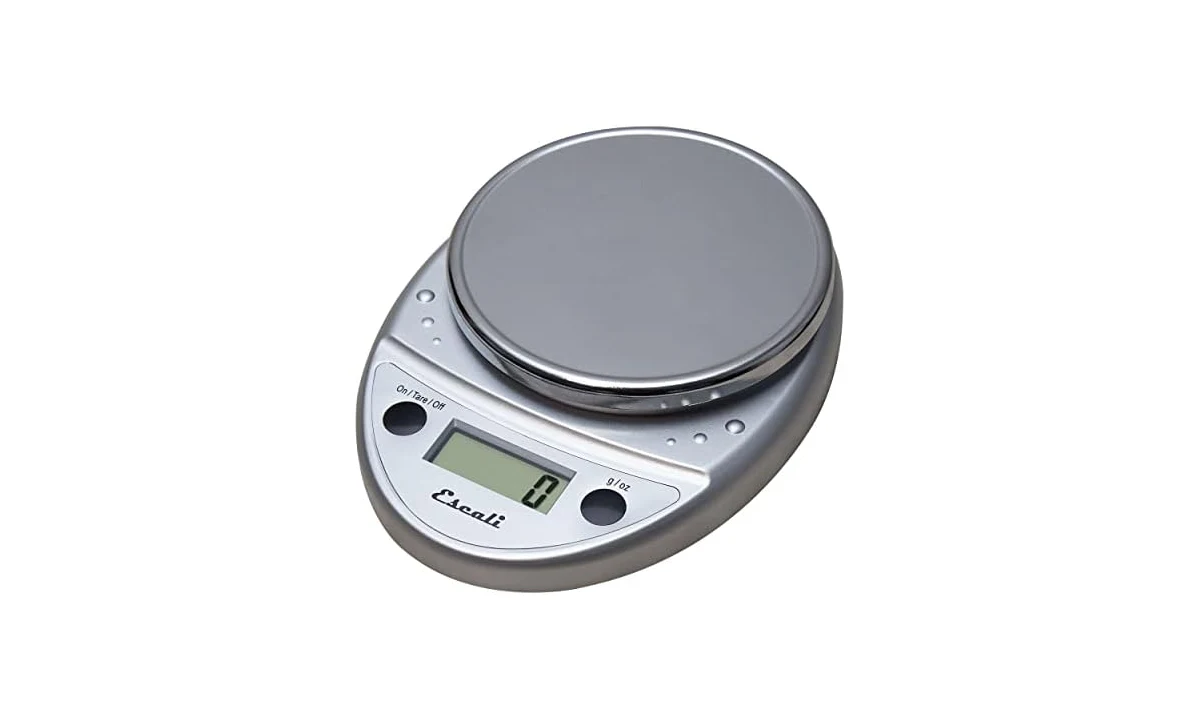
The Escali Primo is a straightforward kitchen scale whose main attraction is how little you need to manage. A raised weighing platform, a small display and two buttons cover ordinary ingredient weighing without a phone connection or an elaborate operating routine. That can be exactly the right balance for baking, provided you understand its measurement limits and the effect of a container on usable capacity.
This research review concerns the chrome Primo, identified as P115C in the manufacturer’s variant information and the selected US retail listing. We compare KitchenSupply’s current Escali information with Tom’s Guide’s independent evaluation. The decision is less about whether a basic-looking scale feels premium and more about whether it fits the bowls, ingredients and pace of your cooking.
What makes the Primo different from a feature-heavy scale
KitchenSupply describes a traditional platform scale with a sealed control panel, tare function and automatic shutoff. Its interface uses two buttons rather than separating every function into its own key. There is no need to connect an app before beginning an ordinary weighing task.
For someone who repeatedly weighs flour, sugar or portions of dough, that simplicity can reduce friction. You place a suitable bowl on the platform, account for its weight and read the ingredient amount in the chosen unit. A scale that is easy to bring into a routine may be more useful than a more sophisticated device left in a cupboard.
The trade-off is that the Primo is not a specialist instrument for every kind of measurement. It does not become a fine-resolution laboratory scale simply because an independent reviewer found it dependable in kitchen testing. Decide what you need to measure before choosing the level of precision, rather than expecting the scale to adapt to tasks beyond its design.
Match the chrome model carefully
The current manufacturer catalogue groups several Primo finishes together. Chrome is listed as P115C, while other color names have different identifiers. A product page opening on a black example does not mean the chrome version shares that color code. Check the selected finish and the actual item description before ordering.
The chrome appearance also should not be confused with a solid metal body. Tom’s Guide describes ABS plastic construction in the tested scale. If your purchase depends on a particular material or surface treatment, examine that detail rather than treating a metallic-looking photograph as sufficient evidence.
Retailers can also package extra accessories differently. KitchenSupply identifies an optional stainless-steel platform cover as a separate item. Do not assume a cover, bowl or storage case is included unless the exact package says so. A small accessory difference can make a misleading comparison between two otherwise similar-looking offers.
Capacity includes more than the ingredients
KitchenSupply gives the Primo a maximum capacity of 11 pounds, or 5,000 grams. That is the total supported load, not an allowance for that quantity of ingredients on top of any bowl you choose. A heavy vessel uses some of the scale’s available capacity even after the display is tared.
Taring changes the reference on the display; it does not increase what the scale can physically support. This is easy to overlook with a heavy mixing bowl and a substantial dough mixture. If you often work near the limit, consider the vessel and the whole recipe together before deciding the Primo has enough headroom.
For lighter everyday baking, the capacity may be entirely adequate. The relevant check is your actual batch, not the largest advertised number among competing scales. A higher-capacity model is not automatically the better choice if its platform is harder to store or its display is less convenient for the bowls you use most often.
Resolution and accuracy answer different questions
Tom’s Guide lists one-gram increments for the tested Primo. An increment describes the steps the display can show. It is not a guarantee that every small addition will register immediately or that every measurement has an error smaller than that step. Keep those concepts separate when comparing kitchen scales.
This is relevant when a recipe calls for very small quantities. A scale suited to a bowl of flour may be the wrong instrument for tiny additions where a small absolute difference represents a large part of the intended amount. Choose a suitable finer-resolution tool for those tasks rather than assuming the Primo’s everyday kitchen performance answers them.
Likewise, a display that remains steady is not by itself proof of accuracy. It may be easier to read, but measurement quality requires more than a calm-looking number. Use the scale on a suitable stable surface, follow its instructions and investigate inconsistent behavior rather than selecting whichever repeated reading seems most convenient.
What independent testing adds
Tom’s Guide tested the chrome version and found the simple controls and cleaning arrangement useful. Its reviewer also reported consistent readings with small test weights at different positions on the platform, while being less enthusiastic about the scale’s appearance and battery-compartment clip. Those are useful observations about an actual sample, not a calibration certificate for every unit sold.
That distinction keeps the recommendation realistic. We do not turn one reviewer’s successful test into a guarantee of indefinite accuracy, impact resistance or performance after years in a damp kitchen. The independent evidence supports considering the Primo for ordinary cooking, with condition and appropriate use still relevant.
The design criticism may also matter differently to different buyers. Someone who leaves a scale on the counter may care about how it looks beside other equipment. Someone who takes it out only while baking may prefer a plain, easy-to-operate tool. Neither preference changes what should be checked about the measurement task itself.
Tare is useful, but keep a recoverable workflow
The tare function lets you subtract a bowl’s displayed weight or return to zero between ingredient additions. That can reduce the number of containers involved in a recipe. It also means you should pay attention to what the current display represents, particularly when someone else joins the preparation or a task is interrupted.
Before taring again, confirm the quantity you have just added. If you clear that reference and then realize the last ingredient was incorrect, the scale cannot reconstruct the previous sequence for you. Working from a clear recipe and adding ingredients deliberately is more reliable than rushing because everything can go into the same bowl.
For recipes where correcting an addition would be difficult, a separate small container may still be worthwhile. The convenience of fewer dishes should be weighed against the cost of losing track of an ingredient. The Primo provides a measurement tool; it does not replace the organizational decisions that make a baking process repeatable.
Automatic shutoff and interruptions
The current manufacturer description says the scale turns off after four minutes of inactivity. That conserves battery power, but it is a real workflow limitation when you step away from an unfinished tare sequence. Do not assume it will preserve a temporary reference throughout a long interruption.
A practical approach is to assemble ingredients before starting and finish a weighing step before leaving the scale unattended. If your normal cooking involves substantial pauses, decide whether this timing behavior will become annoying. A feature that is convenient for occasional use may be less suitable for a different style of preparation.
Older reviews can report slightly different observed shutoff timing. Use the current instructions for your supplied unit rather than treating a reviewer’s stopwatch result as a contractual setting. The same caution applies to small differences in published dimensions: if the scale must fit a tight space, measure the actual storage area and verify the current product details.
Bowl size and display visibility
The raised circular platform does not eliminate the need to check whether a large bowl obscures the front display. Consider the shape of the bowl’s base and how far its sides extend. A scale can have enough load capacity yet still be inconvenient when you cannot read the result comfortably.
The Primo is also not supplied with a dedicated bowl in the reviewed standard arrangement. That gives flexibility to use your own containers, but means compatibility is partly your responsibility. Test the ordinary bowl and plate sizes you expect to use, rather than assuming every vessel is equally stable or equally easy to read around.
If large containers are central to your routine, compare the OXO pull-out-display food scale. Its design addresses a different visibility problem. That is a more useful comparison than choosing between scales solely on their maximum capacity, because the reading experience can determine whether the tool is pleasant to use every day.
Cleaning without confusing sealed with waterproof
KitchenSupply describes a protective shield over the controls and display to guard against accidental spills. That does not establish that the entire scale can be immersed or placed in a dishwasher. Clean the scale according to its care instructions and keep water away from areas not intended for it.
The separately available stainless-steel platform cover has its own cleaning description. A dishwasher-safe accessory does not make the underlying electronic scale dishwasher-safe. Check which component a seller’s cleaning statement refers to before relying on a short feature bullet.
Give the battery area appropriate care as well. Tom’s Guide’s reviewer found the compartment clip awkward, which is a reminder to open it deliberately rather than forcing it. Keep the scale dry and inspect its condition before use. Ordinary maintenance supports reliable operation without justifying an invented durability promise or a predicted service life.
The reviewed Primo uses two AA batteries, rather than a USB charging connection. That is convenient if you prefer common replaceable batteries, but it means checking the supply before a planned baking session. Follow the supplied instructions for the battery type and installation. If you strongly prefer rechargeable built-in power, include that preference in the comparison from the beginning; a metallic-looking finish does not imply the scale has the charging arrangement of a more electronic-looking model.
When another scale is a better purchase
The Etekcity EK6015 is a relevant everyday kitchen alternative to compare on platform shape, controls and storage. Do not assume two scales with similar capacity have the same readability, shutoff behavior or response to small additions. Choose the details that affect your actual recipes.
A specialized finer-resolution scale is the more appropriate comparison if tiny quantities dominate your use. A larger platform scale may be better for heavy vessels and bigger batches. Neither is automatically an upgrade for someone who simply wants straightforward ingredient weighing without extra complexity.
If you mainly follow volume-only recipes and do not intend to change how you measure, consider how often the scale will earn its storage space. It can be useful, but buying it does not automatically make a recipe more repeatable unless you also use suitable weight-based instructions and maintain a consistent process.
Our buying recommendation
The chrome Escali Primo is a sensible candidate for ordinary cooking and baking when simple controls, tare and a compact platform matter more than advanced features. Independent testing provides a credible reason to consider it, while the one-gram display increments, shutoff behavior and bowl visibility set practical limits.
Confirm P115C, the selected finish, standard accessories, seller and current support terms before purchase. Check the combined vessel-and-ingredient load and whether your preferred bowl leaves the display readable. Choose a different design if you need finer measurement, larger batches or better visibility around oversized containers. The Primo works best when simplicity matches the task, rather than being mistaken for precision beyond its intended role.