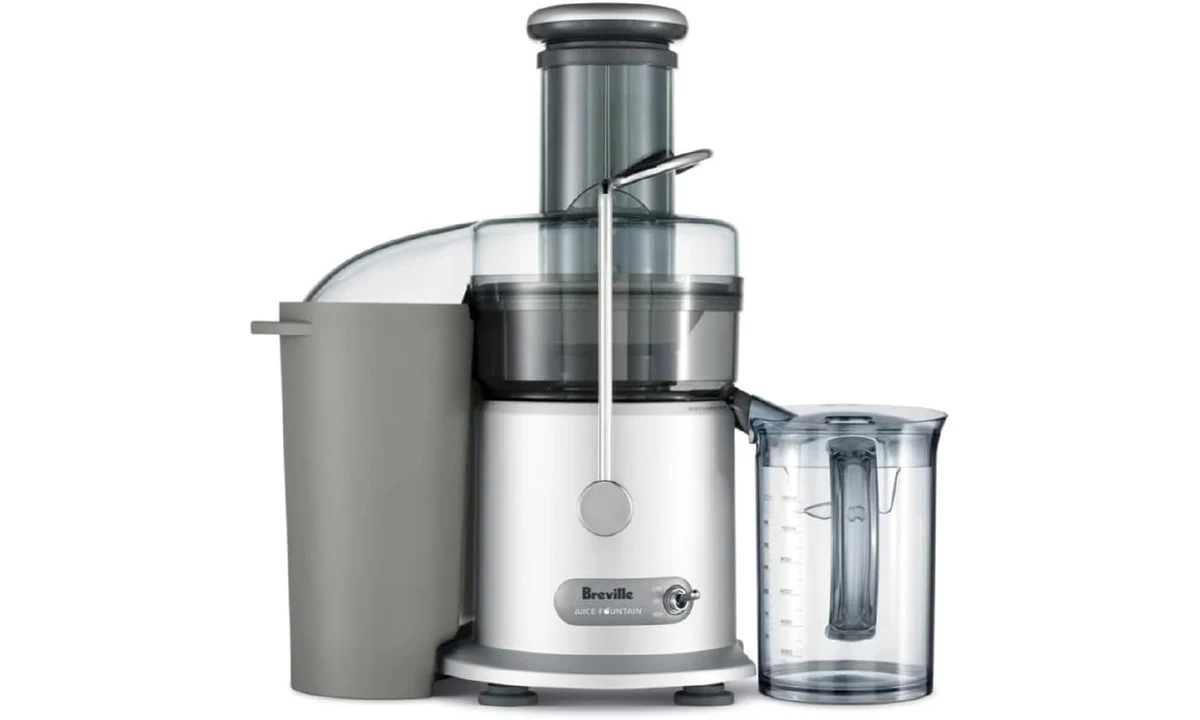
The Breville JE98XL Juice Fountain Plus is most persuasive for someone who regularly wants juice from firm produce and is willing to clean the extraction parts afterward. Its wide chute and two speeds can simplify the working sequence, but they do not remove ingredient preparation or pulp handling. The right purchase decision starts with the produce you intend to use, rather than a general promise that a juicer makes every breakfast easier.
This review concerns the Silver US JE98XL, using Breville’s current specifications and manufacturer instructions alongside TechGearLab’s original testing. We have not measured yield, noise or preparation time ourselves. Our recommendation is qualified around the centrifugal method, counter space and cleaning routine. We do not infer a nutrient, detox or medical benefit from the appliance or from the amount of juice it can produce.
A juicer and a blender solve different jobs
The JE98XL separates liquid from pulp. A blender such as the Vitamix E310 already covered on TopDataLLC processes ingredients together into a different type of drink. That difference should settle the category choice before comparing motor specifications. If you want a thicker blended drink containing the processed ingredients, a juicer’s separate pulp stream may be precisely the behavior you do not want.
The separate output also changes what happens after preparation. You need to handle both the juice and the collected pulp, rather than simply emptying a blender container. Decide what your routine will be for each stream. An appliance can feel quick while running and still leave an inconvenient collection of parts and material once the drink has been poured.
Do not assign health superiority to one method based on the product category alone. Ingredients, portions and the way the drink fits into a diet are separate questions. This review evaluates an extraction tool, not a nutrition program. The useful comparison is the type of drink you want and the effort you will repeat, rather than broad claims about cleansing or improved wellbeing.
For occasional citrus juice, a simpler appropriate press may be a more direct tool. For regular mixed produce, the JE98XL offers a different range of preparation possibilities. Buying a large general-purpose juicer for a narrow occasional task can make the cleaning burden disproportionate. Start with your recurring ingredients and frequency, then choose the mechanism that fits them.
Firm produce is the strongest researched use case
TechGearLab’s original tests found strong performance with hard produce and much weaker extraction from leafy greens. Soft-produce results varied by ingredient. That is more useful buying evidence than treating the juicer as equally effective for everything that fits its chute. A routine centered on firm vegetables makes a different demand from one centered on delicate leaves or small quantities of herbs.
We do not transfer the tester’s exact yields to your produce. Variety, freshness, preparation and technique can change the output. The useful conclusion is about comparative fit: if leafy greens dominate the planned recipe, investigate a juicing method and exact model with stronger relevant evidence. A lower purchase price is not necessarily good value if the machine struggles with the ingredients you repeatedly buy.
Breville provides two speed choices for different produce types. Follow the manufacturer’s ingredient guidance rather than assuming the fastest setting is always the most effective. More speed is not a universal substitute for suitable preparation. The practical advantage is having a documented choice within the machine’s intended method, not unlimited control over every extraction condition.
Make the first assessment with a familiar, supported ingredient and a manageable quantity. Observe the complete process from preparation through cleanup, rather than judging the machine only by a glass of attractive juice. A result that suits your taste but requires more produce and washing than you are willing to repeat is an important purchase finding.
The wide chute reduces some cutting, not all preparation
The feed chute is three inches wide. That can reduce cutting for suitable produce, but it does not make every whole fruit or vegetable appropriate to insert unchanged. Physical fit and ingredient suitability are different questions. Follow the manual for washing, removing unsuitable parts and preparing the particular food rather than turning a wide-chute photograph into a universal instruction.
Preparation space still matters. You need a place for washed produce, a suitable cutting area where needed and somewhere to keep the juice jug and pulp container accessible. A narrow strip of counter occupied entirely by the juicer leaves little room for those supporting tasks. Measure the working arrangement, not just the appliance body.
Use the supplied food pusher and the documented feeding method. Fingers and improvised tools do not belong in the feed chute. The convenience of a large opening should not encourage shortcuts around the safety instructions. Learn the ordinary sequence before operating with a large batch, and keep the preparation area organized so you are not reaching around moving equipment for forgotten ingredients.
The safety-arm assembly and correct component installation are part of setup. Follow the manufacturer’s directions and stop if the machine is not correctly assembled or behaves abnormally. Do not treat a safety interlock as an obstacle to work around. A straightforward-looking juicer still contains moving cutting and filtering components that require the intended handling procedure.
The jug and pulp bin need their own space
Breville lists a 1.1-quart juice jug with a froth separator and a nominal 2.6-quart pulp container. These are capacities of different outputs, not a promise that any recipe produces those amounts together. The ingredient and extraction process determine the relationship. Do not calculate a fixed number of drinks from the appliance’s container labels alone.
The froth separator is a serving feature rather than a different extraction technology. It can help control what is poured from the jug, but it should not be interpreted as eliminating every bubble or changing the nutritional character of the drink. Decide whether that serving arrangement suits your preferences and whether the jug is comfortable to handle and clean.
Keep the pulp container positioned correctly and follow the manual about monitoring and emptying it. A large bin can reduce interruptions for some work, but it does not remove the need to observe the process. Different ingredients create different amounts and textures of pulp. A capacity that seems generous during one recipe may require more attention during another.
If you intend to make several servings, plan where the juice goes next and how the ingredients and equipment will be handled. We do not supply an invented storage-life promise for homemade juice. Use appropriate food guidance for serving and storage rather than assuming the jug or froth separator preserves a batch for a particular interval.
Cleaning the filter is the recurring commitment
The mesh filter and cutting assembly deserve close attention during cleaning. A quick rinse of the visible jug is not equivalent to cleaning the extraction path. Breville includes a cleaning brush for the relevant routine. Follow the instructions for the exact parts and do not assume that every surface with a silver appearance can be treated with the same abrasive cleaner or tool.
Turn the appliance off, allow moving parts to stop and disconnect it before the documented disassembly. The electrical body is not a container to immerse. Keep the distinction between removable food-contact parts and the powered base clear, and use the care method specified for each component. A retailer’s broad easy-clean description is not a complete set of washing instructions.
Consider how the parts fit your sink and drying area. A juicer can have a manageable footprint while its separated components occupy much more space during washing. If you dislike leaving wet equipment around the kitchen, identify a practical drying and storage arrangement before buying. Cleanup is easier to maintain when it fits the room’s ordinary routine.
TechGearLab considered cleaning convenient relative to several tested peers, which is useful context. It does not mean the process is effortless or optional. A person making juice occasionally may experience the same cleaning steps as a large burden, while a regular user may regard them as a reasonable part of preparation. Frequency and expectations change the value of that observation.
Counter fit and material expectations
Breville’s listed dimensions are 12.6 × 14.1 × 16.4 inches. Allow additional appropriate working access for feeding, assembly and the containers, following the manufacturer’s placement instructions. A juicer that fits under a cabinet while stored may still need more room for operation. Check the height and access of the chute rather than considering the closed silhouette alone.
The body is polymer with stainless cutting and filtering components. The Silver finish should not be mistaken for an entirely stainless-steel appliance. That is a straightforward construction distinction, not a reason to dismiss the product. Compare what the materials actually do and how the parts are maintained rather than assigning quality solely from a metallic appearance in a product image.
A permanent counter position makes the routine easier if you use the machine frequently. Repeatedly moving a substantial juicer from a low cupboard, assembling it and clearing the surrounding area can change the appeal of a quick drink. If you lack a convenient location, a smaller tool or a different preparation method may be more likely to get used regularly.
Confirm the US electrical version and follow the unit label. This is a countertop appliance for an appropriate mains supply, not a portable device made region-independent by a simple plug change. If you are buying for another country, choose and research the relevant local version. The shared Breville family name does not establish identical regional equipment.
Evaluate a complete batch rather than one attractive feature
A useful assessment includes ingredient preparation, assembly, feeding, pouring, pulp handling, cleaning and putting the parts away. Time spent cutting may be reduced by the chute while time spent washing remains. The right question is whether the whole sequence fits the frequency with which you want juice. A fast-running motor alone cannot settle that decision.
Noise and household timing also deserve consideration, although we do not provide a measured sound level for this unit. Think about whether you would operate a countertop extraction appliance near sleeping people, calls or a shared living area. Avoid relying on an unsupported quietness claim. If noise is decisive, seek a relevant demonstration or exact-model test before ordering.
Check the current seller, package contents and support route. The same model can appear in bundles or marketplace offers with different accessories and conditions. We do not repeat historical review prices as current value evidence. Compare the actual package you can buy with the method and cleaning commitment you are prepared to maintain.
Alternatives and verdict
A suitable slow-juicing design deserves comparison when leafy greens are the main ingredient, while a blender fits a different preference for processed whole ingredients and a thicker drink. A simpler citrus tool can serve a narrow occasional job. None is automatically the best answer for all produce. Choose the output and recurring ingredients first, then compare the appropriate category.
The JE98XL earns a conditional recommendation for regular firm-produce juicing in a kitchen with enough work and cleanup space. Its wide chute, separate containers and two speeds form a coherent arrangement for that role. Skip it if the primary task is leafy-green extraction, if you want a blended drink or if cleaning the filter would prevent regular use. The useful purchase is the juicer whose complete routine suits the household, rather than the one with the most persuasive extraction headline.