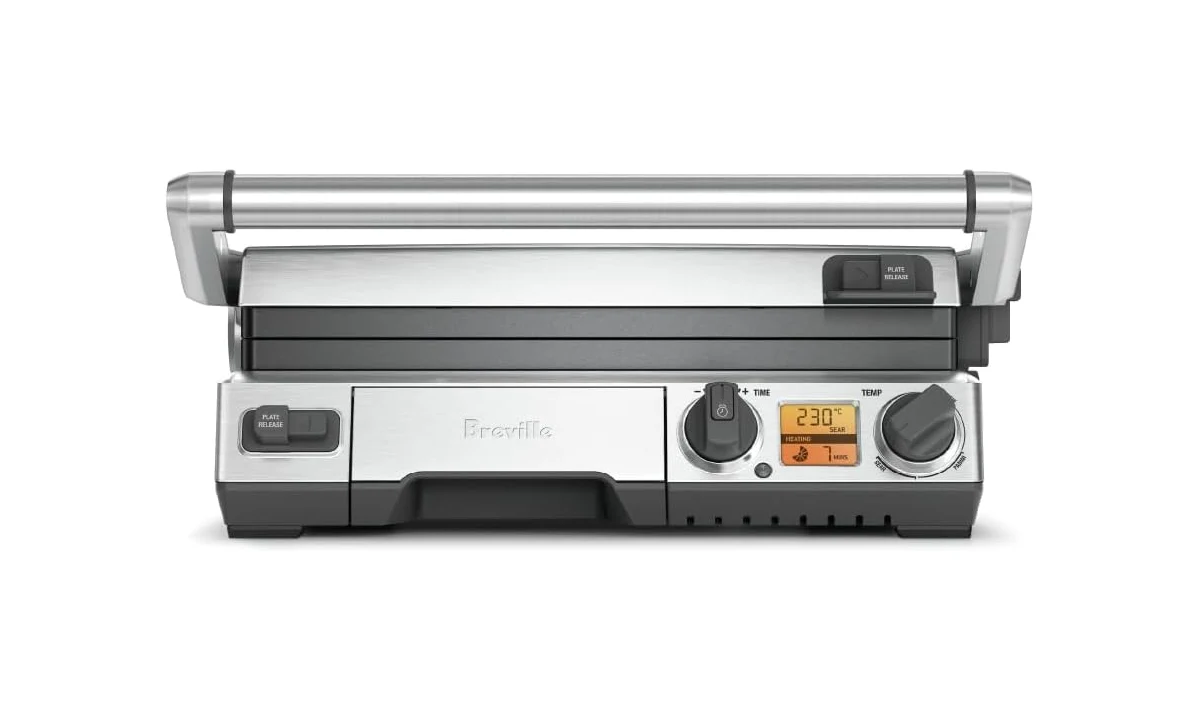
The Breville Smart Grill BGR820XL makes sense when pressed sandwiches and open-plate cooking are regular jobs, and you have room for a substantial appliance to remain accessible. It can work as a closed contact grill or open flat, with removable heated plates. Its flexibility is useful, but the name Smart should not be read as a promise that the grill measures food doneness or ends cooking when a countdown reaches zero.
This review concerns the US BGR820XL, not the separate Smart Grill Pro. It uses Breville’s current specifications and instructions, with Williams-Sonoma’s original commercial demonstration as additional workflow context. We have not measured plate temperatures, smoke, cooking speed or durability, and the retailer demonstration is not an independent laboratory test. Our recommendation is therefore conditional around the documented construction and the work you want it to do.
Contact grilling and open cooking are different arrangements
In contact use, the upper and lower cooking surfaces act on the food from opposite sides. That suits certain sandwiches and other supported foods, with the upper plate’s position affecting the result. Open-flat use provides a different working surface and requires a different handling routine. Buying the grill for both modes is reasonable, provided both actually fit the meals you prepare.
The open arrangement does not resemble a compact closed sandwich press once it is in use. You need appropriate space for both sides, access for utensils and somewhere suitable for ingredients and serving plates. Measure the intended working area rather than choosing a position from the appliance’s closed dimensions. A product can store neatly while requiring much more room to operate usefully.
Breville advertises 260 square inches of cooking area when open flat. That describes the combined surface, not an unlimited serving capacity. Food shape, spacing and the mix of flat and ribbed surfaces affect how you can use it. Avoid turning the area figure into an unsupported number of portions that ignores the food and cooking method.
The flexibility is strongest for a household that actually switches between contact and open cooking. If you mainly want one quick sandwich, a simpler press can be more proportionate. If you mainly want a broad flat surface, a dedicated griddle may offer a more direct layout. Count the jobs you perform regularly rather than valuing every theoretical mode equally.
The plate arrangement matters to the meal
The selected package uses removable nonstick plates with flat and ribbed surfaces. Those are different cooking interfaces. A ribbed surface and a flat surface do not produce identical contact patterns, and opening the appliance does not make both sides interchangeable in every recipe. Consider whether your usual food suits the supplied arrangement before assuming you effectively receive one uniform large griddle.
The upper plate’s adjustable position is useful for supported foods of different thicknesses. It does not mean every stacked sandwich can be closed with unlimited pressure or that a fragile filling will behave like a firm cut of food. Follow the guide for the supported height arrangement and avoid forcing the mechanism around something that does not fit comfortably.
A sandwich routine is also about filling and moisture. Ingredients that overflow or release liquid create cleanup and handling demands beyond the bread’s size. We do not offer a universal recipe that makes every filling suitable. Start with the manufacturer’s supported examples and evaluate the complete result rather than judging only the attractive lines left by a ribbed plate.
The plates contain heating elements as part of the removable design. That is a specific construction feature, not a promise that every spot remains at an identical measured temperature. We have not performed that measurement. If temperature uniformity is the decisive buying requirement, seek relevant exact-model testing rather than treating embedded elements as sufficient evidence of a laboratory result.
Temperature control is not internal-food control
Breville specifies 1800W and an electronic temperature-control arrangement with an LCD. Those features describe the appliance’s heating and interface. They do not establish the internal state of food placed on it. Food thickness, starting condition and cooking method still matter. Use appropriate recipes and food-temperature guidance rather than treating a selected plate setting as a direct reading of the meal.
This model should not be confused with a different grill offering a food probe or another form of doneness assistance. Similar names and stainless styling can make separate Breville models look more alike than their controls are. Check BGR820XL explicitly when comparing a review, retail package or replacement component. Do not assign features from the Smart Grill Pro to this model because of a shared product family.
Preheating is part of the documented operation. Allow the appliance to reach the appropriate state before expecting the same behavior as a recipe that assumes a preheated plate. Adding food changes the cooking conditions, and the interface can indicate that heating continues during use. That is not, by itself, an instruction to keep adding time or to disregard the food’s actual progress.
For repeated batches, follow the manual rather than assuming the first batch establishes every later outcome. Residue and ingredient changes can affect the working surface, and different quantities place different demands on the routine. The useful ownership habit is observing and adjusting a supported process, not believing that an electronic display removes ordinary cooking judgement.
The countdown does not turn off the heat
One of the most important details in Breville’s instructions is that the countdown timer alerts you but does not stop heating when it ends. Treat it as a reminder within an attended cooking routine. Do not load food, set a timer and leave on the assumption that zero means the plates have switched off. The distinction should be understood before the first meal.
The appliance has a separate inactivity shutdown described in the manual. That is not the same as an end-of-recipe control or a signal that food is ready. Do not use an inactivity feature as a substitute for turning the temperature control off when the cooking task is finished. Follow the stated shutdown and cooling process rather than relying on an unrelated protective behavior.
This matters in a shared kitchen, where another person may reasonably expect an appliance timer to end its heating cycle. Explain the behavior and leave the grill in a clear state after use. A familiar countdown display can encourage the wrong assumption if no one reads the operating guide. The useful Smart feature is accessible control, not a different meaning for the underlying heating task.
If automatic cooking completion is central to your routine, compare an appliance that documents the behavior you need. Even then, food checking and the manufacturer’s instructions remain relevant. The BGR820XL is better suited to someone comfortable attending the process and using the timer as a reminder, rather than someone buying specifically to step away from cooking.
Drip handling and ventilation need a plan
The removable drip tray is part of both contact and open operation. Fit it correctly and follow the manual for tilt and drainage arrangements. The existence of a tray does not make every fatty or overfilled food tidy. Consider where liquid can move, how the tray will be reached and when it should be handled safely after use.
An electric countertop grill should not be assumed smokeless simply because it operates indoors. Food, temperature, residue and the surrounding ventilation affect the experience. We have not measured smoke from this model and do not promise that it avoids triggering an alarm. Follow the manufacturer’s placement and use guidance, with appropriate kitchen ventilation rather than an unsupported expectation of smoke-free operation.
Leave the required space around hot surfaces and plan the cable route before cooking. A location convenient for storage can be unsuitable when the lid is open or the grill is laid flat. Keep the handling area stable and uncluttered. The product’s versatility should not lead to improvised operation in a space that cannot accommodate the mode you have selected.
Use appropriate utensils and protection for the task. A large handle makes the lid approachable, but it does not make all nearby surfaces cool. Learn where the controls, tray and plate releases are while the appliance is not hot. Familiarity helps keep the ordinary routine deliberate when several parts of a meal are competing for attention.
Removable plates help, but do not erase cleanup
Breville identifies the removable plates as dishwasher-safe under its instructions, with hand cleaning also described. Follow the exact process, including cooling, release and handling. The powered body is a different component and should not be treated like a removable cooking plate. A broad easy-clean description does not replace the care instructions for the heating contacts, tray and exterior.
Nonstick surfaces need suitable utensils and cleaning materials. The manual warns against aerosol nonstick sprays, which should not be replaced by a generic assumption that extra spray always makes cleanup easier. Use the approved method and keep residue from accumulating. An appliance can have convenient removable parts while still requiring care to preserve the surfaces that make them convenient.
Check the sink and dishwasher arrangement before buying. Large plates can be awkward in a small washing area and may compete with the rest of the meal’s cookware. If cleanup requires clearing half the kitchen every time, the grill’s flexibility can become less appealing. Consider the complete ownership routine rather than judging solely by how readily a plate detaches in a demonstration.
The drip tray needs its own handling and cleaning plan. Allow components to reach the condition specified for safe removal and avoid spilling collected liquid while moving them. A tray that slides out neatly on an empty display unit can be a different task after a meal. Plan an accessible route to the sink and keep the area around the appliance clear.
A permanent position strengthens the case
The closed dimensions are listed as 14 × 16.7 × 5 inches. That already represents a meaningful part of a small counter, before allowing space for opening and food preparation. Measure the usable work area with the appliance in its intended mode. The distinction between stored footprint and operating footprint is especially important for a product whose major feature is opening flat.
Repeatedly lifting a substantial grill out of a cupboard can reduce how often it is used. We do not assign a portability claim or assume that every owner has a suitable storage shelf. If sandwiches and griddle meals are frequent, a convenient permanent location may justify the appliance. If they are occasional, existing cookware or a smaller press may be easier to live with.
The selected US model needs its appropriate electrical supply. Follow the unit label and regional instructions rather than assuming a plug adapter makes every version interchangeable. Compare replacement plates and other parts by exact model as well. A superficially similar accessory can be the wrong fit for the heating and release arrangement that makes these plates removable.
Alternatives and verdict
A skillet or suitable stovetop griddle can be preferable if you mainly need one open cooking surface and already have an appropriate hob. A smaller sandwich press can serve a narrow occasional task. An air fryer and toaster oven address different cooking arrangements rather than reproducing contact pressure and direct plate cooking. Compare the method you need, not simply the total number of foods pictured in an advertisement.
Choose the BGR820XL for frequent contact and open cooking, with enough work and cleanup space and a willingness to attend the process. Its removable heated plates and adjustable arrangement are meaningful features. Skip it when compact storage or automatic end-of-cook heating control is essential. The strongest reason to buy this grill is a recurring meal routine that uses its physical flexibility, with the timer’s real behavior understood from the start.