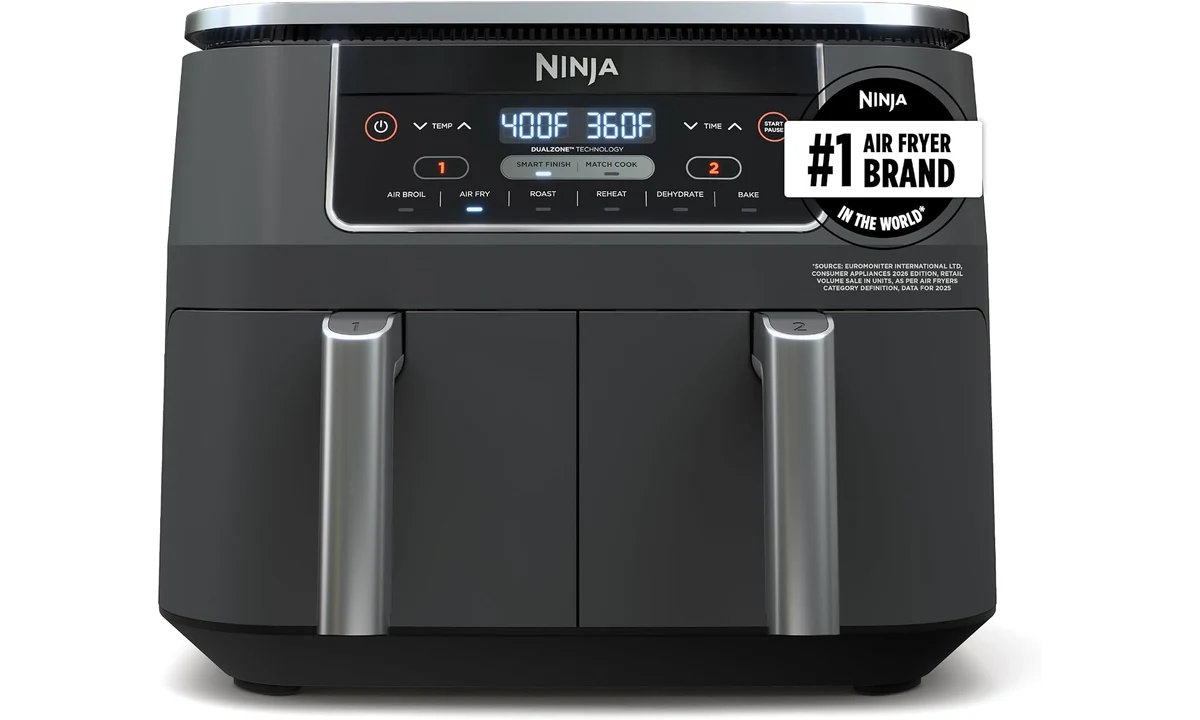
The Ninja DZ201 is worth considering when the meal you want to cook naturally divides into two separate components. Its two baskets can use different settings, and Smart Finish coordinates their selected end times. That is useful for a main and side, but it is not the same as having one large open cooking chamber. The first decision is whether split space suits the food you actually prepare.
This review covers the US Grey DZ201, an eight-quart DualZone model, rather than another Ninja appliance with a similar family name. We use Ninja’s product information and owner’s guide alongside RTINGS’ original testing. We have not cooked with this unit ourselves. Our recommendation is based on the documented controls, capacity arrangement and practical counter-space requirements, with independent observations identified as evidence rather than presented as our kitchen results.
Two smaller spaces can be better than one large one
The nominal total capacity is eight quarts, divided into two four-quart zones. The baskets remain separate. That is useful when foods need different settings or you want to keep components apart while cooking. It is less useful when your ordinary meal includes one broad item that does not fit comfortably into either basket. Adding the two volume figures does not remove the divider.
Think about the shape of your normal food rather than the capacity number alone. Pieces that need space around them use the basket differently from a deep container of dense ingredients. Appropriate loading and airflow still matter. A basket that can physically hold a pile of food is not necessarily arranged for the even result you expect from an air-frying process.
Separate baskets can also simplify different preferences. You might want one component cooked differently from another without mixing them in the same chamber. However, that convenience should not be confused with a validated allergen-isolation system. The appliance shares its setting, handling area and cleaning routine. Specific dietary handling needs deserve suitable procedures rather than an assumption that a divider solves them automatically.
A single-basket model, such as the AF101 already covered on TopDataLLC, can remain more proportionate when you usually prepare one small component. The DZ201 earns its extra width through repeated use of its separate zones. If one basket would remain empty most days, compare the benefit of occasional flexibility with the permanent space and cleaning requirements of the larger appliance.
Smart Finish coordinates your chosen times
Smart Finish manages different selected programs so the baskets finish together. The practical attraction is avoiding a cooked side waiting while another component continues. It is a scheduling feature based on the instructions you provide, rather than a measurement of what is happening inside each piece of food. Incorrect cooking assumptions do not become correct because the timers reach the end together.
Choose supported settings for each component and understand how the function coordinates them before starting. A meal with different preparation needs may still require shaking, turning or checking during the process. Coordinating the end time does not remove those intermediate actions. The convenience is fewer separate finishing calculations, not a fully autonomous meal-preparation system.
If you discover that one component is ready early, use the documented controls for its zone. Do not continue cooking merely to preserve a synchronized finish. Equally, do not serve underdone food because the selected time has expired. Follow appropriate recipe and food-temperature guidance. The appliance manages heat and time; it does not transfer responsibility for checking the result to the display.
A practical first session should use familiar suitable foods and a manageable quantity. Learn what happens when you pause one zone, remove a basket or adjust a setting. Testing the controls with a simple meal is more informative than attempting several unfamiliar recipes at once. You want to understand the coordination before depending on it during a busy family dinner.
Match Cook is a different convenience
Match Cook copies compatible settings between zones. That is useful when both baskets contain similar food and you want to avoid entering the same choices twice. It does not create one larger basket or make different loads behave identically. A more heavily filled side or differently sized pieces can still need separate attention even when the displayed settings match.
The distinction between copying and coordinating is worth learning. Smart Finish is aimed at different cooking arrangements ending together, while Match Cook is aimed at using corresponding settings across the baskets. Confusing the two can make the controls seem more complicated than they are. Start with the actual meal requirement and choose the function that addresses it.
Ninja’s guide places limits on Air Broil: it cannot operate in both zones simultaneously or through Match Cook. That is a meaningful exception to a casual claim that every function is freely duplicated across both sides. If simultaneous broiling is central to your plan, this limitation should affect the purchase rather than being left as a surprise after installation.
The exact model matters here. Ninja’s wider DualZone family includes different capacities and feature combinations. A demonstration of another model may show a control or capability absent from the DZ201. Follow the applicable guide and compare the actual control panel. A shared brand or similar two-drawer appearance is not a complete specification.
Six programs do not replace every kitchen tool
The DZ201 offers Air Fry, Air Broil, Roast, Bake, Reheat and Dehydrate. Those labels provide different supported operating arrangements within the same basket appliance. They do not mean that the physical space, food handling and results become identical to a full oven, a contact grill or a dedicated dehydrator. Assess the tasks you will use regularly rather than counting program names as separate appliances automatically replaced.
Baking is still constrained by basket shape and appropriate accessories. A recipe designed around a broad oven tray may need a different method or vessel, and a vessel fitting the basket does not establish that every material is suitable. Use the manufacturer’s guidance rather than improvising around an attractive recipe photograph. The appliance needs room for the food and the intended airflow.
Reheating can be useful for appropriate foods, but follow reliable instructions for the particular meal. We do not provide a universal temperature or time that applies to every leftover. Portion size and food composition vary. The buying advantage is access to a controllable process, not a claim that pressing a program label makes every ingredient ready without further thought.
Dehydration introduces a different time commitment and loading pattern. Consider whether you actually want that routine and have room to leave the appliance working as instructed. It may be a useful occasional feature, but it should not obscure the decision about ordinary air-frying meals. A long list of possible jobs only adds value when those jobs fit the household’s habits.
Independent testing supports a qualified recommendation
RTINGS found generally good air-frying results, quick heating and useful cooking surface area, while reporting bulk and some unevenness. Those findings support treating the DZ201 as a capable two-basket option with practical tradeoffs. They do not establish a fixed cooking time or identical texture for every ingredient, load and unit. We have not reproduced the tests ourselves.
The observation about uneven results is relevant to how you load and attend to food. More capacity does not remove the need to follow guidance about spacing and turning. A large appliance can be underused through overcrowding just as a small one can. Judge the result of the whole batch rather than one attractively browned piece at the top.
Do not turn an independent speed observation into a promise that every meal is quicker than using your existing oven. Preheating, preparation, batch size and cleanup all contribute to the complete task. The DZ201 can be more convenient for some meals and less convenient for others. Evaluate the dinner you normally make, including the parts that happen before the cooking timer starts.
An air fryer is also not evidence of a nutritional outcome by itself. The food, quantity and preparation determine more than the appliance category. We do not repeat broad health or fat-reduction marketing as a reason to purchase this model. The useful case is a cooking arrangement that suits your meals and makes the routine easier to manage.
Plan for the working footprint
The DZ201 is a substantial countertop appliance, and RTINGS specifically identifies its bulky design. Leave the placement and ventilation space required by the manufacturer. The closed body is only part of the working footprint: you also need room in front to pull out baskets and somewhere appropriate to place a hot basket during handling. A tight shelf fit is not the same as a workable cooking location.
Think about the route between the appliance, preparation area and serving plates. Two baskets can create more movements than a single tray if the counter is crowded. Keep the intended handling space clear and use appropriate protection for hot components. A small kitchen can still accommodate the appliance, but it should be planned as a working tool rather than squeezed into the last available gap.
If you intend to store it after every use, consider the effort of moving and cleaning a two-basket unit. A product can be attractive for occasional entertaining yet inconvenient for everyday lifting from a low cupboard. Permanent counter space makes the proposition more persuasive for frequent use. Occasional use should justify the storage cost as well as the purchase price.
Confirm the regional electrical version and follow the label and manual. A US model should not be treated as an interchangeable appliance for a different mains supply merely by changing the plug arrangement. This review concerns the selected US retail model. Choose equipment intended for the location where you will actually use it and plan its appropriate electrical connection before installation.
Cleaning both zones is part of ownership
Allow components to cool and clean baskets and crisper plates according to the supplied instructions. Follow the maker’s distinction between removable food-contact parts and the electrical body. A claim about dishwasher suitability for a removable part does not mean the whole appliance is washable. Keep the cooking area and ventilation openings in the condition the manufacturer requires.
Two baskets can be useful for separate foods, but using both also creates two sets of food-contact parts to handle. Consider the sink and dishwasher space, especially after a meal that already produces other cookware. The appliance’s usefulness is the combination of cooking and cleanup. A meal that finishes together can still leave an inconvenient washing routine if the kitchen is not arranged for it.
Use suitable utensils and avoid treating a nonstick surface as indestructible. Follow the care instructions for the coating and any removable components. If parts become damaged, identify replacements by the exact model and side where relevant rather than assuming every Ninja basket is interchangeable. A similar handle or capacity label does not establish a correct replacement fit.
Verdict for a two-component meal routine
Choose the DZ201 when you regularly want separate cooking settings, can use its finish-time coordination and have room for the full handling and cleaning arrangement. Its split capacity is a strength for that household, provided the food fits the individual baskets and the owner understands the difference between Smart Finish, Match Cook and actual doneness.
Choose a smaller single basket for modest one-component jobs or a different cooking format when one broad item is the priority. Check the exact model and program restrictions before ordering. The DZ201 is a sensible tool for a planned mains-and-sides routine, rather than a universal replacement for every oven task simply because the combined capacity sounds large.