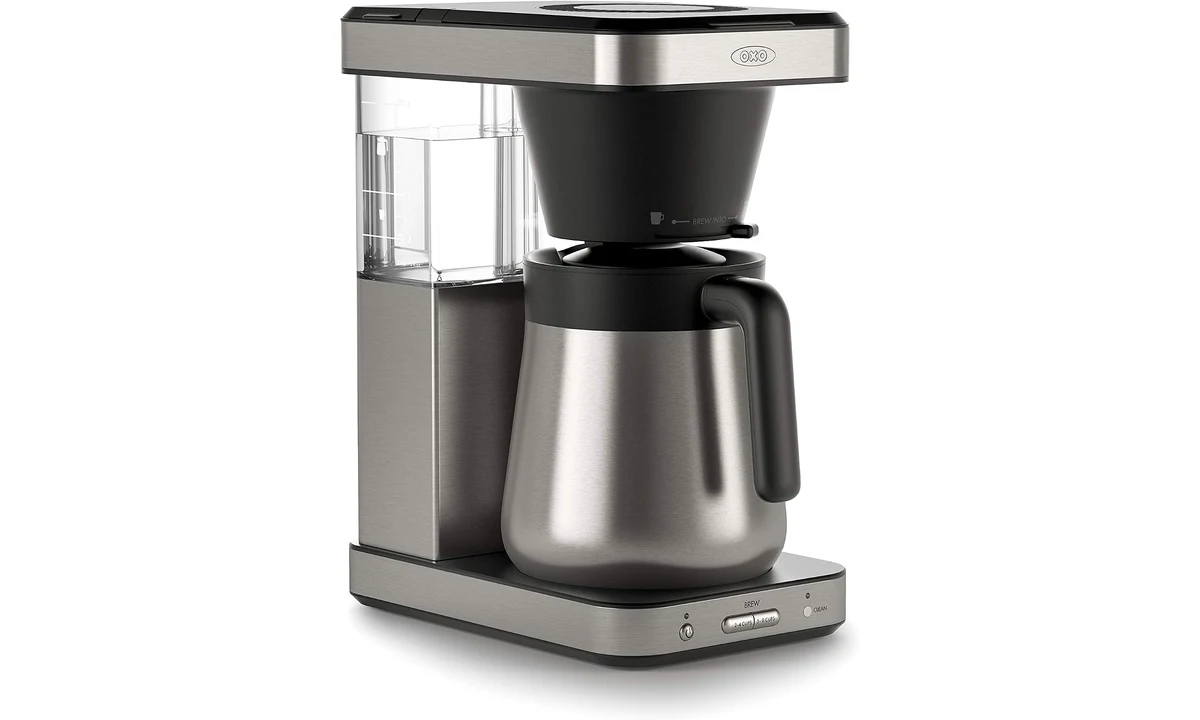
The OXO Brew 8-Cup is for someone who alternates between a single mug and a batch of filter coffee, and is happy to start the brew manually. Its thermal carafe and separate single-serve arrangement are the useful features. The fixed reservoir is the main practical compromise. Before buying, understand that the machine uses all the water you put in for each brew, rather than holding a full tank and dispensing a separately selected portion.
This review concerns the US 8718800 model, not the programmable OXO 9-Cup or another brewer with a similar stainless finish. It combines OXO’s current information and instruction manual with Tom’s Guide’s original test. We have not measured brewing temperature, retention or flavour ourselves. Our recommendation depends on refill access, serving size and whether a straightforward manual-start routine fits the way you make coffee.
Eight coffee cups are not eight large mugs
The capacity label uses the manufacturer’s coffee-cup measure. It should not be read as a promise to fill eight large mugs. Start with the vessels you actually use and how many people need coffee together. A household sharing modest servings makes a different demand from several people each filling a large travel mug before leaving home.
The single-serve capability helps when you do not want a full carafe, but it is a separate setup rather than an automatic recognition of whatever cup is underneath. You need the appropriate basket arrangement, filter and amount of water. Think about how often you will change between one mug and a batch, and whether keeping the necessary parts accessible is convenient in your kitchen.
A brewer’s nominal maximum also does not establish the ideal quantity for every recipe. Follow the manual’s supported ranges and proportions. If your ordinary requirement lies outside them, choose a machine designed for that job rather than stretching a capacity label. The best purchase is the brewer that handles the amount you repeatedly prepare, not the one with the most impressive cup count on the shelf.
Consider refills as well as first servings. A household that drinks a batch gradually has a different routine from one that needs several fresh batches close together. The thermal carafe is part of that sequence: it has to be emptied, cleaned and returned appropriately. Buying around total daily consumption alone can hide the more useful question of how the servings are distributed through the morning.
Fill only the water you intend to brew
The manual states that the machine uses all the water added to the reservoir for each cycle. This is an important difference from a machine that meters one chosen serving out of a larger stored supply. If you only want a mug, add the appropriate water for that mug under the instructions. Filling the tank to the top does not create a convenient reserve for later single servings.
This makes a measuring vessel part of the ordinary workflow. You may use an appropriate jug or the serving vessel in the way the manual describes, while avoiding spills around the appliance. A clearly planned filling routine is more useful than repeatedly guessing at the tank. The control panel does not compensate for adding a different amount of water from the amount your recipe expects.
The reservoir is fixed rather than removable. Tom’s Guide’s reviewer identified that as the main inconvenience despite liking the machine’s coffee and straightforward operation. Think about the location of the tap, the container you will pour from and the available access above the brewer. A machine that looks compact on the counter can still be awkward to refill beneath a low cabinet.
Check cleaning access too. You cannot simply carry the whole reservoir to the sink as you could with a removable tank. Follow the manufacturer’s method for maintaining it. If lifting and pouring a separate vessel is the part of coffee making you most want to avoid, this design may be a poor fit regardless of how attractive the carafe or controls appear.
The single-mug arrangement has its own parts
OXO supplies a single-serve basket accessory to use with an appropriate filter. That insert changes the brewing arrangement for a smaller quantity. Keep it identifiable and use the filter guidance for the specific setup rather than assuming the paper used for a full batch is interchangeable with every insert. A familiar-looking basket can still require a different filter shape or placement.
The well cover can elevate a shorter mug or be removed to make room for a taller one. Check your actual vessel before choosing the appliance around a travel-mug photograph. Height, width, handle position and the pouring path all affect practical fit. Do not assume every insulated mug fits merely because the brewer supports single servings in principle.
A single-serving option can reduce the need for a separate manual brewer, but it does not eliminate the supporting steps. You still measure water and coffee, install the appropriate filter and clear the grounds afterward. The Hario V60 and AeroPress guides elsewhere on TopDataLLC describe different approaches to a modest serving. Compare the complete routine rather than only the number of buttons pressed.
If you switch frequently between a mug and a carafe, choose a place for the unused accessory where it remains clean and accessible. Parts stored at the back of a cupboard can make a useful advertised feature inconvenient in practice. A brewer earns its flexibility when the alternate arrangement is easy to use on an ordinary busy morning.
A thermal carafe changes how coffee stays warm
The OXO uses a vacuum-insulated thermal carafe rather than continuing to heat coffee on a hot plate. That is a meaningful design choice for someone who wants to serve a batch over time. It does not establish that coffee remains at a preferred temperature indefinitely. Initial conditions, quantity, serving habits and the vessel all affect how the experience develops.
The brew-through, pour-through lid is intended to reduce handling between brewing and serving. Follow the manual for fitting and using it correctly. An insulated body cannot compensate for an incorrectly assembled lid or an unsuitable cleaning routine. Familiarize yourself with how it opens and closes before deciding whether the carafe is comfortable to use when full.
Preheating and serving arrangements should follow the maker’s guidance rather than an improvised claim about exact heat retention. We do not assign a measured number of hot hours to this carafe. Someone who drinks immediately and someone who returns much later are assessing different needs. Choose according to your actual interval between brewing and drinking, with realistic expectations about any unheated vessel.
If you prefer a freshly prepared cup every time, the thermal carafe may be less central to the decision than the single-serve setup. If several people share a batch, its handling becomes more important. Consider grip, pouring and cleanup, not just the stainless appearance. The vessel is a daily interface with the coffee, rather than a decorative accessory beneath the machine.
Straightforward brewing means giving up a wake-up timer
The 8-Cup starts manually and does not offer the programmable wake-up routine associated with the different 9-Cup model. That is a clear purchasing distinction. If you want coffee ready automatically at a chosen morning time, compare a brewer that documents that function. A simple control layout is an advantage only when the actions left to you fit your schedule.
OXO’s brewing system manages aspects of water delivery and the brew cycle, including a bloom arrangement and showerhead distribution. The brand identifies the machine as SCA-certified. Those are relevant features, but they do not establish that every coffee, grind and dose will produce a drink you like. The machine controls part of a process that still depends on the ingredients and setup.
A grinder remains a separate choice. The Ode Gen 2 and OXO conical grinder guides address different ways to prepare coffee for brewing. Choose a suitable grind and use the brewer’s guidance as the starting point. If a batch tastes weak or harsh, assess the coffee, water and proportions rather than assuming a certification label makes those variables irrelevant.
Make adjustments deliberately. Changing beans, grind and dose together can make it difficult to learn what improved the result. Keep a simple record if you are establishing a new routine, particularly when several people share the machine. Repeatable preparation is more useful than chasing an elaborate recipe that no one can reproduce before work.
Cleaning separates the removable parts from the appliance
OXO specifies hand washing for the carafe and lid, with top-rack dishwasher suitability for certain listed removable brewing components. Follow the supplied instructions for each part rather than applying one cleaning rule to the entire machine. The electrical brewer, reservoir and removable filter accessories have different roles and need appropriate treatment.
The cleaning mode supports maintenance, but it does not remove ordinary washing or the need to address mineral buildup as directed. Water conditions and use affect the routine. Keep appropriate supplies available and follow the stated process instead of waiting until performance changes during a morning when coffee is needed quickly. A simple brewer still has a water path that needs care.
Clear wet grounds and filters through a suitable household routine. A single cup can use fewer ingredients than a batch while still leaving a basket to empty and rinse. If your goal is almost no interaction with wet grounds, compare that preference honestly with the convenience and waste implications of another brewing format. The OXO’s simplicity does not mean it becomes a sealed cartridge system.
Dry and store the single-serve insert and other removable pieces sensibly. Missing or poorly cleaned accessories can make the alternate serving mode less attractive over time. The ability to brew different quantities is only valuable when both arrangements remain ready for use. Maintenance should preserve the flexibility that was the reason to buy the appliance.
Compare the whole morning routine
A manual pour-over can be preferable if you mostly make one serving, enjoy managing the pour and want less permanent equipment. A programmable batch brewer is the more relevant alternative if automatic morning preparation is essential. The OXO sits between those routines: it automates the brewing process after setup without supplying the delayed-start function some households expect from an electric coffee maker.
A larger batch machine can make sense when the actual mug requirement exceeds this brewer’s useful serving range. Conversely, buying extra capacity for rare guests can consume space every day. Compare the frequency of the large occasion with the ordinary routine. A second modest batch may be acceptable occasionally even when it would be inconvenient as the default arrangement.
Current prices, filters, warranty terms and package contents belong in the final comparison. We do not assign a permanent value ranking based on an old review price. A brewer with fewer features can be better value when it does the exact job you need, while a cheaper machine that lacks a required timer or refill arrangement can be the less useful purchase.
Verdict
The OXO Brew 8-Cup is a sensible option for someone who wants straightforward drip coffee, alternates between a mug and a carafe and can manage a fixed reservoir comfortably. Its thermal serving vessel and small-batch arrangement are practical strengths. The important limitations are manual starting, the all-water-per-cycle behavior and the need to keep the alternate basket and filters ready.
Choose a different brewer if a removable tank, delayed start or a larger ordinary batch is central to your routine. Check mug fit and refill access before ordering, then establish a repeatable recipe and cleaning habit. The OXO makes its strongest case through a coherent everyday workflow, rather than through an assumption that an eight-cup label or certification settles every preference about coffee.