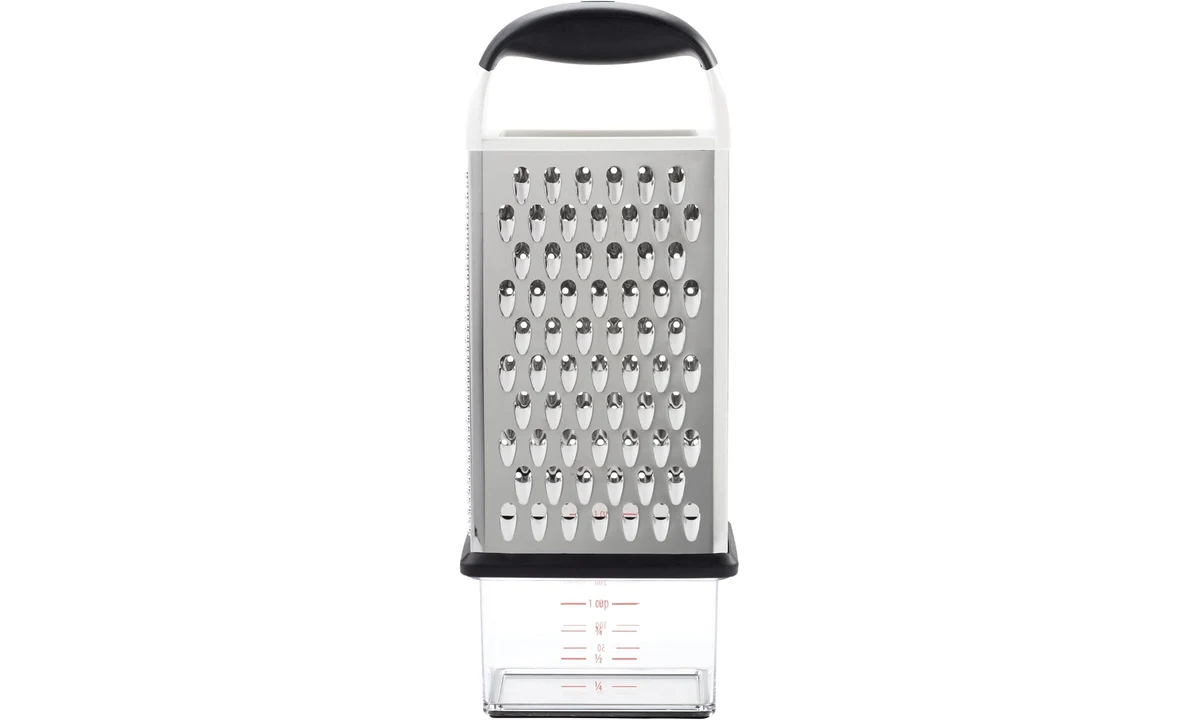
The OXO Good Grips Box Grater is an everyday preparation tool whose appeal lies in the details around its cutting surfaces. A comfortable handle, a stable base and a container that catches the results can make a modest kitchen task less awkward. Those features matter more than treating a familiar four-sided shape as automatically equivalent to every cheaper grater.
This research review concerns OXO’s standard Box Grater, SKU 1057961, rather than its separate etched model with a removable zester. We use the manufacturer’s product information and Good Food’s independent testing to examine where the tool is useful, why the collection container is a mixed benefit and when a narrower specialist tool would be a more sensible purchase.
Know which OXO grater you are buying
OXO sells more than one grater that can appear similar in a small retailer image. The standard model here has four stainless-steel faces and an attached collection container. It is not the Etched Box Grater with Removable Zester, and features from that other model should not be assumed to apply.
The official description identifies two wider faces for coarse and medium grating, plus narrower faces for fine grating and slicing. That is a useful range for ordinary ingredient preparation. It does not mean each face replaces a dedicated specialist tool equally well, or that the slicing face offers all the adjustment and control of a separate slicer.
Before ordering, match the model identifier, product name and actual photograph. If a listing uses standard and etched descriptions interchangeably, clarify the item being supplied. Buying a multipurpose tool for a particular removable component that belongs to a different product is an avoidable disappointment.
The value of the four-sided format
A box grater gives you several textures without changing a blade insert. That can be useful when preparing different ingredients during the same meal: a coarse texture for one component, a finer result for another, and occasional slicing when appropriate. The upright format also gives a handle to stabilize the tool while working on a suitable surface.
The trade-off is bulk. Even a relatively slim box occupies more volume than a flat grater, and all of its faces need appropriate care during storage. If you only grate a small amount of hard cheese at the table, carrying a box tool through the whole storage-and-cleaning routine may be unnecessary.
Think about the task you repeat most often. A box format is more persuasive when you genuinely use several of its surfaces over time. It is less persuasive when the feature count mainly describes things you could theoretically do, while a single specialist surface would suit nearly everything you prepare.
What Good Food’s tests contribute
Good Food’s review liked the comfortable grip, solid base and useful range of surfaces. Its testers found the tool capable with ingredients such as cheese and vegetables, while identifying two specific drawbacks: the collection box was small and the fine zesting surface could retain food that was awkward to clean.
Those findings are helpful because they describe more than initial sharpness. A grater can perform well during preparation yet become frustrating when ingredients lodge in a face or the collection container needs repeated emptying. The right assessment includes the work before and after the food has been cut.
The review’s positive recommendation should not be read as proof of a fixed service life or identical performance on every ingredient. Different food textures and preparation quantities change the job. Use the independent result as support for the design, while keeping the stated cleaning and collection limitations visible in the purchase decision.
Coarse and medium surfaces: choose the result deliberately
Different grating textures change how an ingredient behaves in the finished dish. A coarser result may suit a mixture where visible pieces and texture are desirable; a finer result can distribute an ingredient differently. The useful choice starts with the recipe’s intended texture rather than using whichever face is easiest to reach.
With a multipurpose grater, it is easy to turn a convenience into inconsistency by switching surfaces without noticing. Keep track of which face produced the result you liked in a recipe. That is particularly useful when repeating a preparation and trying to understand why the texture differs from the previous attempt.
The grater is still a manual tool. You control pressure, angle and how the ingredient contacts the surface. If the task requires uncomfortable force, stop and reassess the ingredient, tool and method rather than treating more effort as the default solution. A stable tool and an appropriate task matter more than a reassuringly familiar brand name.
The fine face and the specialist-zester question
A fine surface is convenient when you want to work with a smaller texture without taking out another tool. Good Food’s cleaning caveat matters here: material can remain caught in the fine teeth. That can make the final cleaning step disproportionately awkward compared with a quick coarse-grating task.
If fine zesting is your main reason to buy, compare a dedicated narrow zester. Its shape may suit the ingredient and the way you prefer to work more naturally. That is not an argument that a box grater’s fine face is useless; it is a reminder to compare tools against the dominant job rather than a list of occasional possibilities.
Do not assume the standard model’s fine face detaches. That feature belongs to a different OXO product. If removing a zesting surface for cleaning or serving is essential, verify the actual model that provides it. The distinction is easy to miss when retailer titles compress several product names into similar wording.
Slicing is a separate use, not a mandoline replacement claim
The fourth face provides a slicing surface. That broadens the tool’s usefulness, but should not be taken as evidence of adjustable thickness or a complete food-holder system. Assess whether the fixed arrangement suits the ingredient and the level of control your task requires.
As with any sharp manual preparation tool, keep attention on hand position and follow the supplied use guidance. A comfortable handle helps the stabilizing hand; it does not remove the cutting edge from the other hand’s path. Stop before a small remaining piece becomes difficult to hold safely, rather than trying to extract the maximum possible amount from it.
Someone who regularly prepares larger quantities of evenly sliced ingredients may prefer a tool designed specifically for that purpose, with appropriate guarding and instructions. For occasional use, the grater’s slicing face may be enough. The distinction is about the intended workflow and control, not simply whether both tools can produce a slice.
The container changes where the gratings go
OXO’s collection container attaches beneath the grater and includes measurement markings, a lid and a non-slip base. That can reduce the need to transfer freshly grated ingredients from a board into another vessel. It can also help organize a small amount of prepared food during a cooking session.
Good Food’s observation that the box is small is a meaningful limitation. For a larger task, frequent emptying may interrupt the rhythm or make grating over a board more convenient. Decide whether your usual quantity matches the container’s role before treating it as the feature that justifies the purchase.
The markings are useful for approximate recipe preparation, but they should not be treated as a substitute for weighing when a recipe specifies ingredient mass. Loose grated food can pack differently depending on its texture and how it settles. If repeatable weight matters, a suitable kitchen scale answers a different measurement question from the lines on a collection box.
The lid is a convenience for collecting and organizing prepared food; its presence alone does not establish that the container is suitable for heating, freezing or every other storage use. Check the supplied care instructions before giving it a job beyond the one described by the manufacturer. Avoid inferring an airtight-storage claim from a photograph of a fitted lid.
Working without the collection box
The detachable container gives you a choice about where to grate. For a task that exceeds its convenient working volume, preparing over an appropriate board or vessel may be simpler. The best arrangement is the one that keeps the tool stable and leaves a clear place for the ingredient to collect.
Consider the entire work area. A handle, a non-slip element and a convenient container do not compensate for an unstable support surface or an overcrowded counter. Give yourself room to control the ingredient and see what is happening. That can make more difference to ease of use than an extra surface you rarely need.
If you often switch between ingredients, think about whether the faces need cleaning between steps and where wet pieces will be placed. The box format gathers several functions in one object, but it also means one object can carry residue from one task into another. Good organization remains part of useful preparation.
Cleaning and storage are buying criteria
Good Food identifies the grater as dishwasher-safe, but follow the care information supplied with your particular unit. Fine teeth may still need attention where food remains lodged. Handle the sharp surfaces carefully and use an appropriate cleaning tool rather than running fingers over the cutting edges.
The container can store inside the grater, according to the independent review, which helps keep the pieces together. That is useful only if the storage space fits the assembled shape. OXO lists dimensions of 2.9 by 4.5 by 11.8 inches, so check the relevant drawer or cupboard rather than assuming slim means it will fit anywhere.
Also consider neighboring utensils. A sharp box grater loose in a crowded drawer can be awkward to reach around. A deliberate storage position keeps the surfaces from snagging other items and makes it easier to take the tool out safely. Count that space as part of the purchase, particularly in a compact kitchen where every frequently used item needs an accessible home.
Manual grater or powered processor?
For modest quantities, a manual grater can avoid setting up a motorized appliance and cleaning its bowl and attachments. You still supply the effort, so repeated larger preparation may favor a suitable powered processor. The best choice depends on quantity, frequency and what you already own.
Our Hamilton Beach bowl-scraper processor guide discusses a different preparation approach. A processor is not automatically better because it is powered; it adds storage and cleaning requirements of its own. Equally, a manual tool is not automatically simpler if the actual task is large enough to become tiring.
If your current processor already has a suitable shredding accessory, consider whether adding a box grater solves a smaller recurring job that is inconvenient to set up electrically. That is a useful reason to own both. Buying a second tool solely because it has a familiar shape or a positive review is less persuasive than identifying the task it will make easier.
Who should choose this model?
The standard OXO Good Grips Box Grater is a reasonable choice for a cook who wants several everyday textures in one stable manual tool and will make genuine use of the detachable collection container. The independent evidence supports its grip and general usefulness, with the small container and fine-face cleaning as concrete limitations.
Choose a flat grater or specialist zester if one narrow task dominates and storage is tight. Compare a suitable processor if volume and effort are the main problems. Before purchase, confirm SKU 1057961 and check that you are not expecting features from the separate etched model. The best case for this grater is practical versatility, not the assumption that four surfaces automatically replace every other preparation tool.