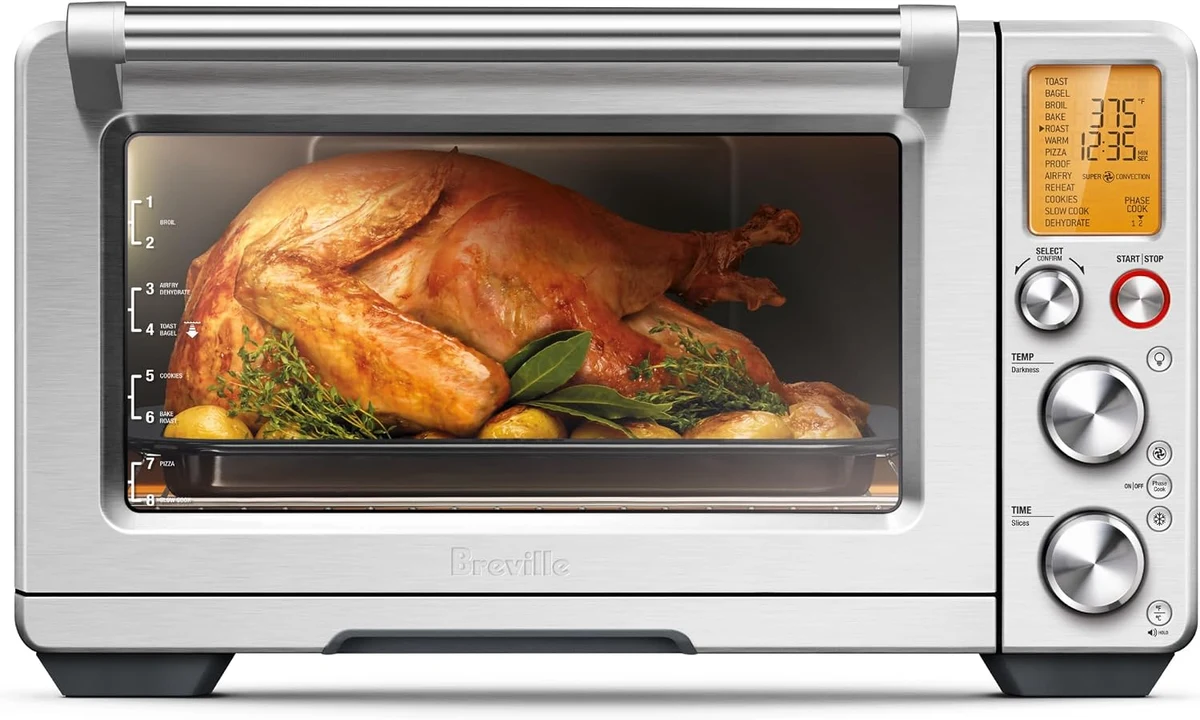
The Breville Smart Oven Air Fryer Pro BOV900BSS is most convincing when you want a substantial countertop oven for tray meals, baking and roasting as well as air frying. Its large chamber is the central feature. If the everyday job is warming one small snack or making a quick round of toast, that same chamber can mean unnecessary preheating, counter space and cleanup rather than a meaningful upgrade.
This assessment covers the brushed-stainless US BOV900BSS, not the Joule BOV950 or the smaller Mini Smart Oven. We use Breville’s current specifications and instruction book alongside RTINGS’ original testing. We have not cooked with or measured this unit. The recommendation depends on the meals, cookware and permanent kitchen space that would make its size worthwhile, with the independent test findings kept distinct from manufacturer claims.
The chamber should solve a recurring space problem
Breville describes capacity through familiar examples, including toast, a pizza and suitable rectangular baking equipment. Those examples help explain the category but are not universal serving counts. Bread dimensions, food shape, cookware handles and rack position change what fits. Start with the actual pan or meal you want to prepare rather than assuming any object with a familiar capacity label will work inside.
This is a more natural option for someone who regularly wants an oven-style tray arrangement than for someone who simply wants more nominal air-fryer capacity. A drawer-style air fryer and an open rack chamber organize food differently. A tray can provide a broad surface, while a basket has its own handling convenience. The Ninja AF101 and DZ201 guides on TopDataLLC address different versions of that basket decision.
A family could also value a second cooking space when the main oven is occupied. That role depends on the specific meal and available work area. It does not establish that the BOV900 can replace every function or cookware arrangement of a full-size oven. Think through what would move into this appliance on an ordinary week, not just on the rare occasion when several meals need to finish together.
Buying for hypothetical capacity has a daily cost in space. If the larger task happens infrequently, compare using existing equipment for that occasion with keeping a large countertop oven in place all year. The BOV900’s strongest case is repeated use of the chamber and racks. Paying for physical flexibility you seldom use can be less satisfying than choosing a simpler appliance that suits normal meals.
Thirteen programs still share one cooking chamber
The BOV900 offers thirteen functions, including baking, roasting, air frying, proofing and dehydration. These are different supported operating arrangements within the same oven, not thirteen independent appliances available at once. Two foods with incompatible temperature and timing requirements still need a plan. A long list of program names should not obscure the practical fact that the cooking space is shared.
Start with the cooking method rather than choosing a program solely from the name of the food. A reheated slice, a tray of vegetables and dough rising before baking present different needs. Use the manufacturer’s guide for suitable rack positions and settings. The oven’s controls make the supported method accessible; they do not identify every ingredient, determine its starting condition or establish internal food doneness automatically.
Proofing and dehydration can add genuine value when you already want those routines. They also commit the chamber and counter position for a different kind of session from a short bake. Consider whether another person needs the oven while that task is running. Versatility is useful when the household can use it deliberately, rather than when one long program repeatedly conflicts with the appliance’s main meal role.
The Smart name should not be read as an app feature. This BOV900 is different from the Joule model, whose connected functions belong to another product. Compare the exact model if remote guidance or a particular connected workflow is the reason to buy. Similar styling and overlapping cooking modes do not make software and control features interchangeable across the range.
Stable cooking and quick preheating are separate strengths
RTINGS found stable temperatures during cooking and useful air-frying results, while identifying slow preheating. That supports a balanced view of the large chamber. It can be a capable place to cook once ready without necessarily being the fastest route to a modest snack. We do not turn the test result into an exact timetable for your food or claim that the oven always beats a full-size alternative.
Preheating belongs in the complete task calculation. A small item that cooks quickly after loading can still take longer overall than expected if you only compare the displayed cooking interval. Conversely, a longer tray meal may make the initial waiting period less important. Decide around the meals you repeat rather than trying to rank every appliance using one isolated stage of the process.
The adjustable convection arrangement is another useful control within the documented functions. Air movement and the selected cooking method affect the result, so follow the guide rather than enabling maximum fan behavior for everything. A setting suitable for one tray of food is not automatically ideal for a delicate bake. The feature is valuable because you can choose the supported arrangement for the task.
The machine does not supply a universal conversion for every existing recipe. Food quantity, vessel shape and the starting state still matter. Establish a familiar recipe first and note what works in your setup. That approach builds a useful routine without treating either the manufacturer’s program label or an independent tester’s outcome as a guarantee about an unfamiliar meal.
Toast should not be the main reason to buy it
RTINGS’ full-capacity testing found uneven browning and a relatively slow toasting process. Those observations matter if breakfast toast is the central job. A large chamber can accommodate more bread while still being a less convenient tool for a quick small breakfast. Evaluate how often you would actually use the larger loading arrangement and whether consistent ordinary toast is more important than occasional capacity.
The Breville A Bit More toaster already reviewed on TopDataLLC serves a different type of breakfast routine. It does not offer the BOV900’s broad cooking methods, but that can be irrelevant if bread is the main task. Compare the method and daily handling rather than assuming the larger appliance makes the simpler one redundant. A countertop oven can be useful without becoming the best tool for every small job.
If you would keep a separate toaster anyway, include both footprints in the kitchen plan. Counting appliances theoretically replaced can exaggerate the amount of space saved. Likewise, removing a toaster only to leave the larger oven inconveniently placed may create a worse working area. The practical question is which equipment remains in ordinary use after the new purchase, not which names appear on a marketing comparison.
Measure the safe operating position
Breville’s manual requires at least 4 inches at both sides and 6 inches above the appliance. Those spaces are part of the installation decision, not optional empty room to reclaim with nearby storage. A body that fits tightly on a shelf is not necessarily in an appropriate operating location. Check the exact manual for placement and the surrounding materials before deciding that a spare counter corner is suitable.
Allow for the door and for handling a hot pan as well. You need somewhere appropriate to move cookware and space to reach it with suitable protection. The closed shape in a product image understates the working arrangement. A kitchen can have enough room to store the oven while lacking a convenient place to operate it with the door open and a meal partly assembled nearby.
The exterior and door can become hot during use. Do not treat the flat top as ordinary storage while cooking. The manual describes particular permitted accessories rather than approving every tray, cloth or decorative item that fits above the unit. Keep placement deliberate, especially where the oven shares a counter with equipment and ingredients used by other people at the same time.
The US unit is rated at 1800W and is intended for the appropriate regional electrical supply. Follow the label, supplied instructions and relevant outlet arrangement. This review does not claim that a plug adapter makes another region’s model suitable. A fixed cooking appliance should be selected for where it will operate, rather than purchased around a familiar brand name and an attractive international listing.
Rack positions and cookware affect usable capacity
The manual assigns roles to different rack positions. Follow those arrangements rather than assuming every shelf location gives equivalent distance from the heating elements. A pan can fit physically and still be placed poorly for the intended method. The useful capacity is the supported space around the cookware and food, rather than simply the volume enclosed by the oven’s walls.
Check handles and rims when comparing your existing cookware. A nominal pan size does not necessarily describe the full outside dimensions. Use appropriate oven-safe vessels and the documented placement, with room for the intended airflow. Replacing a baking dish can be a modest extra purchase or an unnecessary complication, depending on how many familiar recipes rely on equipment that does not suit the chamber.
Multiple racks also introduce a planning question about loading and access. One broad tray and several smaller levels can create different cooking conditions and handling demands. Use the manufacturer’s guidance for the selected mode instead of treating every possible rack combination as interchangeable. Flexibility is an advantage when the arrangement works for the meal, rather than when it merely looks capacious with empty shelves.
Accessories add cleaning and storage work
The wire racks, pans and air-frying basket each need appropriate care after cooling. Follow the current instructions rather than assuming every removable metal item belongs in the dishwasher. Cleaning an open mesh basket after suitable but messy food is a different task from wiping a smooth tray. Include that recurring work when deciding whether oven-style air frying is more convenient than a drawer for your meals.
Breville warns against covering the crumb tray with foil. A shortcut intended to reduce washing can interfere with the appliance’s documented operation. Use the specified care method, remove residue as directed and keep the components correctly fitted. A flexible oven depends on the small supporting parts remaining in their intended condition, rather than only on the main chamber looking clean from the outside.
Plan where unused accessories will be stored. Keeping them inside the oven while it is not operating may be convenient, but they must be handled appropriately before use. If every ordinary meal begins with clearing a pile of unrelated cookware, the appliance has become storage rather than a ready cooking tool. A simple dedicated place for the accessories preserves the convenience that the extra functions are meant to provide.
Verdict for a kitchen that will use the space
Choose the BOV900BSS when tray cooking, baking and roasting are frequent enough to justify a large permanent countertop oven, with air frying as another useful supported method. Its chamber and controls offer meaningful flexibility. Accept the preheating and cleaning commitments, check safe placement and compare your actual cookware before ordering. This is a purchase whose value depends on the surrounding kitchen as well as the hardware.
Choose a smaller oven, basket air fryer or dedicated toaster when the main task is narrower. The existing Mini Smart Oven guide is a useful comparison for a different capacity decision. The BOV900 earns its place by repeatedly doing work that needs its larger chamber; it is less persuasive when bought mainly because thirteen programs sound like an automatic solution to every cooking task.