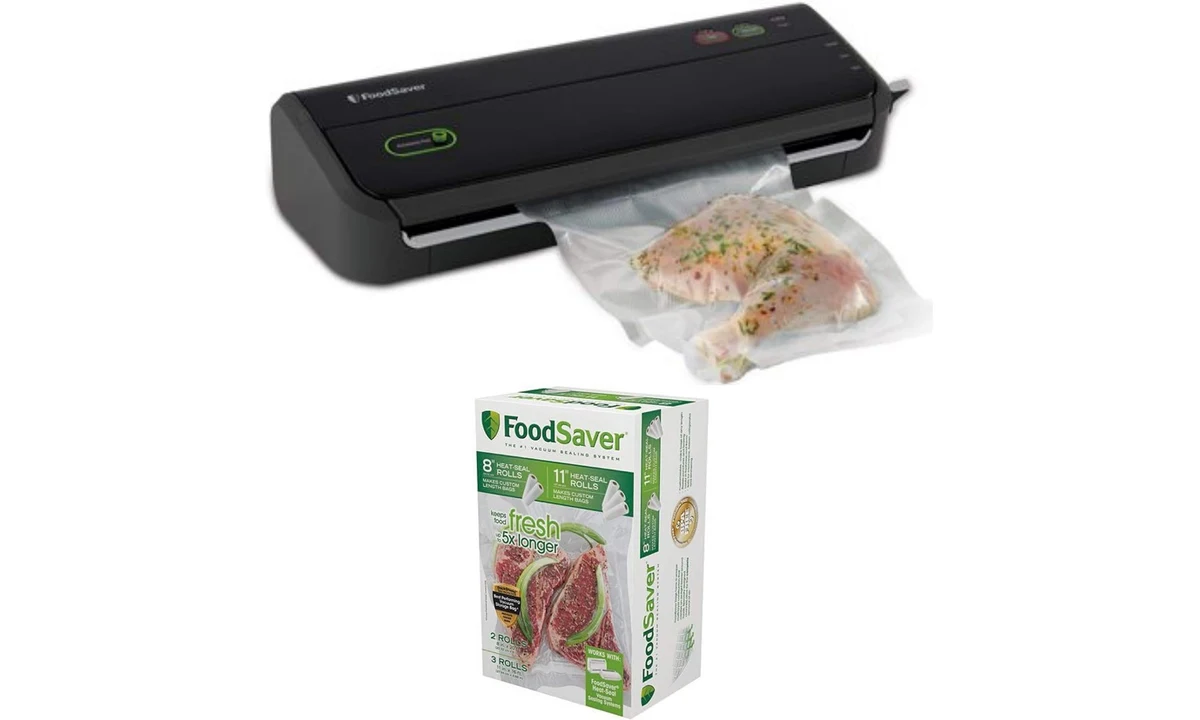
The FoodSaver FM2000 suits a household that wants straightforward vacuum packaging and accepts a manual process around the machine. It can remove air from suitable bags and seal them, but roll cutting, bag preparation, food handling and organized storage remain your jobs. The selected Amazon offer combines the starter kit with additional rolls, which makes package checking particularly important when comparing it with a plain FM2000 listing.
This review uses FoodSaver’s support information and owner’s manual, with The Cooking World’s original assessment as a secondary account of the controls and cleanup. We have not operated this unit. Historical claims about storage life, household savings or years of reliability are not treated as predictions for a new purchase. The useful question is whether this model’s documented workflow matches the food you actually portion and store.
Identify the machine and the bundle
The FM2000 is an external-bag vacuum sealer. The open end of a supported bag sits in the machine while the food remains outside in the bag. That arrangement is different from a chamber sealer, where the whole package is placed inside a vacuum chamber. Understanding this distinction helps explain why bag type, moisture and preparation matter so much to a simple countertop model.
The selected US retail offer adds eight-inch and eleven-inch rolls to a starter package. Treat that as a particular bundle, rather than proof that every FM2000 box contains the same extras. Check the seller’s current contents, regional power arrangement and supplied instructions before paying. A photograph that shows accessories together does not establish that compatible containers or every handheld attachment are included.
FoodSaver’s support record and manual are the authority for the machine itself. The Cooking World’s older review is useful for its discussion of straightforward latch operation and the removable drip tray, but its historic price and package cannot determine today’s order. Avoid comparing offers solely by the large appliance image; the amount and type of consumables can materially change what you need to buy next.
A simple control arrangement
The main jobs are vacuum-and-seal and seal-only operation, with a manual latch securing the lid. This is an intentionally limited interface. You prepare and position the bag, close and latch the machine correctly, then select the appropriate operation. It can be approachable for occasional portioning, especially if an elaborate control panel would add little to the foods you usually pack.
Seal-only operation matters when making a bag from a roll. A roll is a tube rather than a ready-made pouch, so you first create one closed end, add the contents and then complete the vacuum-sealing process at the other end. That extra seal is part of the workload. Precut bags remove the cutting and first-end step, but their sizes and ongoing cost need to match your portions.
The latch is more than a handle used to hold the lid down. Follow the manual’s operating and release positions so the machine can form the intended vacuum arrangement. If a bag does not seal correctly, begin with placement, the bag material and the gasket condition rather than repeatedly forcing the lid or improvising repairs. A simple design still depends on its parts being clean and correctly seated.
Roll cutting and storage are separate tasks
There is no integrated roll-storage compartment or built-in cutter on this model. You need a place for the rolls and an appropriate separate way to cut the required length. That is manageable for occasional use, but it creates a preparation area outside the appliance’s own footprint. Include the open bag, food portions and spare roll when deciding whether the machine fits your counter.
Allow the amount of empty bag specified by the manual so the opening can reach the correct position without food crowding the sealing area. Cutting every bag as tightly as possible can make alignment difficult or waste material when the first attempt fails. A straight, clean opening and suitable working space are more useful than trying to save a small strip while learning the process.
Batch preparation helps reveal whether the manual arrangement suits you. Organize the food and bag sizes before you begin, while still following food-specific handling guidance. If you regularly prepare many differently sized portions, repeated cutting and making first-end seals may become more important than the time taken by the vacuum cycle itself. A model with integrated roll handling could then justify its extra bulk for your routine.
Use bags intended for the process
An external-bag sealer needs compatible textured vacuum bags or rolls. An ordinary smooth freezer bag should not be assumed to work simply because it fits under the lid. The material and air channels form part of the intended system. Use the supported supplies and instructions instead of treating a melted-looking seam or a briefly collapsed bag as evidence that an unsuitable material is reliable.
Check the bag’s separate instructions for any intended cooking, heating or freezing use. The sealer does not grant every bag permission for every temperature or preparation method. Likewise, a successful vacuum cycle does not validate a recipe or make a container compatible with a hose. Compatibility is a chain involving the appliance, packaging and intended storage or cooking process, rather than a single claim printed on the machine.
Consumables are a recurring cost even if you already own the appliance. Estimate the bag shapes and quantity your ordinary shopping produces before choosing a large bundle. A household packaging a few portions occasionally has different needs from one processing substantial batches every week. We cannot establish a universal financial saving because food habits, material waste and the price of replacement supplies vary too much between owners.
Moist foods and liquids need preparation
The FM2000 should not be approached as a machine for simply pulling liquid soup into a loose bag. The manual’s instructions for liquids and moist foods involve appropriate preparation, including prefreezing where directed. Follow those methods for the particular food instead of trying to compensate for liquid entering the sealing area by running repeated cycles or overfilling the package.
Moisture, crumbs and folds at the opening can interfere with the seam you are trying to make. Keep the relevant area prepared as directed and inspect the result before storing the package. The removable drip tray makes cleanup more accessible, but it is not a reason to send food or liquid into the machine. Preventing contamination is preferable to assuming a removable part solves every spill.
Delicate foods raise a different question: whether removing air will crush the contents or spoil their useful shape. Consult the manual’s documented approach and compatible accessory options for that task. Do not assume that a basic vacuum cycle automatically recognizes softness or stops at an ideal texture. If delicate items are your main reason for buying, compare the exact controls and container workflow before choosing this model.
Vacuum packaging is not preservation by itself
FoodSaver explicitly distinguishes vacuum packaging from canning. Removing air does not make perishable food safe to store at room temperature, and it does not sterilize the contents. Perishable items still need appropriate refrigeration or freezing. This boundary matters more than promotional language about keeping food fresh: the appliance changes packaging, while food-specific safety and storage requirements continue to apply.
Keep existing food-handling limits in place and use suitable guidance for what you pack. A package looking tight is not evidence that its contents can ignore a use-by date, storage requirement or safe handling rule. Do not infer safety from appearance or smell alone. The benefit of a neatly sealed portion should be considered alongside the storage conditions it needs, rather than used to extend those conditions by guesswork.
Label packages with useful contents and date information, then organize them so older suitable portions are easy to find. Separate raw-food handling from ready-to-eat preparation and clean the workspace appropriately. The machine cannot create an effective inventory system or prevent cross-contamination on a busy counter. A modest labeling habit often makes packaged food more useful than producing many anonymous bags that disappear into the freezer.
Inspect the seal and allow the machine to pause
The owner’s manual requires a pause between seals. Build that interval into your workflow rather than treating the FM2000 as a continuous production line. During the pause, inspect the completed seam, prepare the next appropriate bag and keep food under suitable handling conditions. Repeatedly pressing controls without respecting the documented interval is not a reliable way to increase throughput.
Begin with a low-stakes practice package and learn what correct placement and a complete seam look like. Follow the manual’s troubleshooting instructions if the vacuum does not form or the seal looks incomplete. A bag that collapses during operation can still be unsuitable if the final closure is defective. Inspecting the outcome is part of packaging, rather than an optional step reserved for obviously failed attempts.
This also explains why no broad storage-life multiplier is appropriate here. Packaging quality depends on the material, contents, seal, handling and later storage. A review of one appliance cannot turn that combination into a universal number of extra days or years. The FM2000 is best judged as a practical tool within an existing storage routine, with the result checked each time.
Cleanup and storage affect reliability
After use, follow the manual’s unplugged cleaning procedure and remove the drip tray for the prescribed care. Keep the sealing area and gasket arrangement free from food residues. Avoid immersing powered parts or inventing a dishwasher routine for components whose instructions do not permit it. The point is to restore the documented working surfaces, not simply wipe the exterior until the appliance looks tidy.
The storage position of the latch matters as well. FoodSaver directs owners to keep it outside the operating position during storage so the gaskets are not left compressed. That is an easy instruction to overlook when putting the machine away after a large session. A little attention at the end of use is more relevant to the next seal than repeatedly increasing pressure on an incorrectly stored lid.
Consider whether you have a dry, accessible location for the machine and a separate organized place for rolls and bags. If it is buried under other appliances, the setup effort may discourage use for small quantities. If it stays on the counter, include the space needed to open the lid and support a bag. A compact body does not eliminate the working area required by an external-bag process.
Accessories, alternatives and the verdict
Compatible containers or a handheld arrangement can serve different jobs, but require the correct connection and exact supported accessories. Check the manual and selected package before buying them. A general mention of accessory compatibility does not mean an arbitrary container lid will form a vacuum, or that every part needed for the intended task arrives in the starter bundle. Price the complete arrangement you would actually use.
A more elaborate external-bag model may be preferable when integrated roll handling, a cutter or different documented controls would remove frequent frustrations. A chamber machine is a substantially different approach with its own size, cost and process, worth investigating if liquids dominate the job. For simple short-term organization, ordinary suitable containers may also be enough; vacuum packaging is not automatically necessary for every leftover or dry ingredient.
Choose the FM2000 when you want basic vacuum-and-seal operation, are happy to cut and store rolls separately and will follow the preparation, pause and cleaning requirements. Pass when you expect continuous batch throughput, effortless liquid packaging or a replacement for refrigerated food storage. Its appeal is a clear, learnable workflow for suitable portions, with the bag bundle understood and no promise that the machine alone will save money or determine food safety.