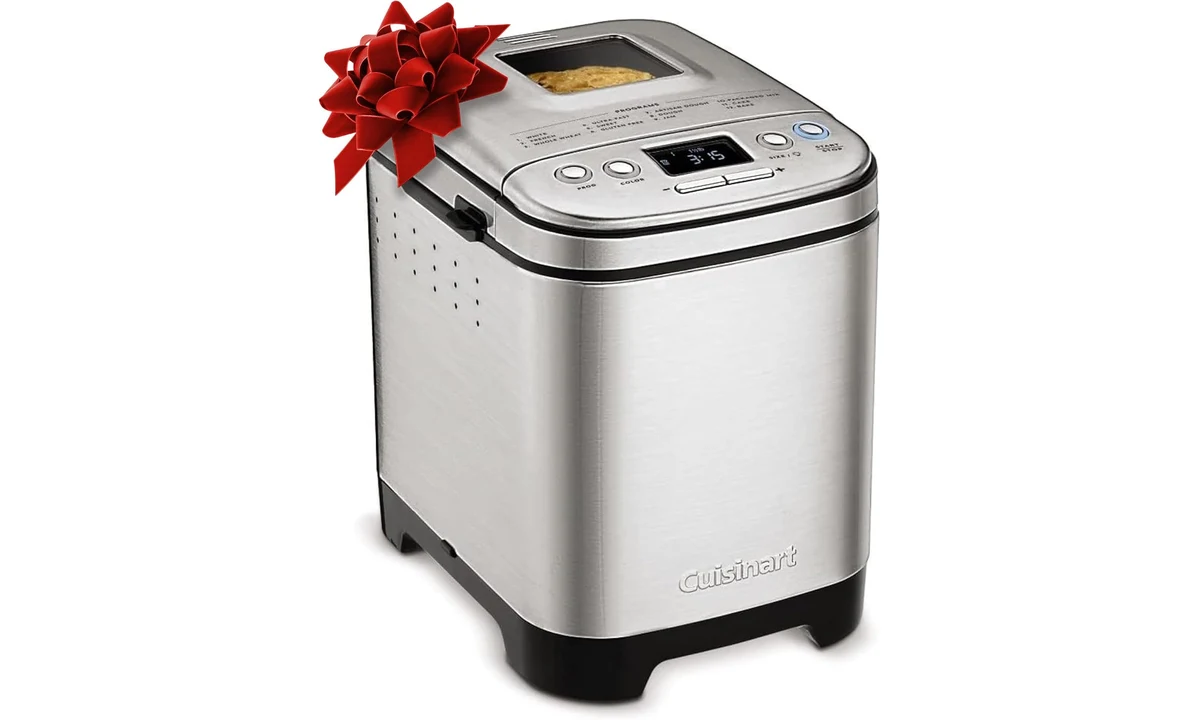
The Cuisinart CBK-110NAS makes sense when you want bread making to become a manageable household routine, but have little interest in arranging a separate mixer, proving space and oven session every time. Its compact vertical pan is the central compromise. You gain a machine that mixes, kneads, rises and bakes a suitable recipe in one place, while accepting a taller loaf and preset control over much of the process.
This assessment uses Cuisinart’s current product information and linked manual, alongside King Arthur Baking’s guidance on adapting recipes for bread machines. That guidance is useful baking evidence, but it is not an independent performance test of this particular Cuisinart. We have not baked in this machine, so the recommendation rests on documented operation and practical fit, without invented crust, noise or taste results.
Start with the loaf you actually want
The current US model is CBK-110NAS. Listings and older discussions can use shorter CBK-110 names or discontinued suffixes, so match the supplied manual and package before ordering. This is the compact vertical-pan design, distinct from the larger Cuisinart CBK-210 and the horizontal, dual-paddle Zojirushi BB-PDC20 already covered on TopDataLLC. Similar stainless styling does not make their pans or programs interchangeable.
Vertical baking produces a loaf whose shape deserves attention before you compare menus. Think about how your household slices bread, the size of sandwich containers and the opening of your toaster. A tall loaf can be completely usable while still requiring a different slicing arrangement from a familiar supermarket loaf. Pan shape is a recurring ownership choice, rather than a cosmetic detail visible only on the counter.
Cuisinart provides nominal one, one-and-a-half and two-pound recipe sizes, with three crust choices and twelve preset menus. Those options are recipe dependent. A loaf-size button does not authorize filling the pan with any mixture of the corresponding weight, and every menu does not necessarily expose every setting. Use the manual’s chart and a matching recipe to establish the permitted combination before changing ingredients.
What automatic bread making actually removes
The benefit is consolidation. For a supported bread recipe, the machine handles the mechanical kneading and the scheduled stages that follow. You do not need to transfer the dough between equipment simply to complete its normal cycle. This can be particularly helpful for someone who wants familiar sandwich bread regularly and finds the separate stages of traditional bread making difficult to fit around other work.
It still needs accurate ingredients, correct loading and a little observation. Yeast, flour, liquids and room conditions influence dough regardless of which appliance moves the paddle. Automation cannot make an unsuitable recipe fit the pan, repair an incorrectly measured ingredient or establish that a substituted flour behaves like the original. Treat the machine as a repeatable process for suitable recipes, rather than a universal correction system.
The viewing window and interior light support that approach. They let you see what is happening without repeatedly lifting the lid, although a visible rising loaf is not a substitute for following the recipe and program. On a first attempt, being nearby helps you learn the sequence and reminders. That preparation is more useful than committing immediately to an unattended loaf needed for a particular meal.
Presets versus control of fermentation
The twelve menus cover different jobs, including bread and dough preparation. Their value depends on whether those jobs match your cooking. A household that repeatedly uses a basic loaf and an occasional dough cycle may benefit more from that focused routine than someone who expects every preset to become part of weekly life. Count useful tasks, rather than treating the number of menu labels as a quality score.
The limitation is control. This is not a machine for freely programming an arbitrary series of kneading and rising periods. If you want to experiment extensively with fermentation or develop a personal schedule around a particular dough, check the available menus against that exact plan. A standard preset may be convenient for an established recipe while feeling restrictive to someone who normally adjusts each stage by observation.
King Arthur Baking’s recipe-conversion guidance offers a sensible boundary: match the recipe to the machine’s capacity and follow the manufacturer’s ingredient order. Hand-mixing instructions should not be transferred unchanged merely because the ingredient list looks familiar. A recipe designed around a large mixing bowl may exceed a compact machine’s useful working space before the loaf ever reaches its final baked volume.
Measuring and adapting recipes
Start with a basic recipe provided for this model, at one of its specified sizes. Use the stated ingredients and method before changing flour, sweeteners or add-ins. That first loaf creates a reference for the machine’s normal cycle and the bread your household receives. If several ingredients change at once, a disappointing result tells you very little about which change actually mattered.
A kitchen scale can make repeated measurements easier when the recipe provides weights. Where it provides volume measures, use the prescribed measuring method instead of casually scooping or packing ingredients. The point is consistency rather than an invented universal formula. Different flour types absorb liquid differently, and a successful conversion still needs attention to the particular recipe and the manual’s capacity limits.
Make one controlled adjustment at a time and keep a short note of the result. That is practical recipe development, not a reason to override safety or loading instructions. A machine that produces the bread you like from one reliable recipe can be a worthwhile purchase even if it does not reproduce every loaf seen online. Conversely, a long preset list will not satisfy someone whose central recipe needs an unsupported process.
The paddle and the finished loaf
The CBK-110NAS uses a single removable paddle. That part mixes the dough inside the pan and affects the base of the baked loaf if it remains through baking. The manual includes a reminder associated with optional paddle removal. Whether you use that option depends on your routine and willingness to attend the machine at the appropriate stage, following the documented handling instructions.
Keeping the paddle in place is simpler, but a hole in the loaf may be part of the outcome. Removing it introduces a timed intervention, so it changes the promise of completely unattended preparation. Neither choice should be disguised in a buying recommendation. Decide whether a small interruption is acceptable or whether convenience matters more than the appearance of the bottom slices.
Likewise, take the finished loaf out and handle it as the manual and recipe direct, allowing suitable cooling before slicing. Cutting very fresh bread immediately can create a misleading impression of its texture and make clean portions harder to achieve. Think through the cooling and storage stage before planning the machine’s finish time around breakfast or packed lunches. Baking is only one part of making useful bread available.
Delay start has ingredient restrictions
The manufacturer offers a delay of up to thirteen hours, but that feature has a clear food-handling boundary. The manual excludes perishable ingredients from delayed-start recipes, including examples such as milk, eggs and cheese. It also identifies ingredients such as yogurt and chopped fruit or vegetables. Do not interpret a timer as permission to leave a perishable mixture waiting at room temperature.
Choose a recipe explicitly suitable for the delay function and follow its ingredient order. Keep the yeast and other ingredients arranged as directed rather than improvising from a hand-mixed method. A delay setting changes when the machine begins; it does not turn the pan into refrigerated storage or make every enriched dough suitable for overnight preparation. This restriction can determine whether the feature matches your intended daily loaf.
A useful first test is an attended run of the intended recipe without relying on the timer. That establishes the settings, reminders and finished loaf before you add scheduling. If the bread you most want contains restricted ingredients, plan a normal attended start or choose another appropriate recipe. There is no benefit in buying chiefly for a delayed breakfast loaf that cannot be prepared within the documented conditions.
Add-ins and other dough jobs
The manual describes reminders for adding ingredients. Raisins, nuts or other recipe additions can therefore require your presence at the relevant point. Check the instructions for the selected menu instead of assuming every recipe is fully unattended from loading to removal. For some owners, responding to a reminder is a minor task; for others, it undermines the main reason for using a bread machine.
The dough function offers a different arrangement. The appliance can prepare suitable dough, after which you shape it and finish it separately according to the recipe. This is useful if you want rolls or a shape that the vertical pan cannot produce. It also means managing the remaining rise, oven preparation and baking yourself, so it should be understood as assistance rather than a finished-bread program.
A gluten-free menu similarly describes a program choice, not proof of an allergen-free kitchen or a medically suitable result. Ingredient selection, contamination control and the needs of the person eating the bread remain separate considerations. Do not buy based on the menu name alone when those requirements matter. Read the full recipe and cleaning instructions, and seek appropriate dietary guidance where necessary.
Cleaning, placement and repeat use
The removable pan and paddle need hand washing in accordance with the manual. Protect their surfaces and avoid treating the stainless exterior as evidence that every food-contact part tolerates abrasive cleaning. Inspect the paddle arrangement and remove residues as directed so preparation begins from a clean, correctly assembled pan. A complicated cleaning habit can become the real obstacle to weekly use even when the baking cycle is easy.
Compact does not mean the machine fits every shelf position. Allow for opening the lid, lifting out the pan and working around a warm appliance. Measure the intended location with those movements in mind, follow the placement instructions and use an appropriate stable surface. A low cupboard that permits storage may still make filling and removal awkward, especially when the machine must be moved for every bake.
Consider where the machine, cooling loaf and ingredients will live together. If the appliance occupies the only clear preparation area, a compact footprint may still disrupt the kitchen. On the other hand, a permanent accessible position makes a repeat recipe much easier to adopt. This is a workflow decision: the right size is the one that lets you use and clean the appliance without repeatedly rearranging everything around it.
Alternatives and the buying decision
The Zojirushi BB-PDC20 is worth comparing when a more conventional horizontal loaf and a larger bread-making setup are priorities. It is a different investment in space and features, so compare the actual recipes and control options you need rather than assuming the larger machine is automatically better. The compact Cuisinart remains appealing when its vertical loaf and preset approach match the household’s expectations.
A separate mixer and oven offer more freedom over shaping and fermentation, but ask more of your time and equipment. For occasional bread making, hand preparation may also be a sensible way to establish which recipes you enjoy before buying another appliance. Include ingredients, cleaning and unused counter space in the decision; no particular savings or frequency of use can be promised from a machine’s menu alone.
Choose the CBK-110NAS if you want a compact route to repeatable, supported loaves and are comfortable learning its ingredient order, paddle choice and timer restrictions. Pass if your priority is a horizontal loaf, arbitrary cycle programming or unattended preparation of recipes containing perishable ingredients. Its strongest case is a reliable household routine built around appropriate recipes, with the tall pan and limits understood before purchase.