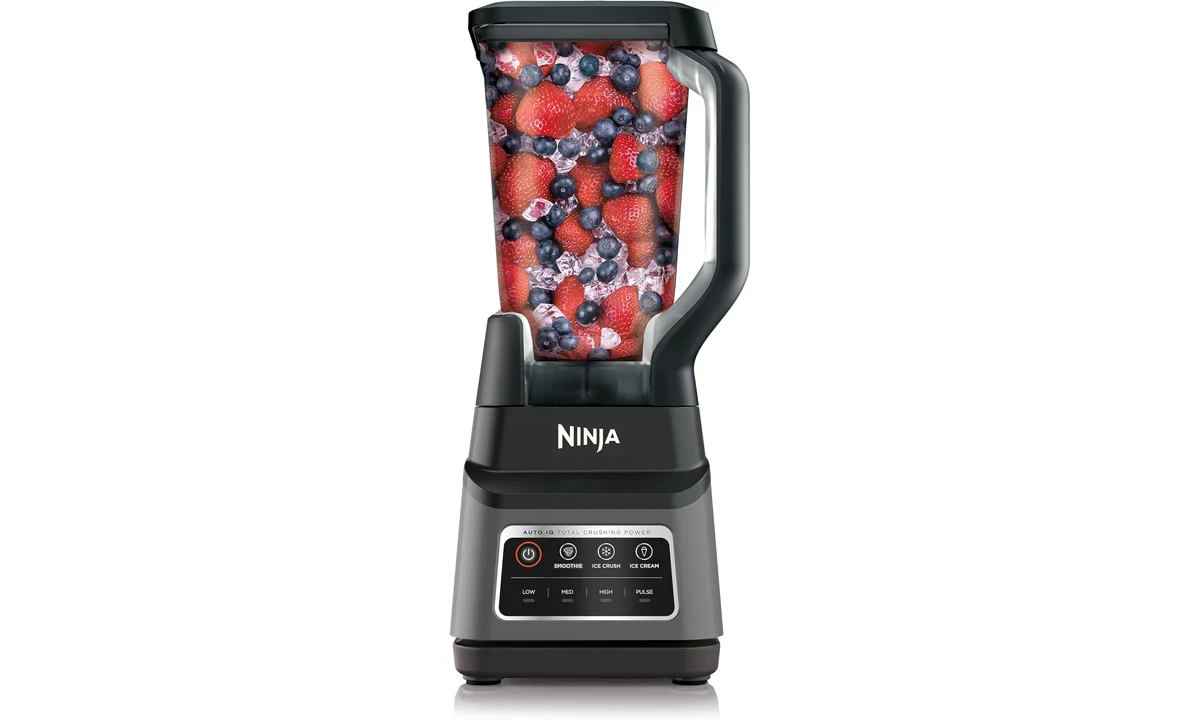
The Ninja Professional Plus BN701 is a pitcher blender for shared cold drinks, smoothies and ice-based preparations. Its large container and timed Auto-iQ patterns are the main attractions. It is a less natural choice when the regular task is one small drink, quiet early-morning operation or blending hot soup. Those distinctions matter more than the prominent peak-wattage figure attached to the product name.
This review concerns the US BN701 pitcher package, not the wider BN801 Kitchen System or a bundle with separate personal cups. Ninja’s product information and BN700-series owner’s guide establish the hardware and limits; Tom’s Guide’s original BN701 review supplies independent performance context. We have not prepared drinks with the unit ourselves. Our recommendation is tied to the intended ingredients, quantities and blade-handling routine rather than a claim of universal blending performance.
Choose the quantity you make on an ordinary day
The pitcher is described as 72oz nominal, with a lower 64oz maximum liquid capacity. Those figures are not interchangeable. Follow the marked limits and loading instructions instead of treating the container’s total volume as a safe amount for every liquid mixture. Ingredients also occupy space differently, so filling to an appealing visual level is not a substitute for understanding the supported preparation.
A large pitcher is useful when several people want drinks together. You can prepare a shared quantity in one container rather than assemble multiple small servings. The corresponding cost is handling and washing that pitcher even when the task is modest. If you normally make one small drink and leave immediately, compare an appropriate personal-blender format before buying primarily around occasional guests.
Shape matters as well as volume. A narrow personal cup and a broad pitcher present ingredients to the blades differently. We do not assume that reducing every shared recipe to a small fraction produces the same result. Use a supported recipe and quantity as the starting point, particularly when the mixture is thick. The right capacity is one that works usefully for your repeated task, not simply the biggest available vessel.
Think about serving and storage after blending. A shared pitcher still needs an appropriate place on the counter, room to pour and a plan for any remaining drink. The BN701 is not a refrigerated dispensing system. Choosing the batch size deliberately can be more useful than filling the container simply because there is room, especially when only one person actually wants a drink immediately.
Auto-iQ patterns are a convenience, not ingredient recognition
The BN701 offers Smoothie, Ice Crush and Ice Cream programs. Ninja describes these as timed combinations of blending, pulses and pauses. The pauses are an intentional part of the routine, not necessarily a sign that the machine has lost power. Learn that behavior with a simple supported preparation before assuming that a quiet interval requires pressing another control.
A program acts on the ingredients and quantities you provide. It does not know whether the drink tastes balanced, whether an unsuitable ingredient has been added or whether every household member prefers the same texture. Check the finished mixture and follow the guide. The benefit is less manual timing for a suitable recipe, rather than a guarantee that any collection of ingredients becomes the intended drink after one button press.
The Ice Cream label also needs context. This blender processes an appropriate frozen mixture; it is not the same mechanism as a churning ice-cream maker or the Ninja CREAMi reviewed elsewhere on TopDataLLC. Choose according to the dessert and preparation process you actually want. Similar words on a control panel do not establish that different appliances produce the same result from the same starting ingredients.
Manual Low, Medium and High settings, plus Pulse, provide another approach for supported jobs. That is useful when you want to observe and stop at a particular texture rather than run a complete preset. It still requires attention to the manual’s ingredient and operating limits. Extra controls are helpful when you understand what you are adjusting, rather than as a reason to improvise tasks outside the intended role.
The independent test favors drinks, with a noise cost
Tom’s Guide found strong smoothie and ice-crushing results from its BN701 test. That supports considering the machine for the cold-drink work around which its pitcher and programs are organized. We do not transfer its exact recipe timing or texture scores to another kitchen. Ingredient preparation, quantities and preferences can change what a useful result looks like.
The same review identified a particularly sharp, intrusive noise during ice crushing. That is a meaningful buying limitation if the blender will operate near sleeping people, video calls or a shared living area. It is more informative than assuming a powerful-looking product will be quiet because its body appears substantial. We do not provide an independently measured sound figure for the unit you would receive.
Consider when you would actually use it. A noisy short task can be acceptable in one household and a persistent source of friction in another. Moving the appliance to a less convenient place for every drink may reduce the benefit of an automatic program. If noise is decisive, seek relevant exact-model demonstrations or testing and compare the complete household routine rather than relying only on the word professional.
Independent evidence also needs to be kept within the tested product. General review language about numerous attachments should not override the contents of the selected BN701 retail package. A blender can perform well in a test while the specific offer you buy contains fewer accessories than another configuration. Establish what is supplied separately from evaluating how the pitcher itself handles a supported drink.
Peak power is not a complete performance comparison
Ninja promotes 1400 peak watts for this model. That is not the same claim as a continuous measured power level, nor a complete ranking of blending quality. Blade design, container geometry, recipe and controls matter too. Choosing between this and another blender by comparing only the largest wattage number can conceal a much more important difference in the methods and quantities each is designed to handle.
The Vitamix E310 already reviewed on TopDataLLC offers a different control and container proposition. Compare the documented supported uses, ownership routine and current packages rather than assuming a simple numerical power comparison settles it. A household making shared cold drinks may value the Ninja’s presets, while another buyer may prioritize a different style of control or a broader set of manufacturer-supported preparations.
Do not assume that more power makes an unsuitable task acceptable. The BN701 owner’s guide prohibits hot-liquid blending and dry-ingredient-only processing. These are material purchase limits. If the primary goal is processing hot soup, choose equipment specifically intended for that workflow rather than deciding to work around a restriction because the motor specification sounds strong enough.
The same principle applies to other accessories. A blender base with a familiar connection is not evidence that every similarly branded container or blade assembly is supported. Check compatibility by exact model and manufacturer guidance. A bundle can be good value when its parts serve real tasks, but an incompatible extra is not a useful way to expand a purchase after discovering that the original package was too narrow.
The removable blade tower changes everyday handling
The stacked blade assembly is sharp, removable and not locked permanently into the pitcher. That construction deserves attention before the first preparation and before cleaning. Read the guide’s pouring and removal instructions carefully, including the distinction between using the locked lid’s spout and handling the pitcher with the lid removed. The blade arrangement is part of the ownership decision, not a detail to learn casually while emptying the container.
A buyer accustomed to a jar with a fixed lower blade may find the routine unfamiliar. Consider whether everyone who will use the appliance understands the difference. A shared kitchen benefits from consistent assembly, pouring and cleaning habits. The product’s accessible presets do not make its sharp components harmless or remove the need for deliberate handling around the pitcher and sink.
Keep the blades out of a pile of other washing where they can become difficult to see. Follow the maker’s unplugged cleaning process and use suitable tools rather than reaching directly toward the cutting edges. If that routine feels like a poor fit for the household, another supported design may be a better purchase. Ease of pressing a program button is only one small part of ordinary use.
The guide also requires correct container and lid installation. A control that does not operate because the components are not fitted correctly should be addressed through the instructions, not by trying to defeat an interlock. Learn the expected assembly and indicator behavior when there is time to understand it. That makes everyday preparation more dependable without treating the safety arrangements as an inconvenience to bypass.
Loading and texture remain human decisions
Use the manufacturer’s ingredient guidance and an appropriate amount of liquid for the supported preparation. A preset cannot compensate for every unsuitable loading arrangement. If ingredients fail to circulate, stop and follow the documented process before making changes. Repeatedly running an unproductive cycle is not evidence that the mixture will eventually become suitable simply because the program has been selected again.
A frozen ingredient and a fresh version of the same fruit create different starting conditions. So do different quantities and ingredient sizes. Begin with a familiar supported recipe, then change one aspect at a time when adapting it to taste. That approach makes the controls useful and helps you identify what changed, instead of treating every texture difference as an unpredictable problem with the appliance.
Do not assign a nutritional or health advantage to the program names. A smoothie depends on its ingredients and quantity, not merely on the presence of a button labeled for it. This review evaluates the blending tool and the work involved. It does not promise a dietary outcome, detox effect or a benefit inferred from the appearance of fruit in a promotional photograph.
Cleaning and storage should fit the kitchen
Ninja identifies the pitcher, lid and blade assembly as dishwasher-safe under its instructions, with the recommended rack arrangement and sharp-blade precautions. That does not make the powered base washable in the same way. Keep the distinction between food-contact parts and the electrical body clear, and follow the supplied care guidance for each component rather than applying one broad easy-clean claim to the complete machine.
Check how the pitcher and removable parts fit your sink, drying area and dishwasher. A large container can be simple to detach and still awkward in a small washing space. If preparation happens often, a convenient cleaning route matters. The product becomes less appealing when its normal drink routine consistently leaves the kitchen difficult to use for the next task.
The assembled height also needs attention beneath a cabinet. Filling, removing the lid and lifting the pitcher require more access than the closed appliance’s outline suggests. Decide whether it will remain on the counter or be stored after use, including where the sharp assembly is kept appropriately. A blender that is easy to reach and ready for its ordinary job is more likely to earn its space than one repeatedly unpacked from an inconvenient location.
Verdict for shared cold drinks
Choose the BN701 when shared smoothies and ice-based drinks are frequent, the pitcher size suits the quantity and the household accepts the sound and removable-blade routine. Its presets and manual controls provide useful ways to handle supported recipes. Confirm the exact bundle before purchase, and judge the complete sequence from loading through washing rather than the one-touch part alone.
Choose a smaller format for regular single servings, another supported blender for hot liquids or a different dessert appliance when the process itself is different. The BN701 is a coherent choice for a particular cold-drink job. It is less persuasive when bought as a universal kitchen processor on the assumption that peak watts and several program names can replace checking what the appliance is actually intended to do.