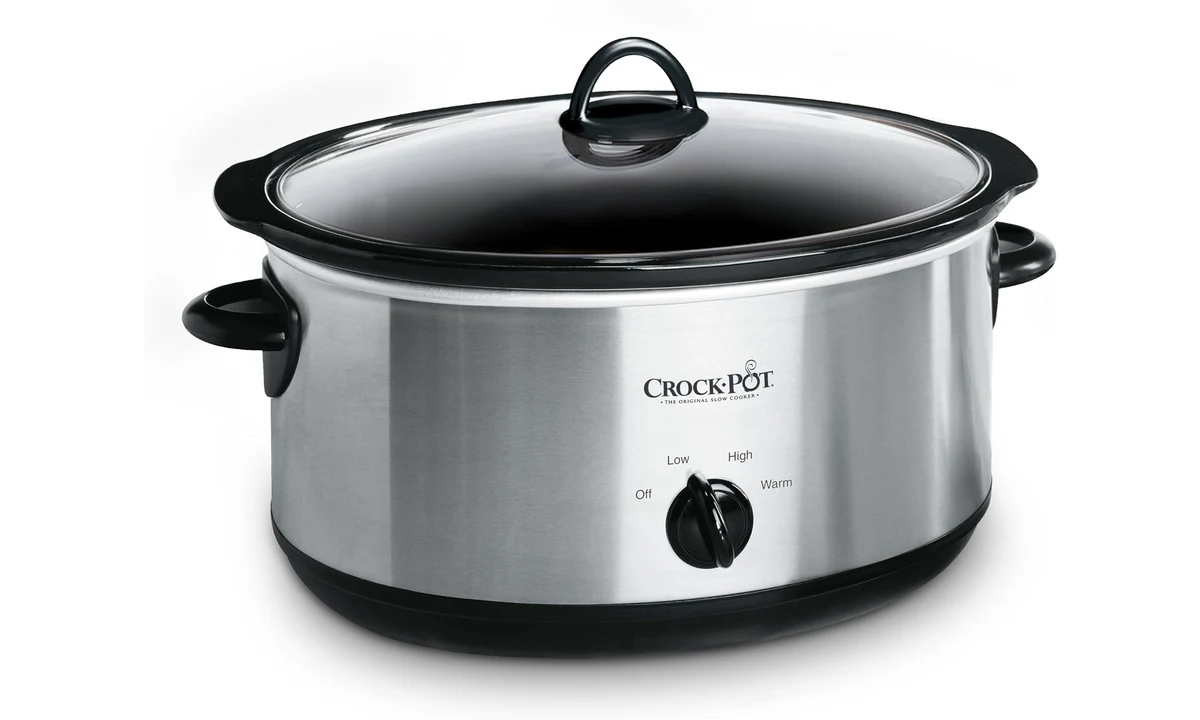
The Crock-Pot seven-quart manual slow cooker is a straightforward way to prepare a substantial batch when you can manage the cooking schedule yourself. Its appeal is a large removable pot and a simple dial, rather than a program that changes modes for you. That distinction should decide the purchase. If you need dinner to switch automatically from cooking to holding while you are away, this is the wrong kind of slow cooker.
This review concerns the stainless manual model sold as SCV700-S-BR or SCV700SS, using Crock-Pot’s current information and manufacturer instructions alongside the University of Maine Cooperative Extension’s independent slow-cooker guidance. We have not measured this unit’s temperatures or cooked recipes in it. The extension material supports general handling principles; it is not a performance test of this particular appliance.
Capacity should follow the meal routine
The nominal capacity is seven quarts, with an oval cooking vessel. That creates room for larger batches, but the figure is not an instruction to fill the pot to the rim. Follow the manufacturer’s filling and recipe guidance. Cooking space, suitable fill level and the number of portions you want are related questions, rather than interchangeable measures.
Start with the meals you actually prepare. A household that routinely cooks a large batch and has a plan for leftovers can make good use of the size. Someone preparing a small serving may find the appliance occupies more space and requires more cleanup than the meal justifies. A generous vessel is not automatically a versatile solution for every quantity.
Do not infer an assured serving count from a catalogue photograph. Portions vary with the dish and the people eating it. A vegetable-heavy meal, a sauce served with separate rice and a large joint of meat use capacity differently. Compare appropriate recipes and the maker’s guidance with your intended quantity before deciding that the largest affordable pot is the most economical purchase.
The oval shape can be helpful for certain ingredients, but shape does not establish that any large piece will cook suitably. Fit and cooking method still matter. If a recipe requires you to alter the ingredient size, liquid or timing to suit the appliance, use a reliable slow-cooker recipe rather than assuming that physical fit is enough to ensure a successful result.
A manual dial means manual responsibility
The controls are High, Low, Warm and Off. There is no start timer or automatic change to Warm on this model. You select the mode and remain responsible for the schedule. The simplicity is useful when you want few controls to learn, but it is a functional limitation when your day does not allow you to return at the appropriate time.
Warm is for holding already cooked food under the manufacturer’s instructions. It is not a substitute for a cooking program and should not be used as a general reheating setting. A low-looking temperature choice can seem like a gentler way to start a meal, but safe handling is determined by appropriate cooking guidance, not by a preference for the mildest position on the dial.
An external smart plug does not turn this manual appliance into a safe programmable cooker. Cutting or delaying mains power is different from a controlled cooking schedule designed by the manufacturer. In particular, leaving perishable ingredients waiting before cooking is not a convenience feature. If delayed operation or an automatic finish is important, buy an appliance with the appropriate documented controls and follow its instructions.
The shared manufacturer manual includes material for different control types. Do not assign a countdown or one-touch feature from another section to this manual unit. Compare the actual dial in the product photograph and the model identifier with the applicable instructions. This is a common point where a broad family manual can be misread as a specification sheet for every product pictured.
Plan backward from when food will be eaten
A useful schedule starts with serving time and a suitable recipe, rather than simply turning the cooker on before leaving home. Consider who will check or change the setting and how the meal will be handled if plans change. If no one can manage the finish, a programmable model may fit the routine better even if the manual cooker looks less complicated.
Use recipes intended for slow cooking and follow reliable food-handling guidance. University of Maine Cooperative Extension emphasizes planning, appropriate preparation and safe use of slow cookers. We do not provide a universal cooking duration for every ingredient here. Different foods, quantities and recipes need their own instructions; a generic promise that a large pot can be left for an arbitrary working day is not sound buying advice.
Thaw ingredients as required by reliable guidance before slow cooking, and avoid improvising a method for partially frozen or unusually large pieces. The convenience comes from a planned cooking process, not from ignoring preparation. If your normal routine relies on putting whatever is available directly into the pot without checking a recipe, simplify that routine before relying on a manual cooker.
Leftovers need a separate plan. Appropriate cooling, storage and reheating are not accomplished merely by leaving the pot on Warm. Follow authoritative guidance and the appliance instructions rather than using the cooker as a general-purpose reheater. A batch that exceeds your household’s immediate needs only saves effort if you can handle the remainder properly and have suitable storage space ready.
Counter space, weight and cleanup access
Crock-Pot lists dimensions of 16.9 × 11.8 × 10.4 inches and a weight of 13.85 pounds. That is before adding a meal. Measure the working location and consider the path from storage to counter and from counter to sink. An appliance can fit an empty shelf yet be awkward to lift or clean in the kitchen where it will actually be used.
Leave the placement and clearance required by the manufacturer, using a suitable stable surface. The pot, lid and base have different handling requirements. Do not assume the handles make it comfortable to move the cooker while full and hot. Plan to cook where it can remain safely, and use the maker’s instructions for handling rather than improvising a transfer around a crowded kitchen.
Check the sink as well as the counter. A large removable vessel may be inconvenient in a small sink, particularly when you need to handle it carefully and avoid knocks. Dishwasher suitability can help, but the vessel still occupies substantial space in a load. The size that makes batch cooking appealing also affects the amount of water, space and handling involved in cleaning.
This model does not have a locking travel lid. A glass lid resting on the pot is not a transport seal. If taking hot food to another location is a frequent requirement, look for an appliance or separate carrier designed and documented for that job. Do not treat an improvised strap or a careful car journey as equivalent to a manufacturer-approved travel arrangement.
Cleaning is part of the batch-cooking calculation
The removable stoneware and glass lid are dishwasher-safe according to the applicable manufacturer guidance, after appropriate cooling and handling. The electrical base is different and must not be immersed. Separating those parts correctly is more useful than a blanket statement that the cooker is easy to clean. Check the care instructions supplied with the exact package before choosing a cleaning method.
Avoid sudden temperature changes and follow the manual when dealing with a hot vessel. A removable insert should not be treated as interchangeable with ordinary stovetop cookware. Use only the applications the maker permits. The convenience of taking the pot out for cleaning does not imply that every heating or cooling method is suitable for the material.
For stubborn residue, follow the approved soaking and cleaning approach rather than attacking the surface with inappropriate tools. It is worth planning a simple cleaning routine while the meal is being served. A large batch may reduce the number of cooking sessions, but it does not eliminate the need to wash and dry a substantial vessel afterward.
Inspect the lid, vessel and cord during normal care. Damage deserves attention rather than being dismissed because the appliance has few controls. A manual dial reduces interface complexity, not the importance of using electrical equipment in good condition. Contact the maker about damaged components and replacement suitability instead of assuming a similar-looking lid or insert will fit safely.
What simple controls give up and gain
A physical dial is easy to understand and makes the selected mode visible. For a person who dislikes menus and presets, that can be a meaningful benefit. It also avoids buying features you will never use. The best reason to choose this unit is a cooking routine that already works with manual timing, not a belief that fewer buttons make all cooking decisions unnecessary.
The corresponding limitation is supervision of the schedule. A reminder on your phone can tell you to act, but it cannot change the cooker when you are unable to reach it. If work or travel regularly delays your return, recognize that mismatch before buying. A simple interface is only convenient when the task it leaves to you is something you can reliably do.
We do not claim that this model holds a particular measured temperature more accurately than competitors. No independent exact-model temperature test was established in this research. Manufacturer documentation describes the controls and intended use; it does not justify inventing a performance ranking. Buyers whose decision depends on detailed temperature behavior need relevant testing rather than confidence derived from the Crock-Pot name alone.
Alternatives that solve different needs
A programmable slow cooker is the direct alternative when automatic transition at the end of cooking matters. Compare the exact model’s available settings, holding behavior and instructions instead of assuming every digital display provides the same functions. More controls can be worthwhile if they address a scheduling need that this manual unit cannot meet.
The Instant Pot Duo already covered on TopDataLLC is a different approach for buyers considering pressure cooking and other modes. Pressure cooking and slow cooking are not interchangeable recipes or timelines. Do not choose between them solely on vessel size. Start with the dishes you want to make, the supervision you can provide and the methods you are willing to learn.
A smaller slow cooker can be more appropriate when you rarely prepare large batches. The tradeoff is reduced room for larger meals, but easier storage and a better match to ordinary quantities may be worth it. Avoid using the large capacity as an excuse to overproduce food that will not be stored or eaten sensibly. Capacity should serve the household rather than dictate its habits.
Verdict
The seven-quart manual Crock-Pot is a reasonable choice for planned batch cooking where a simple dial and substantial removable vessel are the priorities. It is less suitable when automatic finishing, delayed operation or secure transport is essential. Check the exact manual model, allow room to use and clean it, and choose appropriate recipes rather than relying on a generic unattended-cooking promise.
Our recommendation is conditional on the schedule as much as the appliance. If you can manage the start, finish and leftovers appropriately, the lack of programming may be an acceptable simplification. If you cannot, choose equipment with the documented controls your routine requires. The useful purchase is the cooker that fits how meals actually reach the table, not merely the largest pot with the fewest buttons.