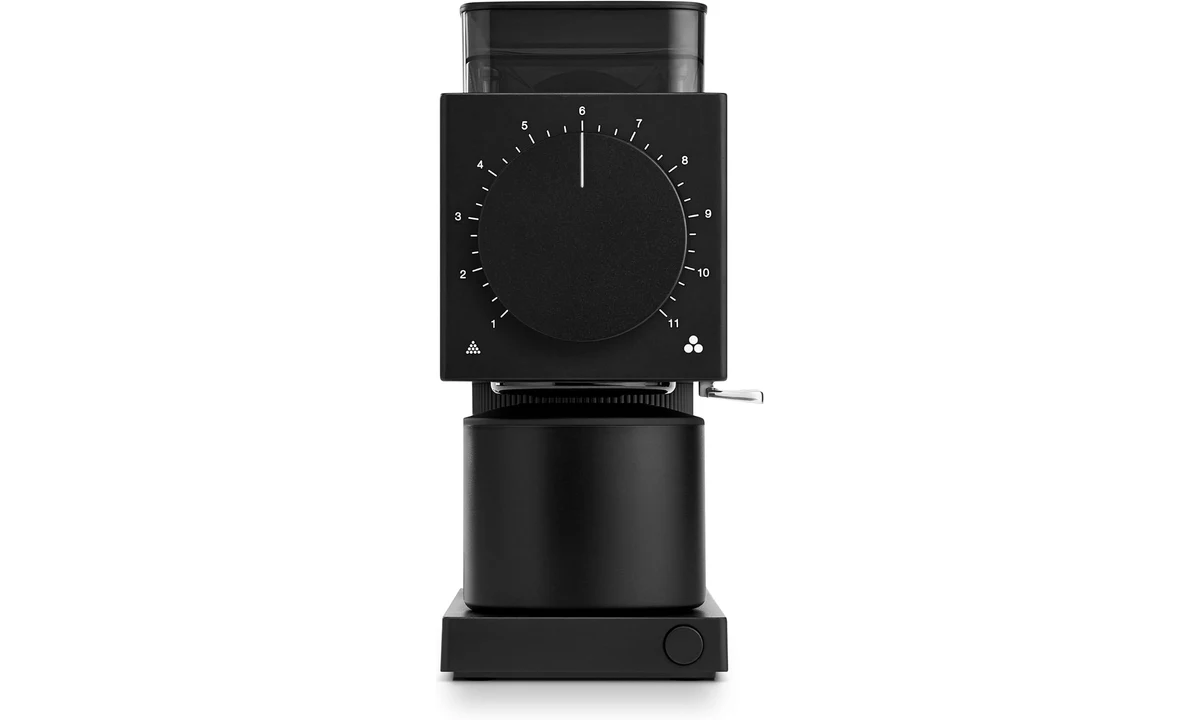
The Fellow Ode Gen 2 is a grinder for someone who has deliberately chosen brewed coffee rather than espresso. Its single-dose workflow, flat burrs and compact form are appealing when you weigh beans for each brew and want to keep different coffees separate. It is a poor purchase if you expect one grinder to grow into every coffee method later. Espresso is outside the intended role of the stock configuration reviewed here.
This review covers the Matte Black US model with Fellow’s stock Gen 2 brew burrs, not the first-generation Ode or an SSP-upgraded package. It combines Fellow’s current product information and maintenance manual with Home Grounds’ original evaluation. We have not measured particle distribution, retention or flavour ourselves. The recommendation is based on the documented workflow and the practical choices it asks the owner to make.
Choose the brewing method before the burr shape
The Ode Gen 2 is designed around methods such as pour-over, drip brewing, French press and cold brew. That focus is the first filter for a buying decision. Someone using a Hario V60, OXO drip brewer or manual press can consider whether the single-dose arrangement improves their routine. Someone planning conventional espresso should begin with a grinder intended for that demand instead.
The presence of substantial flat burrs does not override the product’s intended grind range. A component specification can sound professional while the whole machine remains optimized for a particular job. Do not buy the Ode with the assumption that turning the dial farther or changing a recipe will make it an equivalent espresso grinder. The supported methods should match what you actually intend to prepare.
The Baratza Encore ESP already covered on TopDataLLC addresses a different mixed-method decision, including an espresso-oriented adjustment range. That does not establish that it is better for every filter brewer, or that the Ode is automatically better because it uses flat burrs. Compare the complete grind range and routine rather than turning one piece of construction into a universal quality ranking.
If you are uncertain about future espresso use, be honest about that uncertainty before spending. A dedicated brew grinder can be excellent at its chosen role and still be the wrong first purchase for a household expecting one machine to cover everything. Conversely, paying for a broader range is unnecessary when you know you will remain with brewed coffee and prefer the Ode’s operation.
Single dosing changes the morning sequence
The load bin is rated for 100g, but its intended workflow is loading a measured amount for the brew you are making. This is different from filling a large hopper and using a timer to dispense an estimated dose. A scale becomes part of the ordinary sequence: weigh beans, choose the setting, grind and transfer the grounds to the brewer.
That sequence can suit someone who switches between coffees. You are not leaving a hopper full of one blend that must be worked through before changing to another. It also makes the amount you put into the grinder explicit. The tradeoff is an extra weighing step each time, which may feel worthwhile to a deliberate brewer and unnecessary to someone seeking the fewest possible morning actions.
Automatic stop is a convenience within that workflow, not a weighing system. It does not measure the exact dose you wanted or prove that every particle has reached the catch cup. Likewise, the nominal bin capacity is not an instruction to load more coffee than your intended brew requires. The value comes from matching input to the brewing task rather than treating the bin as long-term bean storage.
A shared kitchen needs a consistent approach to the dial and dose. If different people use different methods, leave a simple record of the setting and recipe rather than expecting the next person to infer the previous arrangement. A single-dose grinder can simplify switching coffees while still requiring communication about grind settings. It removes one kind of leftover material, not every source of confusion.
The stock burrs are a specific configuration
Fellow specifies 64mm flat stainless-steel brew burrs for the stock Gen 2. The brand also sells different configurations, including upgraded burr options. Those packages should not be merged into a single assumed specification. Check what the retailer is supplying before comparing a price or reading a review of a different burr set under the same general Ode name.
Burr geometry, alignment, coffee and recipe interact, so size alone cannot establish how a cup will taste. We do not promise more clarity, sweetness or uniformity in every brew. Home Grounds’ reviewer found the Gen 2 useful for filter methods, but that is an original reviewer’s experience rather than a sensory result established by TopDataLLC. The practical recommendation remains tied to the method and workflow.
The first-generation Ode is also a different comparison. A favourable observation about improved static handling or a changed grind range should not be used as evidence that the models are identical. If buying used or from a mixed listing, identify the generation and burr configuration explicitly. A product photograph or broad title can hide precisely the distinction that matters to the purchase.
Avoid treating a future burr change as a casual solution to an unsuitable purchase. Compatibility, installation, calibration and the resulting supported range need their own evidence. The sensible starting point is a stock product that serves your current brewing needs. Upgrades should be evaluated as separate decisions rather than assumed in the value of a package that does not include them.
Stepped adjustment helps repeatability, with constraints
The stock adjustment provides 31 total steps across the numbered dial arrangement. A stepped control makes it easier to return to a known setting than an unlabeled adjustment without reference points. It does not establish one correct number for every coffee or brew size. Start with the maker’s guidance, then assess the result with the recipe and beans you use.
Change one meaningful variable at a time. If you adjust the dose, water, grind and pouring method together, it becomes difficult to tell what caused the difference. A short note about the coffee and setting is more useful than trying to remember an attractive cup made under unclear conditions. Repeatability is a workflow benefit, not an automatic result of owning a grinder with a numbered dial.
A stepped system also means adjustment occurs at its available increments. That is appropriate to the product’s brewing focus, but it is another reason not to assume it behaves like a grinder designed for highly specific espresso dialing. Buyers should evaluate the range and spacing for their supported brewing method rather than expecting every type of fine adjustment to be available.
The catch cup and brewer should be part of the adjustment routine too. If you regularly change from a paper-filter pour-over to a metal-filter press, the preferred grind and transfer behavior can differ. The Ode can serve several brewed methods, but it does not know which one you have chosen. Keep the human decision visible rather than expecting the automatic stop to represent a complete brewing program.
Static control is useful maintenance-dependent hardware
The anti-static arrangement, magnetic catch and grinds knocker are intended to reduce mess and retained grounds. Home Grounds found static handling improved compared with the earlier generation, while noting that the catch-cup fins can hold some material. That supports a balanced expectation: the design can help the transfer process without making it reasonable to promise zero mess or zero retained coffee.
The knocker is a practical part of finishing a dose. Learn its intended use rather than improvising forceful shaking or tapping that could affect the equipment. A small amount of material around the chute is a reason to follow the cleaning guidance, not proof that a design claiming reduced static must be entirely self-cleaning. The daily handling and periodic care work together.
Consider the vessel receiving the grounds. A catch cup can be comfortable to remove but awkward to pour into a narrow brewing opening, particularly when its interior shape retains particles. Assess the transfer into your actual filter or brewer. The entire job includes getting the coffee where it belongs, not simply observing that the motor has finished turning.
We do not provide a measured retention figure for this unit. A review of another sample, roast or burr configuration cannot establish the exact amount left behind in yours. If precise output dosing matters, use an appropriate scale and a repeatable routine. The single-dose input makes control more explicit, but it does not turn every output into a laboratory measurement.
Cleaning is part of the reason to choose it
Follow Fellow’s unplugged dry-cleaning and burr-access instructions. This is an electrical coffee grinder, not a washable food processor. Do not immerse it or send water through the grinding path in an attempt to simplify care. Use the supplied guidance for the chute, anti-static components and other areas that accumulate coffee rather than relying only on a clean-looking exterior.
Roast characteristics and frequency of use can change how much attention the grinder needs. A kitchen using oily coffee heavily presents a different maintenance workload from one using modest amounts of another roast. We do not assign a universal cleaning interval here. The useful buying question is whether you are willing to maintain the components that support the cleaner single-dose workflow.
Do not use the coffee grinder as an all-purpose spice or grain mill unless the manufacturer specifically supports the task. Strong aromas, oily material and different ingredients introduce problems outside the intended role. The presence of substantial burrs is not evidence that every dry kitchen ingredient is suitable. Keep the product’s purpose narrower than the temptation to justify its price through unrelated jobs.
If grinding becomes abnormal, follow the documented troubleshooting process before forcing the adjustment or repeatedly running the motor. Preserve the model and purchase information for support. A confident-looking metal body does not remove the need to stop when the equipment is not operating normally. Maintenance should restore a supported routine, rather than become an informal project in bypassing the maker’s limits.
Counter space and the US electrical version
The US manual lists dimensions of 239 × 105 × 248.3mm. The relatively narrow body can be appealing on a coffee counter, but it still needs access above the bin, in front of the dial and around the catch cup. Measure the working arrangement under a cabinet rather than judging only the footprint. Filling, adjusting and cleaning each need space of their own.
The selected US version is intended for the appropriate 120V supply. Confirm the label and regional package rather than assuming a different plug makes any version interchangeable. The manufacturer’s electrical instructions take precedence over a generic travel-adapter assumption. A substantial fixed coffee appliance should be purchased for the location where it will actually operate.
Weight and storage also matter if you plan to put the grinder away after every brew. A compact photograph can conceal the inconvenience of repeatedly moving a substantial appliance, especially beside other coffee equipment. The Ode is easier to justify as part of a permanent brewing station than as an occasional accessory brought out from a difficult cupboard.
Verdict for a brew-focused coffee station
Choose the stock Ode Gen 2 when you brew filter-style coffee, like weighing individual doses and will maintain the chute and catch arrangement. Its flat burrs, stepped dial and automatic stop form a coherent workflow for that user. The magnetic catch and static-control features add convenience, but they should be assessed with your brewer and coffee rather than treated as perfect-output promises.
Choose an espresso-capable alternative when that method is part of the plan, or a hopper-and-timer design when weighing every dose does not suit your routine. Confirm the generation, burr configuration and regional electrical version before ordering. The Ode’s strongest quality is a deliberate focus on brewed coffee, and the right buying decision begins by accepting that focus rather than expecting it to disappear later.