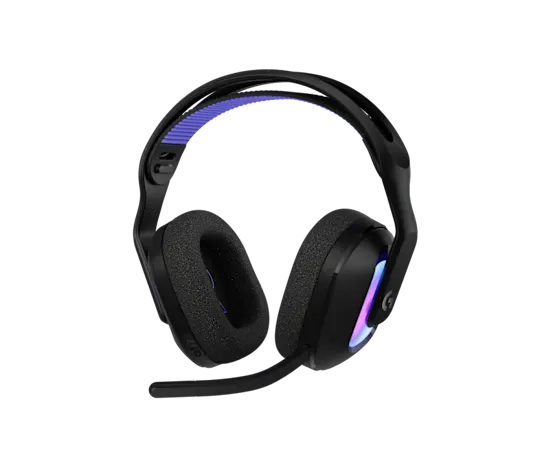
Logitech G522 LIGHTSPEED review
The Logitech G522 LIGHTSPEED is the black US model 981-001491, aimed at buyers who want one wireless headset for everyday PC and console gaming. Its case is less about chasing every specification than choosing the right compromise: a light design, a capable detachable microphone and simple mode switching, balanced against limited headband adjustment, software dependence and competition with longer-lasting models.
Logitech presents this model as a three-mode headset. Its connection options are LIGHTSPEED wireless through USB-A, USB-C-to-USB-A wired use and Bluetooth. The listed package includes the headset, a USB-A LIGHTSPEED receiver, a USB-A cable, a detachable microphone and user documentation. That is a practical starting configuration for a desktop, provided the target device can accept the relevant connection.
The exact console compatibility deserves more attention than the three-mode label. Logitech lists LIGHTSPEED compatibility with Windows, macOS and PlayStation 5 when an available USB 2.0 port is present. For Nintendo Switch 2, Logitech says a firmware update through G HUB on macOS or Windows is required. That makes the headset adaptable, but Switch 2 owners should plan a computer-based setup step rather than expect every connection to be ready immediately.
Bluetooth compatibility is listed for devices supporting Bluetooth 5.0 or greater. Logitech does not describe Bluetooth as a universal replacement for the receiver connection on every gaming platform, so the relevant question is which device will use which mode. A buyer moving among a computer, PlayStation 5 and phone should map that routine before purchase instead of assuming the same wireless path applies everywhere.
The included USB receiver makes LIGHTSPEED the natural desktop option, while the wired cable provides a fallback for a compatible connection. The available manufacturer information does not establish every detail of wired audio behavior on every host, so the safe conclusion is narrower: the headset supports the listed connection types, but platform-specific controls and features still depend on the device and software environment.
Fit and everyday comfort
Logitech lists the G522 at 201.1 mm by 184.4 mm by 81 mm and 290 g. The weight here follows Logitech and the independent review; retail listing details used to identify the US model are not treated as an alternative measurement method. Those measurements describe the product, not the fit on an individual head. The weight does, however, place this model in the lighter end of the gaming-headset conversation, which matches the buying problem here: whether reduced bulk matters more than the sturdier feel some heavier designs provide.
PC Gamer independently described the G522 as comfortable around the ears. That review also characterized its ear cushions as spongy and airy, with enough padding while remaining relatively easy to compress against the frame. These are reviewer observations rather than laboratory measurements, but they provide useful context that the listed 290 g alone cannot provide.
The same review said the cups grip enough to stay in place without adding notable clamminess. PC Gamer also described the headband as adjustable, so the light construction is not entirely fixed in place. Still, comfort is not simply a matter of padding: the amount of available adjustment may decide whether this headset works for a particular head shape.
That adjustment range is limited. PC Gamer reported two adjustment holes on each side of the top band, creating three adjustment settings in total. The reviewer found the standard setting workable for them, but reported that particularly large heads may find the headset tight. Buyers who regularly need the largest setting on other headsets should treat this as a fit warning, not a minor detail.
The lighter material also affects isolation. PC Gamer reported little sound isolation, although the reviewer found that the headset could still drown out background noise at medium volume. This points to a specific compromise: the G522 may feel less sealed during long sessions, but it is not the obvious choice for someone whose priority is maximum passive blocking in a noisy room.
Audio and microphone
The G522 uses 40 mm PRO-G drivers, and Logitech lists a headphone frequency response of 20 Hz to 20 kHz. Those are manufacturer specifications, not a complete description of the headset’s tuning. Frequency range does not by itself establish how the product sounds, how much bass it produces or whether a listener will prefer it for music, dialogue or competitive games.
PC Gamer described the default presentation as full and warm, with a bass emphasis that the reviewer adjusted in G HUB. The important buying implication is not that one EQ profile is universally correct. It is that the headset offers a sound the reviewer enjoyed, while software adjustment may be useful if the default balance does not suit your library or game mix.
In PC Gamer’s listening assessment, the G522 produced a wide-feeling soundstage. The reviewer also said individual elements remained clear in music and game audio, and reported that footsteps in Counter-Strike 2 were easy to pinpoint. These are independent listening findings from named material, not measurements or a promise of a particular competitive result.
Logitech describes the headset as having spatial audio intended to help locate in-game cues. The company also says its PRO-G drivers are designed to reproduce multiple sound layers simultaneously. Those statements explain the intended design. PC Gamer’s observations are more useful for judging the reported listening experience, but they should remain distinct from the manufacturer’s feature description.
The detachable boom is a major reason to consider this model. Logitech lists a microphone frequency response of 70 Hz to 20 kHz and describes full-bandwidth 48 kHz voice clarity with BLUE VO!CE technology. The manufacturer’s specifications establish the stated capability; they do not, by themselves, establish how clearly every voice will sound in every room or application.
PC Gamer independently described the microphone as near top-class and reported that it produced a clear voice with enough bass for a radio-like character. The reviewer also considered it suitable for streaming after a G HUB adjustment. That makes the G522 particularly interesting for buyers who want one headset for game chat, calls and occasional recorded speech rather than a separate microphone setup.
There is a straightforward control limitation. PC Gamer reported that the microphone lacks flip-to-mute. Muting requires finding the switch on the left earcup, although the reviewer noted that a sound and red light provide confirmation. That is workable for a desk routine, but it is less immediate than raising the boom and may matter during fast-moving calls or streams.
Connections, controls and software
Logitech lists wireless range of up to 30 meters. That is a manufacturer maximum, not a room-specific result. Walls, interference, receiver placement and the host device can affect practical reach, so the figure is best read as an indication of intended wireless coverage rather than a reason to expect the same distance in every home.
PC Gamer reported that the included 2.4 GHz receiver and Bluetooth mode made setup quick in the reviewer’s experience. The review also said that moving from LIGHTSPEED mode to Bluetooth took a click of the Bluetooth button. That directly supports the headset’s everyday switching appeal, particularly for someone who alternates between a computer and another Bluetooth device.
Switching modes is not the same as combining them. PC Gamer specifically wished the headset could use Bluetooth and wireless simultaneously for phone audio while gaming. The reviewer found moving back and forth manageable, but buyers who want phone audio layered over receiver-based game audio should treat the lack of simultaneous use as a meaningful limitation.
The controls are concentrated on the left earcup. PC Gamer identified the volume, Bluetooth and power controls there and said the arrangement could be slightly unusual at first, although it became acceptable with familiarity. The microphone mute switch is also on that side, so the layout rewards learning the control positions before relying on the headset during a busy call.
G HUB is part of the product’s adjustment path. Logitech says internet access is required for G HUB, the Logitech G Mobile App and DTS Headphone:X features on compatible platforms. That requirement does not mean the application must remain open for every listening session, but it does mean software and internet access belong in the initial ownership plan.
PC Gamer reported a more troublesome software episode on a work PC: the headset initially failed to connect, requested an update, then requested reinstallation after updating, while reinstalling did not immediately solve the issue. The reviewer later reported that normal day-to-day use was good once settings and firmware work were handled. This is an independent account of software friction, not evidence that every installation will behave the same way.
The practical setup advice follows from both sources. Use a compatible Windows or macOS computer for firmware work and for tuning sound, microphone processing or lighting. After that, decide whether your normal routine can avoid G HUB. Buyers who want the fewest application dependencies should give this issue more weight than buyers who are comfortable configuring a headset once and leaving it alone.
Battery, lighting and ownership
Logitech lists rechargeable battery life of up to 90 hours with lighting off and up to 40 hours with default lighting. The company says battery life can vary with user and computing conditions. These are therefore useful comparison figures, not a fixed schedule for every owner, and the lighting choice creates a clear endurance trade-off.
The headset includes side-facing LIGHTSYNC RGB lighting, according to Logitech’s product description. RGB may have value when the headset appears on camera or when coordinated desk lighting matters, but it consumes part of the stated battery allowance. If charging intervals matter more than appearance, the manufacturer’s own figures point toward using the no-lighting setting.
The supplied technical information does not state a charge-time figure. That means buyers can compare the two listed battery-life modes, but cannot responsibly infer how long a full recharge takes or how quickly a short recharge will restore usable time. Anyone planning around fixed charging windows should regard that missing specification as an unanswered ownership question.
Logitech lists a two-year limited hardware warranty. The manufacturer also identifies the contents as the headset, receiver, cable, detachable microphone and documentation. The supplied records do not establish that a charging dock, spare ear pads or alternate receiver is included, so those accessories should not be assumed when planning the desk setup.
Logitech says the G522’s plastic parts include 27% certified post-consumer recycled plastic, excluding the printed wiring assembly and packaging. It also says the paper packaging comes from FSC-certified forests and other controlled sources. These are specific material and packaging statements; they support a narrower sustainability description rather than a conclusion about the product’s complete environmental impact.
Alternatives and buying decision
The meaningful alternatives are other midrange wireless gaming headsets with different priorities. PC Gamer identified the Razer BlackShark V3, Asus ROG Pelta and HyperX Cloud Alpha Wireless as competition in its comparison. The supplied review does not establish a complete specification match for each named model, so the sound comparison should focus on the category trade-offs rather than invented feature tables.
PC Gamer describes the HyperX Cloud Alpha Wireless as offering up to 300 hours of battery life. That makes the HyperX a sensible alternative to investigate if long gaps between charging matter more than lighting or the G522’s microphone. This is an attributed comparison from the independent review, not a fresh battery test or a guarantee that different headsets run for directly comparable periods under every listening workload.
A charging-stand model may suit someone who wants a visible storage and charging habit. A more heavily built headset may appeal to someone who dislikes the compromises associated with lightweight construction. Those are category-level alternatives, not specifications assigned to a particular competitor. The G522 should be compared according to fit, microphone quality, switching and software tolerance rather than a generic claim that one design is superior.
The G522 is a strong candidate for PC and PlayStation 5 players who want a light headset, a detachable microphone and convenient movement between LIGHTSPEED and Bluetooth. It is also a reasonable option for chat-heavy gaming where voice clarity matters more than maximum battery endurance. The Nintendo Switch 2 path is available, but the required firmware step makes it less immediate than the headline compatibility may suggest.
The buying case weakens if you need extensive headband travel, simultaneous Bluetooth and receiver audio, strong passive isolation or minimal software involvement. It also weakens if lighting is important but charging discipline is inconvenient, because Logitech’s figures reduce from up to 90 hours without lighting to up to 40 hours with default lighting.
Verdict
The Logitech G522 LIGHTSPEED is a focused everyday gaming headset, not a model that wins every specification comparison. Its 290 g weight, comfortable independent fit assessment, documented connection flexibility and unusually promising detachable microphone form a coherent package. The limitations are equally concrete: three headband settings, no simultaneous wireless links, limited isolation and reported G HUB friction.
Choose the black 981-001491 variant when breathable comfort, voice quality and quick LIGHTSPEED-to-Bluetooth switching are more important than maximum endurance or extensive physical adjustment. Choose another category option when your priorities are long gaps between charges, broad fit customization or an almost entirely software-free setup. That conditional balance is the real decision behind this Logitech headset.