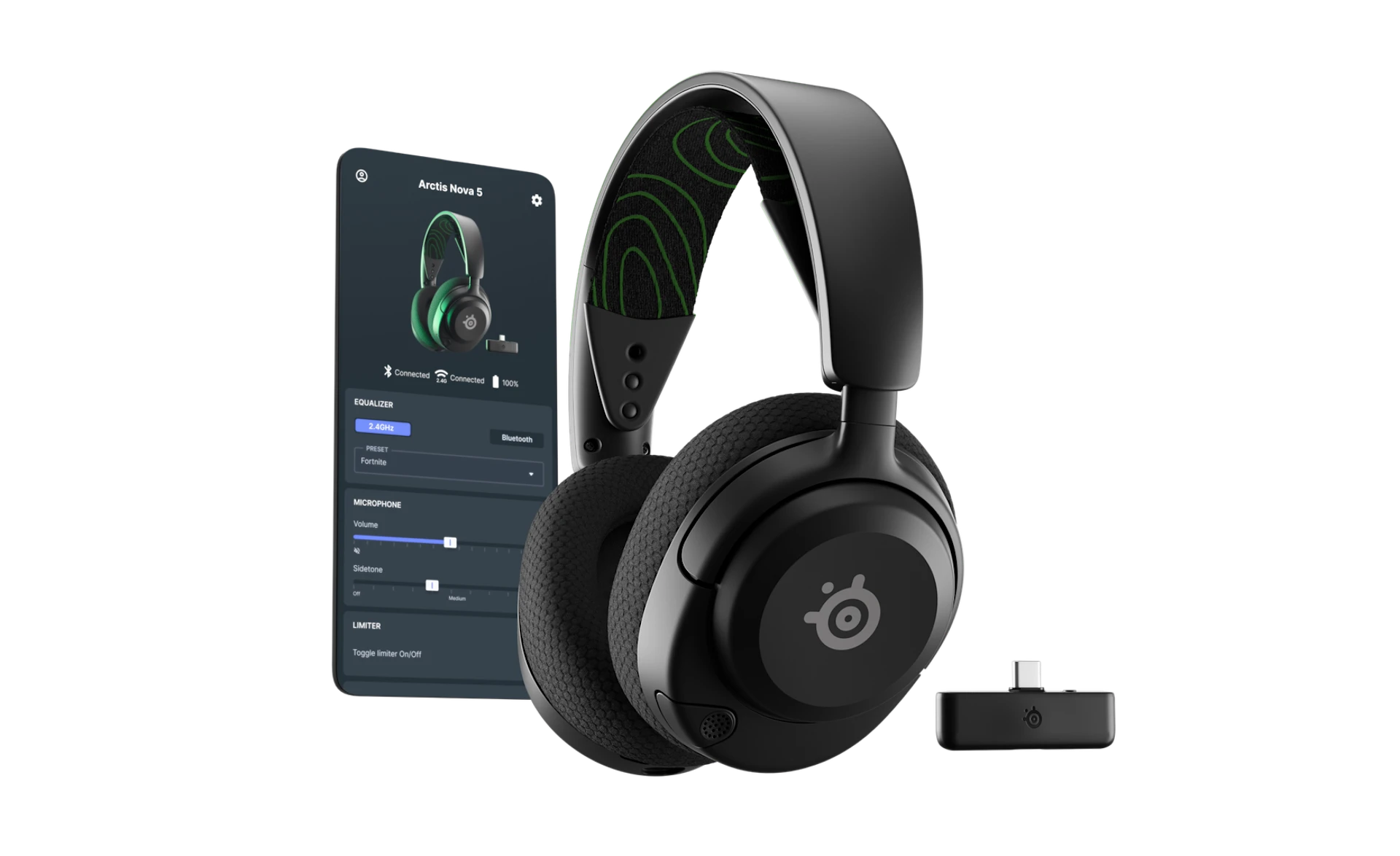
The SteelSeries Arctis Nova 5X Wireless is aimed at buyers who want one headset for 2.4GHz gaming and ordinary Bluetooth listening. The important buying question is not simply whether it offers two wireless connections. It is whether switching between those connections, the headset’s fit, its microphone and its sound balance match the way you play and listen.
This review covers the black US model identified by SteelSeries as the Arctis Nova 5X Wireless, SKU 61676. That exact identity matters because Nova naming is not enough to establish that every model has the same connection or platform behavior. Check the product name and SKU against the listing before buying, especially when shopping for an Xbox-oriented headset.
The important distinction: switching is not mixing
SteelSeries says the Nova 5 can maintain a 2.4GHz connection and a Bluetooth connection at the same time, but it allows only one audio stream to be heard at a time. This is the central limitation for anyone hoping to hear game sound while also listening to a phone or another Bluetooth device.
The headset has a Quick-Switch button for moving between 2.4GHz and Bluetooth. That is more convenient than disconnecting one device and pairing another, but it remains source selection rather than simultaneous audio mixing. The Nova 5X makes changing listening modes easier; it does not combine both sources into one soundtrack.
Call handling follows the same arrangement. SteelSeries says that an incoming phone call during an active 2.4GHz connection produces a notification in the headset. Pressing Quick-Switch answers the call and changes the headset to Bluetooth mode.
The manufacturer also says the headset automatically switches back to game audio when the call ends. That can make an interruption less cumbersome, but it should not be interpreted as hearing the call over the game. Buyers who need teammates, game audio and a phone conversation audible together should look for a headset specifically designed around audio mixing.
This distinction changes how the Nova 5X should be evaluated. Its appeal is a quick handoff between two uses, not a simultaneous console-and-phone workflow. If your usual routine is gaming at one moment and listening to a mobile device the next, the button is relevant. If you expect both sources to remain audible, it is the wrong feature set.
What the model provides
PC Gamer lists 2.4GHz wireless through a USB Type-C dongle and Bluetooth 5.3. Those are two connection paths, with the 2.4GHz route intended for a compatible gaming setup and Bluetooth available for compatible everyday listening devices.
The independent specification describes the headset as closed-back and lists 40mm drivers with neodymium magnets. Closed-back is a useful design classification when comparing it with open-back headphones, although that label alone does not establish a particular isolation level or amount of sound leakage.
PC Gamer lists a frequency response of 20Hz–22kHz. That is a stated specification, not evidence that every part of the range receives equal emphasis. The independent listening assessment is more useful for judging the balance: it describes detailed drivers delivering accurate positional audio.
PC Gamer lists the headset weight as 277g. Its review characterizes the design as very light and describes a soft-touch headband with memory-foam ear cups. Those are independent observations rather than a manufacturer comfort promise, but they make the Nova 5X a plausible choice for people who dislike heavier gaming headsets.
The closed-back format and restrained appearance also make the design less narrowly gaming-focused than headsets with obvious lighting or aggressive styling. PC Gamer describes a matte black finish and says the headset can look like a regular pair of wireless headphones. That may matter if it will be worn away from the gaming desk.
The microphone is a ClearCast Gen 2.X bidirectional noise-cancelling design with a fully retractable boom, according to the independent specification. Retracting the boom helps the headset transition into ordinary listening, but microphone position still deserves attention when chat quality matters.
SteelSeries says the microphone can still pick up sound while retracted, but recommends extending it and keeping it close to the mouth because its directional design produces the best-quality sound in that position. Retraction is therefore a storage convenience, not the preferred arrangement for speaking.
Sound and app controls
PC Gamer’s review describes clear, detailed sound and accurate positional audio across game settings. That points toward a headset for players who value separation and directional cues rather than judging a gaming headset mainly by the intensity of its bass.
The same review found a slight lack of low-end bass. It says drums and explosions can still sound punchy, while music with thick bass lines loses some fullness at the bottom end. This is a targeted warning for bass-focused listening, not a claim that every kind of game audio will sound weak.
The Arctis Companion app is a substantial part of the product’s tuning story. PC Gamer reports that it offers over 100 presets described as being tailored by esports professionals and audio engineers. That gives listeners many starting points, although a large preset collection does not automatically make every setting preferable.
PC Gamer also questioned how transformative those presets are, finding that they differ slightly rather than producing a revolutionary change. The useful interpretation is that the app provides choice, while the underlying drivers and your preferred basic balance remain more important than the number of available profiles.
SteelSeries says the app allows a separate preset for 2.4GHz gaming audio and Bluetooth audio. That separation is practical because game and music preferences often differ. It also makes the app most useful for buyers who are willing to adjust profiles instead of leaving one sound setting in place for every source.
SteelSeries’ support information says the Arctis Companion app is compatible with the Nova 5 headset and Arctis GameBuds at the stated time. It does not establish universal compatibility with every SteelSeries headset, so owners of another model should not assume that its controls will appear in the same app.
The sensible way to approach the presets is to treat them as optional tuning rather than as the reason to buy the headset. PC Gamer says the physical drivers do much of the work behind the clarity. That makes the app useful for preference changes, but less compelling as a substitute for choosing a sound profile you already like.
Fit and microphone trade-offs
The independent review found clamping force strong enough to keep the headset attached while moving and light enough to remain comfortable. It also describes cushioned memory-foam ear cups. Those observations support the Nova 5X for long-session buyers who prefer a lighter fit, although individual comfort still depends on head shape and pressure preference.
The main fit warning concerns maximum size. PC Gamer says the top headband setting is a little small and advises people with very large heads to look elsewhere. Adjustable does not mean universally accommodating, so buyers who regularly struggle with headset or hat fit should treat this as a primary buying check.
The retractable microphone and matte black finish give the Nova 5X a relatively restrained appearance, according to PC Gamer’s review. The microphone tucks into the left earcup, making the headset less conspicuous when chat is not needed. That is helpful for someone moving between gaming and ordinary wireless listening.
Microphone performance has a specific compromise. PC Gamer describes the microphone as clear and distinct, but says the tucked-away design leaves no room for a foam shield and can make it prone to plosives. Noise-cancellation software may reduce some background effects, but placement still matters for speech clarity.
The supplied evidence does not establish a particular isolation or leakage result for the closed-back construction. That is worth keeping separate from the design label itself. Buyers who specifically want an airy open-back presentation should compare categories rather than assuming that closed-back means one precise listening experience.
Battery and charging
PC Gamer lists a battery rating of 50 hours in 2.4GHz wireless mode and 60 hours over Bluetooth. These are mode-specific figures rather than one universal runtime number. Someone who spends most of the time gaming should regard the 50-hour 2.4GHz figure as the more relevant reference.
The independent review reports that its observed battery life broadly matched those ratings and that the headset charged quickly through USB Type-C. That is a reviewer observation, not a separate laboratory measurement. It supports the Nova 5X as a low-maintenance option for people who dislike frequent charging, while actual runtime can vary with use and settings.
The two connection modes suggest a straightforward ownership routine: use 2.4GHz for gaming through the wireless dongle, use Bluetooth for compatible everyday listening, and press Quick-Switch when changing sources. The routine is simple as long as the buyer understands that the two sources are not heard together.
Setup and compatibility
Setup should begin with the connection a device actually supports, not merely with the word wireless. The independent specification identifies a USB Type-C dongle for 2.4GHz and Bluetooth 5.3 for the second connection. Check the intended device before purchase, particularly if its available ports or wireless support are limited.
The supplied manufacturer material identifies this product as SKU 61676 but does not provide a complete platform-by-platform compatibility table. For an Xbox purchase, verify the retailer’s current compatibility information for this exact US model rather than assuming every Nova wireless variant has identical console support.
The companion app is best treated as an optional tuning layer rather than a prerequisite for basic wireless use. SteelSeries supports separate presets for the two modes, while PC Gamer credits the physical drivers with much of the clarity. Starting with the default sound and changing profiles only when a real preference appears is the less complicated approach.
For ownership, the most important maintenance task is preserving the microphone’s useful position during chat and avoiding confusion about which connection is active. The retractable boom is convenient when stored, but SteelSeries specifically favors an extended, close position for the best microphone quality. The switching button is convenient, but it cannot change the one-stream limitation.
Meaningful alternatives
The HyperX Cloud Alpha Wireless is the more relevant comparison when battery duration outweighs Bluetooth flexibility. PC Gamer cites a 300-hour rating for that model and says it has only a 2.4GHz wireless connection. It is therefore a battery-first alternative, not a direct replacement for the Nova 5X’s second wireless mode.
PC Gamer also describes the HyperX model as neither as discreet nor as lightweight, citing bright red accents and sizable ear units. Those trade-offs matter if the headset will leave the gaming desk or remain on the head for long periods. The HyperX choice makes more sense when its much longer stated runtime is the priority.
The SteelSeries Arctis Nova 7 Wireless is the closer same-family comparison mentioned by PC Gamer because it also offers multi-connection options. The review says the Nova 5X uses the same drivers, is much lighter and has better battery life than the Nova 7 Wireless. That makes the Nova 7 worth investigating for its broader feature position, not an automatic upgrade.
The buying choice can therefore be framed around priorities. Choose the Nova 5X for a lighter design, detailed sound, quick source switching and long mode-specific battery figures. Consider the HyperX alternative for its much longer stated runtime, or investigate the Nova 7 when a larger same-family option is specifically appealing.
Verdict
The SteelSeries Arctis Nova 5X Wireless fits a buyer who wants one relatively light headset for 2.4GHz gaming and Bluetooth listening, values detailed positional sound, and can live with switching instead of mixing. Its retractable microphone, separate mode presets and long stated battery ratings support that flexible use case.
The recommendation changes if the priorities are very deep bass, a very large head fit, or simultaneous game-and-phone audio. PC Gamer’s bass and size criticisms are meaningful limitations, while SteelSeries explicitly says that only one audio stream can be heard at a time. Those points define the product’s boundaries rather than being minor settings details.
For everyone else, confirm the exact 61676 variant and intended platform support, then choose the Nova 5X when convenient two-mode switching matters more than audio mixing or maximum bass. Its strengths are practical versatility, light comfort and clear sound; its compromise is that its two wireless paths remain alternatives, not a combined soundtrack.